![[HelloAI] "Latest models, optimal implementation" — Dalpha's modular AI engineering wins](https://orxxvqgegftjfeehmtxl.supabase.co/storage/v1/object/public/blog-media/migrated/content/images/2025/08/7-ee88ca48f85d183f.png)
[HelloAI] "Latest models, optimal implementation" — Dalpha's modular AI engineering wins
Interview with Dalpha Director Yu Seon-bin
In 2025, the AI market is as vast as the world's grocery aisles. New models and technologies pour out every day, but simply taking them off the shelf doesn't immediately make a delicious dish. You need a chef who selects ingredients to suit each guest's taste and situation, and who finds the right proportions and cooking methods. That is exactly the role Dalpha plays. Rather than building the latest AI models itself, Dalpha hand-picks already-proven models like the finest ingredients and recombines them into the form each client wants. We sat down with Dalpha Director Yu Seon-bin to talk about the strategy behind proposing the optimal AI for clients.
An optimal modularization strategy that bridges the technology gap
Founded in 2023, Dalpha started with e-commerce automation but has since expanded into manufacturing, distribution, and logistics, building up industry-specific recipes along the way. With experience deploying more than 400 services, Dalpha's core know-how lets it finish in just a few weeks projects that once took over six months — while cutting costs too. Leading with the strengths of speed, efficiency, and customization, Dalpha effectively turns the complex process of adopting AI into a finished dish anyone can enjoy. As the AI market grows explosively, Dalpha continues its rapid expansion by supplying solutions across industries.
Its core competitiveness lies not in directly researching and developing a particular AI model, but in the ability to combine the latest AI models like LEGO blocks to create custom results for clients. This strategy reduces both development time and cost at once in a fast-changing AI market.
Director Yu Seon-bin said, "As clients' demands grow more sophisticated and difficult, Dalpha is focusing on strengthening its ability to perform complex tasks. We are also accelerating our entry into global markets — we developed a revenue-boosting AI solution for Amazon sellers in the U.S. and recorded our first sales." Building on its experience and references at home and abroad, Dalpha plans to keep leading the market with the speed and efficiency of its AI solutions.
Above all, the part of Dalpha's growth strategy worth noting is the 'gap' between technology and customers. In the AI industry, there is a considerable divide between demonstrating technology and applying it in the real field. Director Yu Seon-bin says, "Externally, there are constant announcements that AI has reached super-intelligence levels, but applying it in practice still comes with many constraints."
To solve this, Dalpha goes beyond simply providing models and takes full responsibility for the process of genuinely embedding AI into the client's environment. By combining AI model functionality with UX improvements, it makes the solutions easy for customers to use, and in the process it deepens its understanding of various industry domains. Its expansion into manufacturing, distribution, and logistics was also built on this accumulated experience.
Internally, Dalpha sets quarterly milestones to reassess its strategic direction and maintains a flexible operating model that quickly adjusts the people and capabilities it needs. Through this, Dalpha has established itself as an organization that responds nimbly even to clients' specific and complex requests.
What's the strategy for sustainability? 'Connection'
Dalpha pursued a strategy of separating AI model development from software implementation to secure both speed and quality. While conventional SI projects take from six months to over a year, internally Dalpha uses a block-based strategy that stacks the AI functions a project needs as modules and manages them in reusable form. On top of this, its in-house development tool 'Cobra' makes it possible to deploy front-end UI and back-end with just a few clicks and simple code edits. By unifying the deployment logic and reflecting the know-how accumulated from delivering over 400 services, it has reduced adoption cost and time and stabilized quality.
Thanks to this structure, both the number of clients and the average revenue per client have grown together, leading to revenue growth. On top of that, combined with an automatic client-tailored proposal generation feature, it demonstrates competitiveness even at the early consultation stage. Just by entering a company name, it recommends an AI solution suited to that industry and, based on it, quickly proceeds with planning and development. Dalpha currently has about 50 employees, more than 70% of whom are developers. Going forward, it is preparing for a new era by pursuing technological advancement alongside a global expansion strategy.
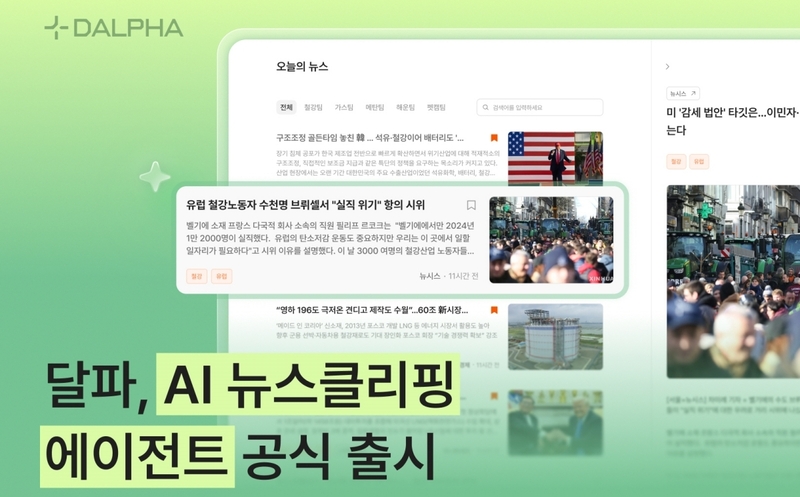
Dalpha takes a strategy of actively embracing client-tailored customization. Unlike general software, AI solutions require fine-tuning to each company's data environment and business processes. Director Yu Seon-bin explains, "Rather than minimizing customization, we chose to take it as a given and instead raise our development speed." A representative example is the market intelligence team's news-clipping agent.
This service is equipped with self-healing AI that can adapt even to changes in the web environment, raising its stability, and it goes beyond simple summaries to support report writing tailored to a company's purpose and internal sharing. It differentiates itself by offering different detailed features for each client, such as email delivery, tracking specific keywords, and VOC collection. Such services were initially low on the priority list, but as inbound demand surged, their strategic weight grew.
Meanwhile, in the U.S. and elsewhere overseas, AI development itself has become easier, but integrating it into actual work environments remains highly difficult. Dalpha leverages the deployment and maintenance systems it has built from hundreds of deployments. In particular, by adopting a subscription-based business model, it stays continuously connected with customers even after providing the service. Through this, it goes beyond simple maintenance to secure opportunities for proposing additional features and upselling.
On the global front, Dalpha is developing a revenue-boosting AI solution for Amazon sellers in the U.S. It raises product click-through and conversion rates with image- and text-generating AI, and is further researching predictive AI that simulates how much specific content contributes to revenue. This strategy covers customers of all sizes, from SMBs to large enterprises, and underpins Dalpha's long-term scalability.
In global markets, Dalpha focuses on services for U.S. Amazon sellers to secure a competitive edge, and on that basis it builds a foothold from which sellers in various countries can expand into the U.S. It is also running, in parallel, solutions that help domestic beauty and consumer-goods companies enter the U.S., and plans to accumulate industry-specialized references. By combining technology modularization with global leverage, Dalpha is presenting a flexible and sustainable growth model in a fast-changing AI market.
Source: [HelloAI] "Latest models, optimal implementation" — Dalpha's modular AI engineering wins
Did this article spark your interest in Dalpha?
Dalphaoffers 1:1 consulting to plan and build
an AI agentoptimized for each company and fieldfor you.
If you're curious about a free consultation,feel free to reach out anytime!
Dalpha Blog