Social/Review Analysis AI: What Do Customers Really Think of Our Product?
"What are customers saying about our product?"
It's an important question, but trying to find the answer can feel overwhelming.
That's because the real voice of the customer is hidden among thousands of posts—Coupang reviews, Instagram posts, Naver blogs, and more.
You have to filter out promotional reviews, exclude sponsored posts, and even once you've sifted out the genuine feedback, deciding whether it's 'a universal reaction' is an incredibly complex and inefficient task.
So you either hand it off to a professional data analyst, ask an intern to do some basic information gathering, or have a team member handle it directly.
You don't need to do any of that anymore. AI tells you customers' real reactions in one go.
From among thousands of posts, it automatically filters out promotional and sponsored reviews,
intuitively shows you whether customer reactions are positive or negative, and even
suggests your product's selling points and areas for improvement.
We'd like to introduce the 'Social/Review Analysis AI,' which gathers only customers' real reactions into a dashboard so you can review them and find insights. It can replace data analysts and interns, and automate the work of your team members.
If you're a marketer, planner, or MD looking to find ways to improve your product or sell it better, be sure to read on.
We'll show you how to use AI effectively to obtain the data that will be crucial to your business's success.
At the end of the article, we're also accepting requests for a demo where you can check reactions to your own product directly, so please read to the end 😄
What is Social/Review Analysis AI?
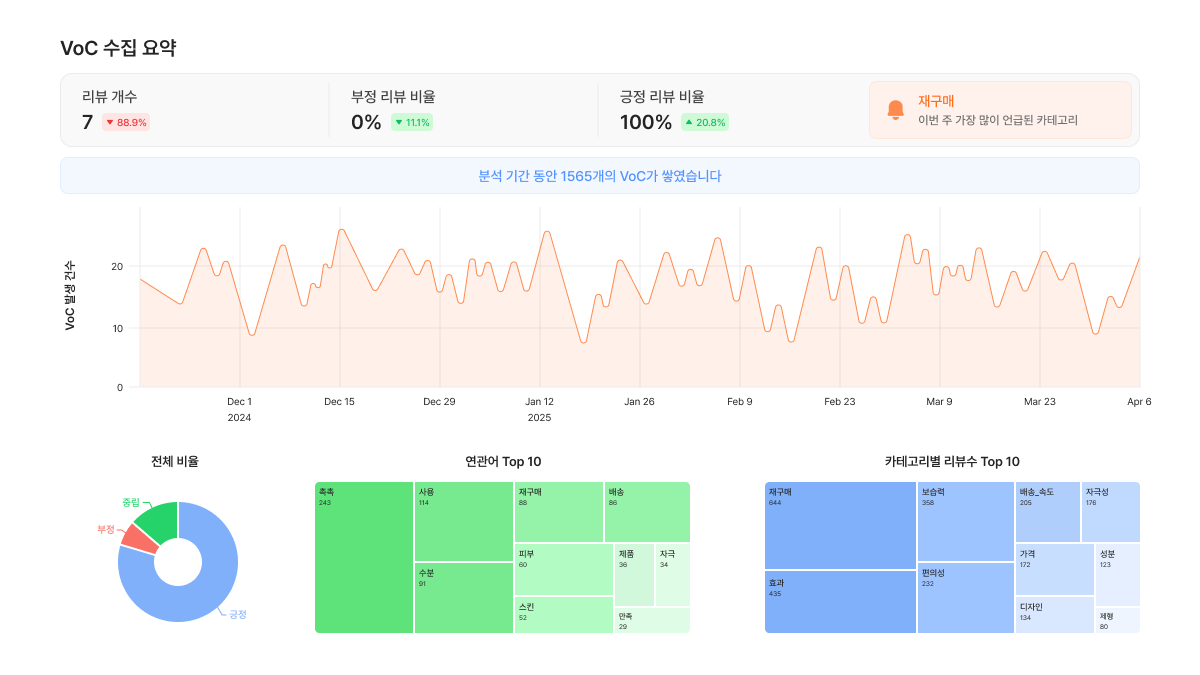
Social/review analysis AI is a tool that collects and analyzes customer reviews, feedback, and posts scattered across whatever channels you choose—Naver, Instagram, YouTube, news, and more. Based on this, it provides the insights your brand needs. It's broadly divided into two functions: collection and analysis.
Collection: It captures the real reactions customers leave across various channels such as social media, news, and communities. For example, it can gather, all at once, reactions about your product or brand mentioned in Naver blog posts, YouTube comments, and news articles.
Analysis: It performs positive/negative analysis, related-word analysis, anomaly detection, time-series flow analysis, and more on the collected customer reactions. Through this kind of analysis, you can turn customers' real reactions into insights.
Hearing this much, some of you may think of 'Sometrend.' But Sometrend isn't a tool for product analysis. While it's easy to grasp overall trends with it, analysis focused solely on your own brand and product is difficult.
Dalpha's social/review analysis AI offers features specialized for analyzing your own brand and products.
It enables customized data collection tailored to your product, and
it provides analysis features optimized for hands-on marketing actions.
Let us walk you through the four features of Dalpha's social/review analysis AI, one by one.
Target Voice Collection
Positive/Negative Analysis
Related-Word Analysis
AI Analysis Report
Target Voice Collection: We collect the 'real' customer voices from the sites you choose
What is Target Voice Collection?
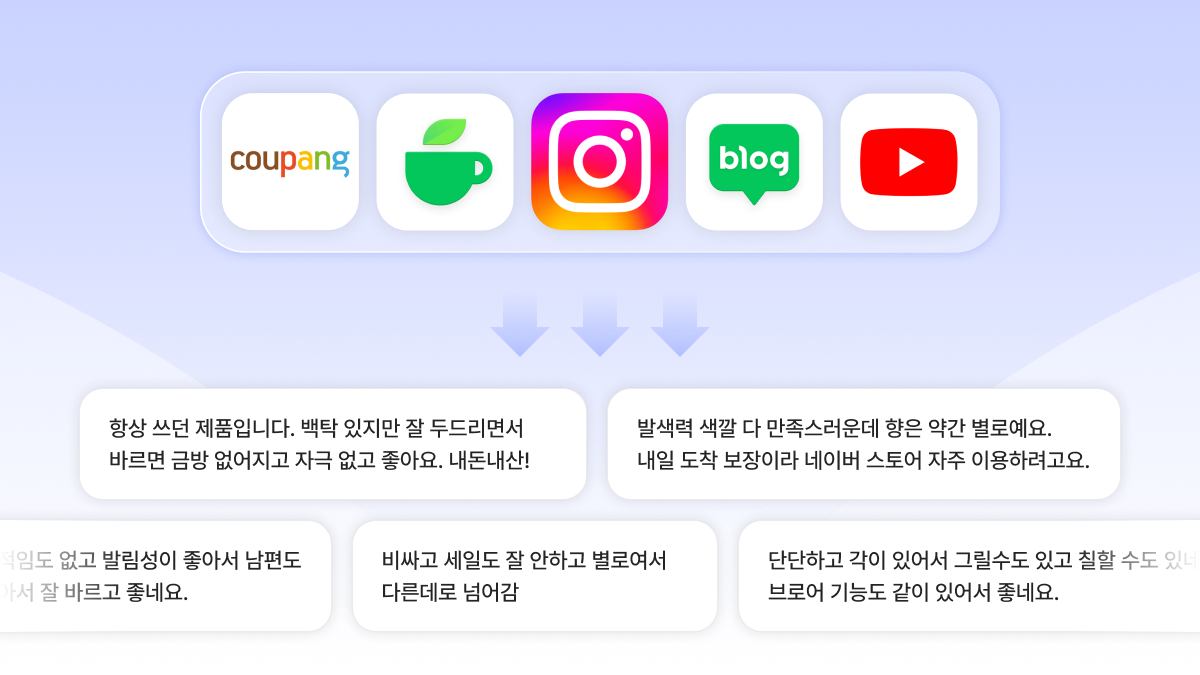
This is a feature that collects the reactions customers leave about your product/brand on the sites you set up. In this process, AI filters out promotional and sponsored content and picks out only the 'real reactions.'
The Existing Problem
Customer reactions were scattered across each channel—Coupang, Naver, Instagram, and so on—making them hard to grasp.
It's hard to filter out sponsored and promotional reviews, and it takes a lot of time to select and identify genuine reactions.
It's difficult to figure out which aspect of your product/brand (price, ingredients, scent, etc.) the feedback is about—whether it's dissatisfaction with the price, dissatisfaction with a feature, or an expression of purchase intent.
The Solution
AI automatically collects customer reactions from whatever channels you want—Naver blogs, Instagram, YouTube, Coupang, news, and more.
It filters out promotional or sponsored posts and brings in only genuine customer reactions.
You can set the categories you want (price, repurchase intent, performance, etc.) to secure more refined feedback.
The Effect
Brand managers no longer have to search through customer reviews themselves, and they can build product strategies by gathering only genuine reactions.
Beyond simple collection, it becomes possible to use data centered on contextual feedback.
Positive/Negative Analysis: Which parts of our product do customers like and dislike?
What is Positive/Negative Analysis?
This is a feature that lets you visually grasp at a glance whether customer reactions are positive or negative.
The Existing Problem
It's hard to grasp how customer reactions change over time.
It was difficult and time-consuming to judge whether a customer reaction was a positive or negative review.
The Solution
You can see how customer reactions change over time.
AI recognizes the emotional expressions within customer reactions and analyzes the emotional flow by category.
Example
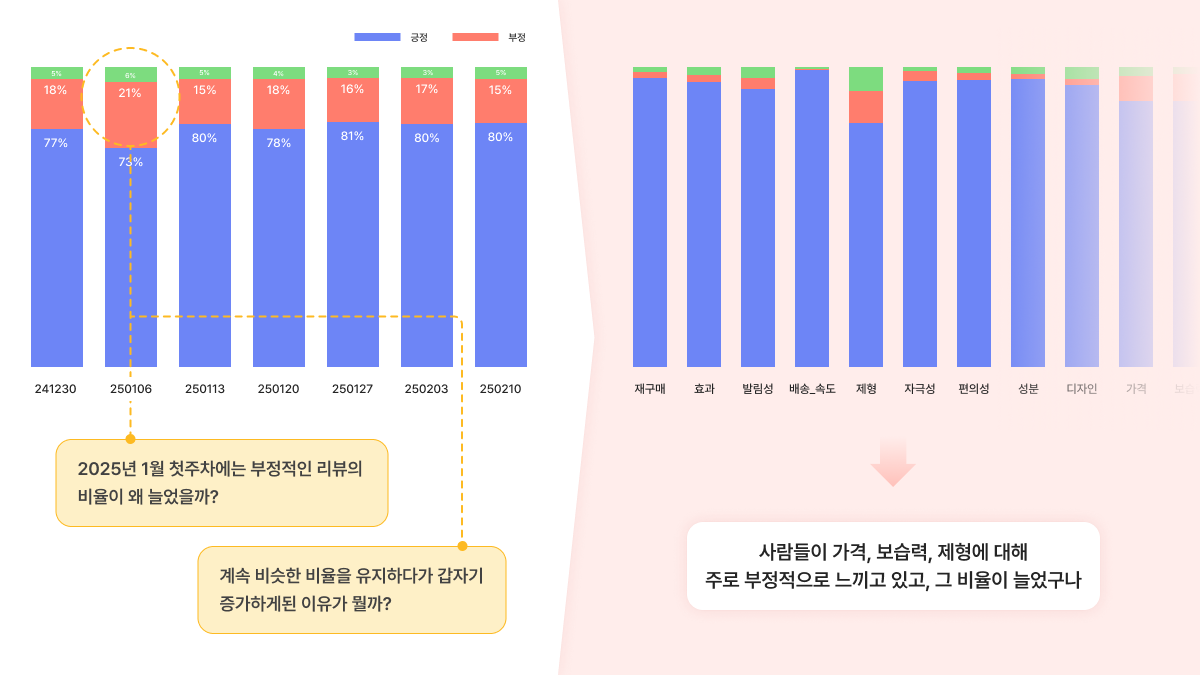
These are customer reactions to cosmetics company D's sunscreen from December 2024 to February 2025. Based on this data, you can draw two insights.
First, negative opinions increased significantly in January. After maintaining a similar positive/negative ratio for a while, you can spot the phenomenon of a sudden increase in negative reactions in January.
Second, you can see that there are many negative reactions regarding price, texture, and moisturizing power.
Based on these two pieces of information, you can think about it like this.
Price: Ah, there was a year-end discount. So after the year-end discount, the number of people unhappy about the price returning to normal from January may have increased.
Texture / Moisturizing power: Since negative comments about the product suddenly increased in terms of moisturizing and texture, we can consider this from two angles.
Could it be a problem in the product's manufacturing process during a specific period?
If there really is ongoing dissatisfaction with the moisturizing/texture, we'll need to improve the product or separate the lines!
The Effect
Marketing/CS teams can monitor reactions in real time and respond quickly.
By analyzing emotional changes over time, you can make data-driven decisions about promotion timing, product upgrade timing, and more.
Related-Word Analysis: How do customers describe our product?
What is Related-Word Analysis?
This is a feature that extracts keywords frequently mentioned alongside your product/brand name, so you can grasp how customers perceive your product.
The Existing Problem
It's hard to grasp the context in which a customer reaction arose. For example, you've identified a negative customer reaction about a foundation product. But you need to figure out whether it's simply negative, or whether it's an issue about side effects, about longevity, or about the price being too high.
It's not easy to make practical use of the data you've collected on customer reactions. Figuring out what context they came from and compiling statistics is no simple task.
The Solution
AI extracts and shows you the words frequently mentioned alongside your product.
Based on the expressions customers frequently use, you can derive effective marketing and product development strategies.
Example
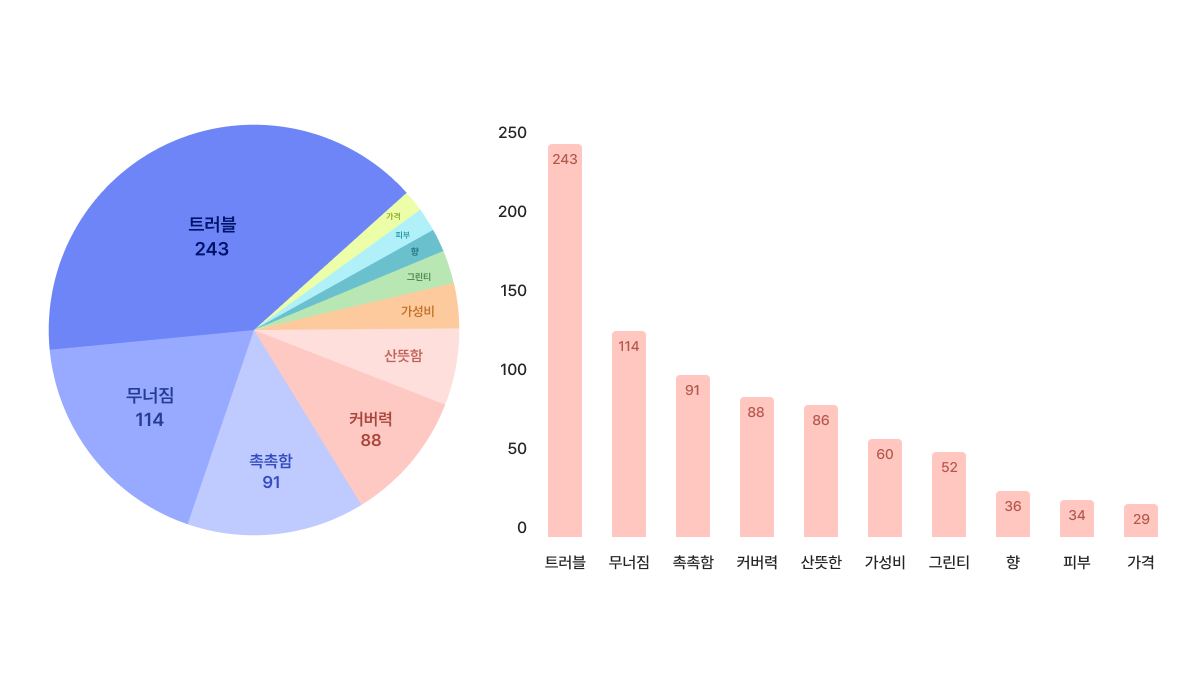
These are customer reactions to cosmetics company D's sunscreen from December 2024 to February 2025.
Words like breakouts, breaking down, moist, coverage, and refreshing mainly appear together.
Based on this information, you can take the following actions.
Breakouts/Breaking down
Need to improve these elements in a product renewal
Moist/Coverage/Refreshing
Maybe we should mention these in our marketing message?
Maybe we should plan a new product with a 'moist + coverage + refreshing' combination?
The Effect
You can analyze the language customers use to express your product's strengths and weaknesses.
You can secure insights you can immediately apply in practice, such as planning new product concepts and improving marketing messages.
AI Analysis Report: Like an outstanding data analyst, it delivers insights on product improvement and sales direction
What is the AI Analysis Report?
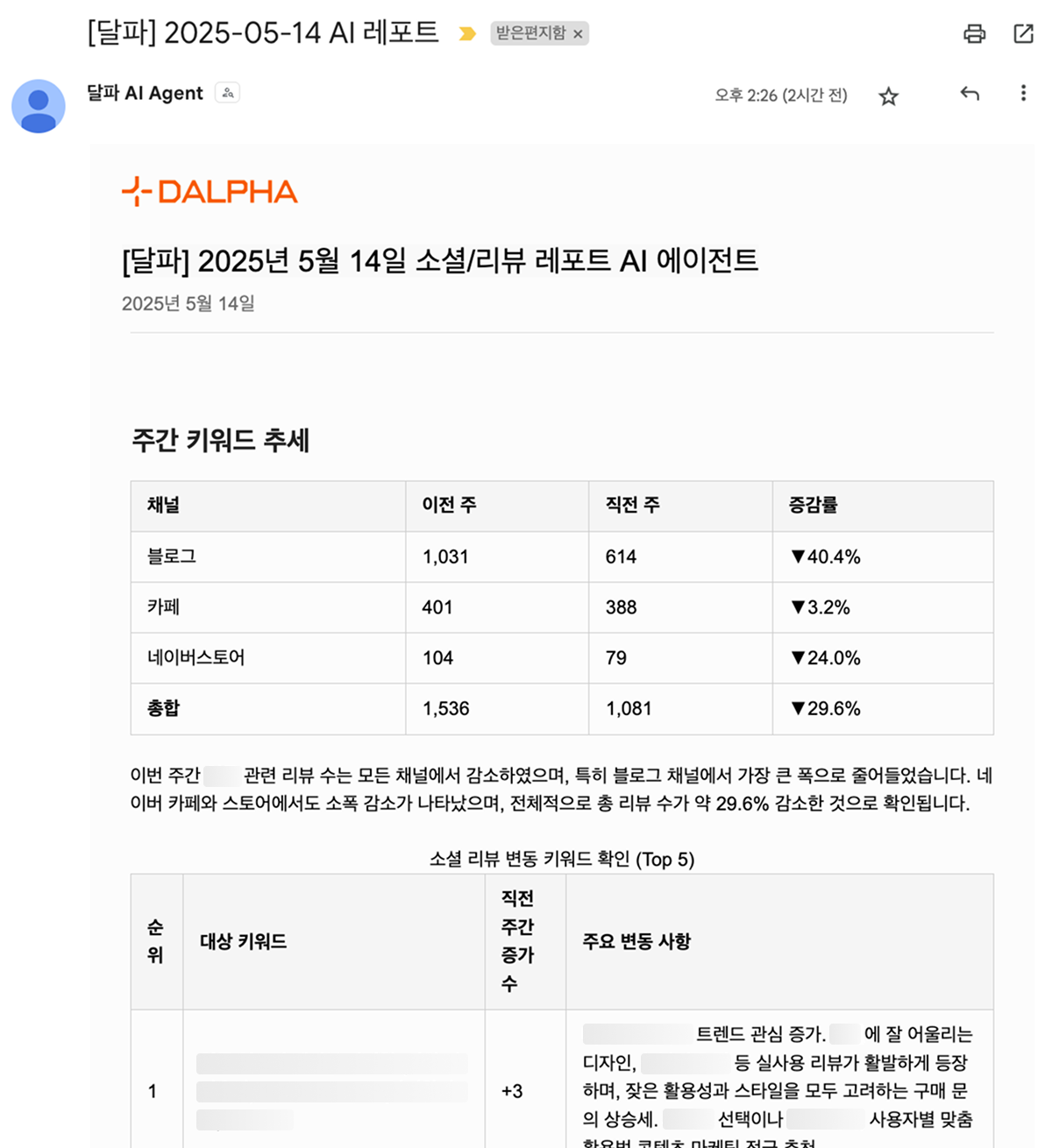
The AI analyzes the collected customer reactions and proposes marketing strategies, product improvements, and more. It can replace the work that data analysts or interns used to do, and it lets you secure consistent-quality insights and data.
The Existing Problem
Even if you gather a large volume of customer reactions, it's hard to extract the meaningful essence from within them.
The output is highly likely to depend on the insight-deriving ability of each individual data analyst or intern. It's also likely to be uneven in quality and not objective.
If the insights extracted from customer reactions aren't specialized for marketing, they're hard to apply in practice.
The Solution
AI extracts meaningful insights from customer reactions and presents marketing messages, product improvement points, development directions, and more.
AI derives insights by consistent standards, guaranteeing stable quality without variance based on individual ability.
It visualizes keyword trends over time, anomaly detection, changes in category ratios, and more, providing them in a form usable in hands-on marketing.
The Effect
You can secure advanced analysis results without manual analysis by interns or junior staff.
You can derive data-driven, objective product improvement directions and marketing action points.
AI can catch and propose, ahead of time, attractive selling factors that people easily miss as well as warning signals that could become problems.
In Closing
So far, we've looked at the features and effects of social/review analysis AI.
If you've read this far and want to use social/review analysis AI, just remember two things.
How deep and accurate the insightsit can extract are?
It shouldn't just show you data—it should interpret the meaning within it and connect it to strategy. Only AI that can precisely analyze customers' emotional flow, the causes of reactions, and related keywords can provide real business insights.
How well it can reduce the time spent on analysis work through automation?
No matter how good the analysis is, it's hard to use if a person has to do it all by hand. Only when the entire process—collection, classification, visualization, and insight derivation—is automated can it finally be applied in practice.
Dalpha's social/review analysis AI satisfies both of these.
For readers of this article only, if you leave your contact information, we'll provide a demo of the 'Social/Review Analysis AI' where you can examine customer reactions to your own product.
Apply below 👇
Dalpha Blog