The Complete Guide to AI Chatbots: Types & Recommendations, Adoption Strategies, and Industry Use Cases
1. What Is an AI Chatbot?
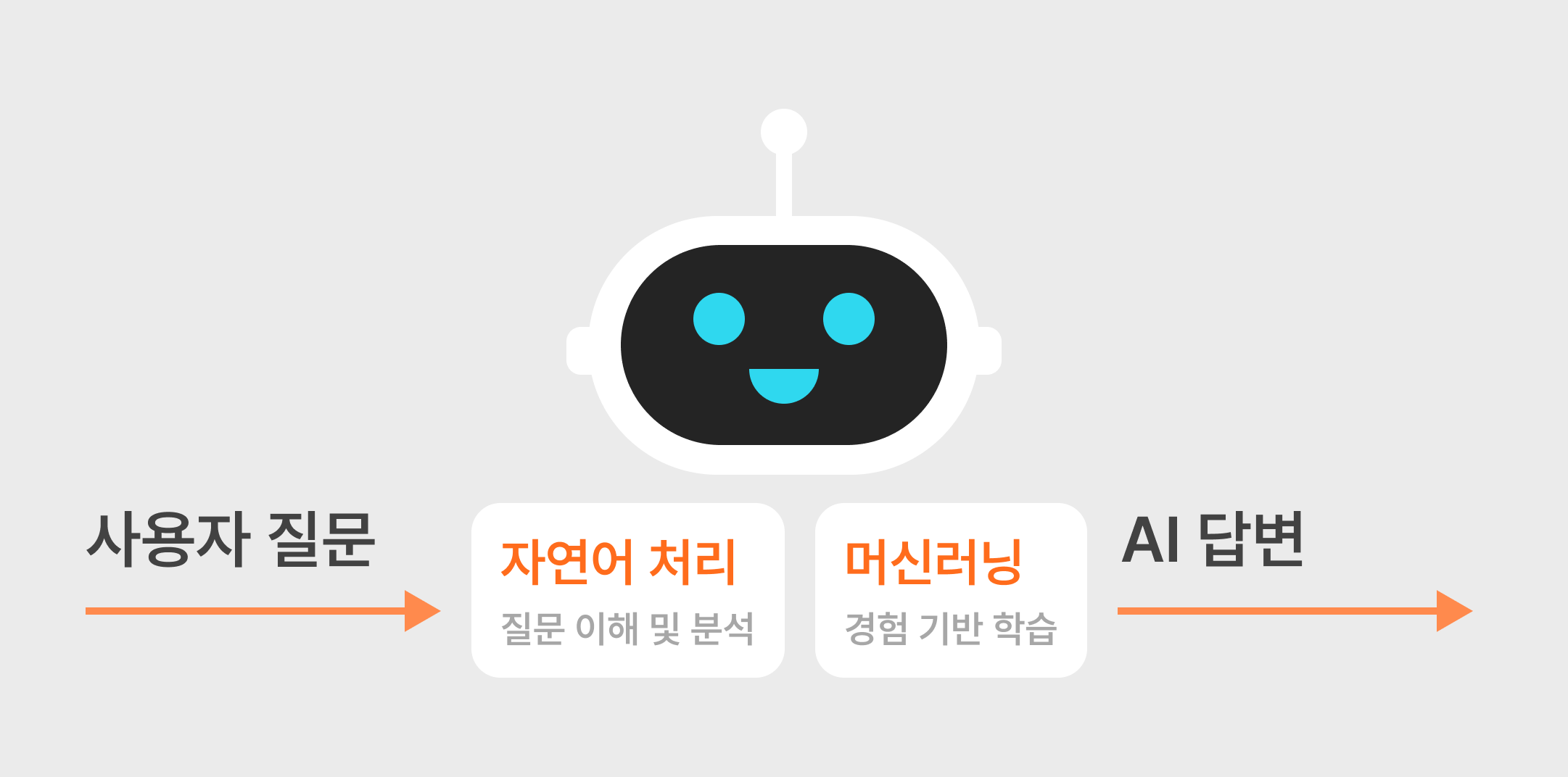
An AI chatbot is a chatbot that can converse like a human. ChatGPTis a prime example of an AI chatbot. Its defining trait is the ability to understand and respond to language, just like talking with a friend. It can grasp the context and intent of a conversation just like a real person.
How can AI chatbots understand questions and generate answers like a human? The answer lies in natural language processing (NLP) and machine learning technology.
Natural language processing (NLP) is
a technology that helps computers understand, generate, and communicate in human language (natural language). It analyzes text or voice data to extract meaning and enables computers to respond appropriately.
Machine learning is
a technology in which computers learn from data to discover patterns on their own, then use them to make predictions or decisions. Machine learning's performance depends heavily on the volume and quality of the data.
When the two technologies combine
by combining natural language processing and machine learning, AI chatbots gain the ability to converse like a human.
To put it simply
✅ Natural language processing = 'understanding human speech'
✅ Machine learning = 'learning from data'
AI chatbot = a chatbot that, through natural language processing and machine learning, can 'understand intent and respond like a human'
2. AI Chatbot Features: What's Different?
The Difference Between (Rule-Based) Chatbots and AI Chatbots
Beyond natural language processing and machine learning, there's another way chatbots generate answers: the 'rule-based' approach, which responds according to predefined rules.
Like this Depending on how they generate answers, chatbots are broadly divided into two types: 'rule-based chatbots' and 'AI chatbots.'
Each approach has its strengths and weaknesses, so you choose based on your needs. They can also be combined into a hybrid form that complements each other. The better you understand the difference between the two, the more effectively you can use them.
(Rule-Based) Chatbots
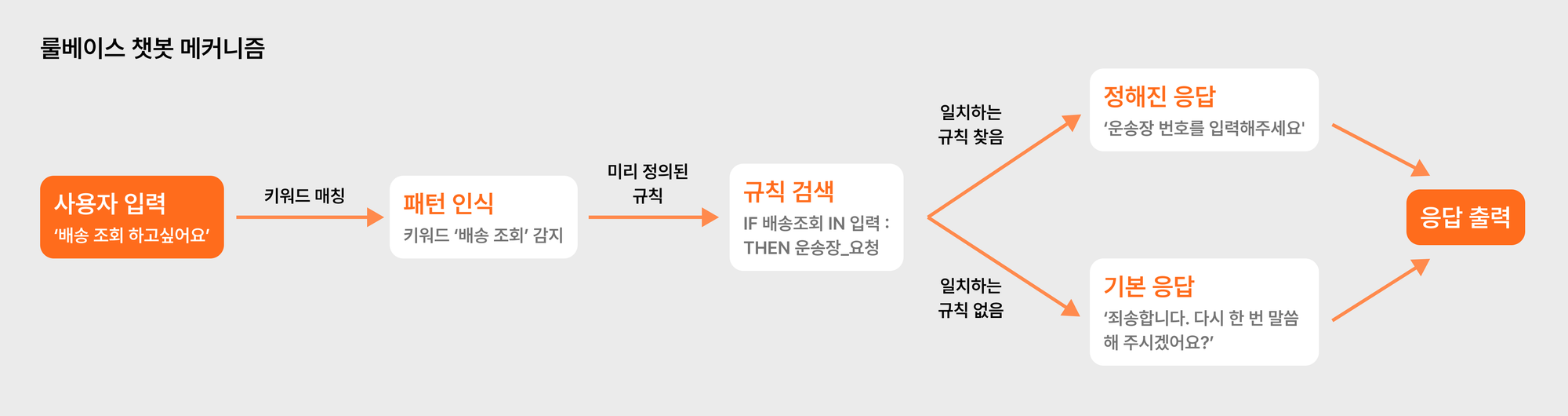
Before ChatGPT, the chatbots we commonly saw were rule-based chatbots. Rule-based chatbots operate based on predefined rules.
For example, you can set the chatbot to respond "Please enter your tracking number" to the keyword 'delivery tracking.'
If an actual user asks, "I want to track my delivery," the chatbot detects the keyword 'delivery tracking.' Then, by the predefined rule, it responds, "Please enter your tracking number."
But for "Please check my parcel," it doesn't detect the keyword 'delivery tracking,' so no answer is given—even though it means the same thing.
Pros
Can provide 100% accurate answers.
Response speed is very fast and stable.
Easy to revise and control answer content.
Easy to manage risk with predictable results.
Highly efficient for handling simple inquiries.
Cons
Cannot handle anything outside predefined scenarios
Conversations feel unnatural and stiff
Can't understand the same meaning expressed differently
No ability to grasp context at all
Rules must be added one by one for every situation
AI Chatbots
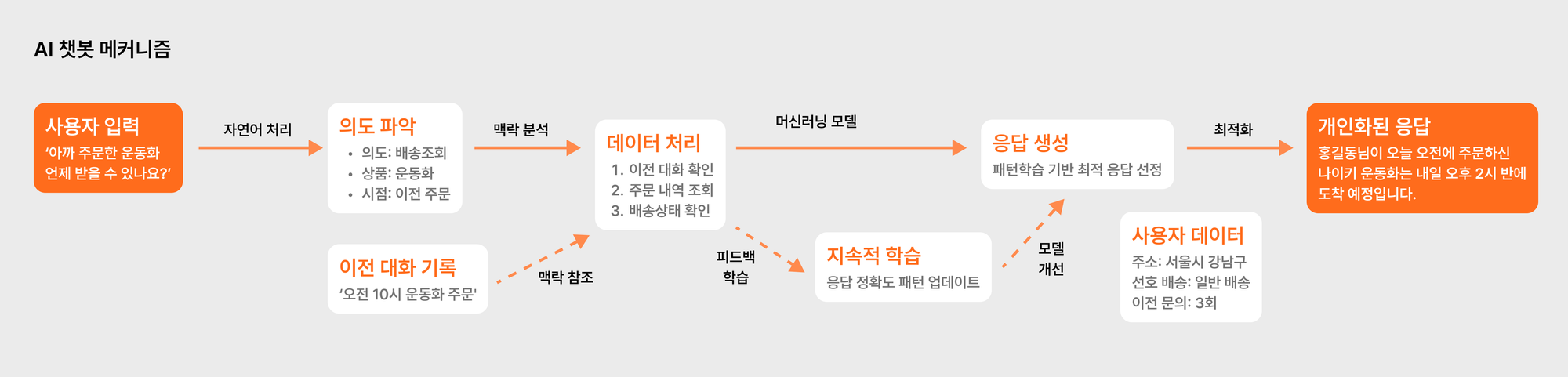
AI chatbots have one defining trait above all: understanding intent. This is the key to why they appear 'smart' and human-like, unlike rule-based chatbots. It's easy to understand if you think of ChatGPT.
For example, even if you ask in various ways—"Where's my package?", "When will my item arrive?", "Tell me the delivery status"—it can grasp that they're all 'delivery tracking' requests. It can flexibly understand and answer your question. On the other hand, depending on how you ask and what it has learned, the answer may not be 100% accurate. It may also produce different results each time you ask.
Another trait is that it remembers and references previous conversations. For example, if a customer asks, "Is that product I mentioned earlier in stock?", it can figure out which product was mentioned earlier in the conversation and check the inventory for you.
Pros
Natural conversation is possible
Can understand various ways of phrasing
Can grasp context and connect the conversation
Understands and responds to complex questions
Performance improves the more it's used
Cons
Unpredictable responses can occur
Hard to guarantee consistency in answers
May provide incorrect information
Conversation quality depends heavily on the data
System overload can occur
Which Should You Use—a Rule-Based Chatbot or an AI Chatbot?
Service purpose
Simple information delivery → rule-based
Complex consultation/recommendation → AI chatbot
Budget and resources
Limited → rule-based
Sufficient → AI chatbot
Response accuracy
100% accuracy required → rule-based
Flexible response needed → AI chatbot
Service scale
Small-scale/specific purpose → rule-based
Large-scale/multipurpose → AI chatbot
To sum up
✅ Risk management, simple and clear results, specific purpose = rule-based chatbot
✅ Flexible answers, complex support, diverse purposes = AI chatbot
3. The Pros and Cons of AI Chatbots: Why Should You Use One?
Are you scrambling to find an AI chatbot just because every other company says they're adopting one?
Check whether an AI chatbot is really right for your business and whether it matches the results you're hoping for. We've put together the pros and cons of adopting an AI chatbot at your company.
Pros of AI Chatbots
AI chatbots excel at user convenienceand the ability to process vast amounts of data.
1) Relatively Easy Initial Setup and Operations Management
Initial setup and operations management are relatively easier than with rule-based bots. A rule-based chatbot requires you to manually input every possible case. An AI chatbot, by contrast, learns patterns on its own. It can handle a wide range of situations with relatively few examples, making it easy to build and scale.
2) Convenient Usability
Users can ask questions freely, just like everyday conversation. Even vague expressions like "you know that thing" or "the one I saw last time" can be understood in context to provide accurate answers, so anyone can use it easily.
3) Leveraging Vast Amounts of Data
It can analyze millions of records in an instant and extract meaningful information. This delivers data-driven insights beyond human limits—trend identification, pattern analysis, predictive modeling, and more.
Cons of AI Chatbots
For an AI chatbot to work, it requires refined data and rule learning. It also requires the staff and expertiseto manage the chatbot well within the organization.
1) Burden of Upfront Investment
There is a burden of upfront investment. System-building costs are high, building high-quality data takes considerable time and money, and specialized staff are also needed.
2) Difficulty in Quality Management
Quality management has to be ongoing. You need to monitor the chatbot's response quality, take care that inappropriate responses aren't sent out, and manage the training data.
3) Need for Organizational Change and Training
Change management is needed within the organization. Employees may resist, existing work processes have to be redesigned, and related training is also required.
4. Types of AI Chatbots: Who Uses Them, and How?
By how they're used, AI chatbots can be classified into CS chatbots, internal-search chatbots, product-recommendation chatbots, character chatbots, and educational chatbots.
Which AI chatbot is the right fit for your company?
We've organized the departments that use each chatbot, the purpose of adoption, and the key features.
1) CS Chatbots
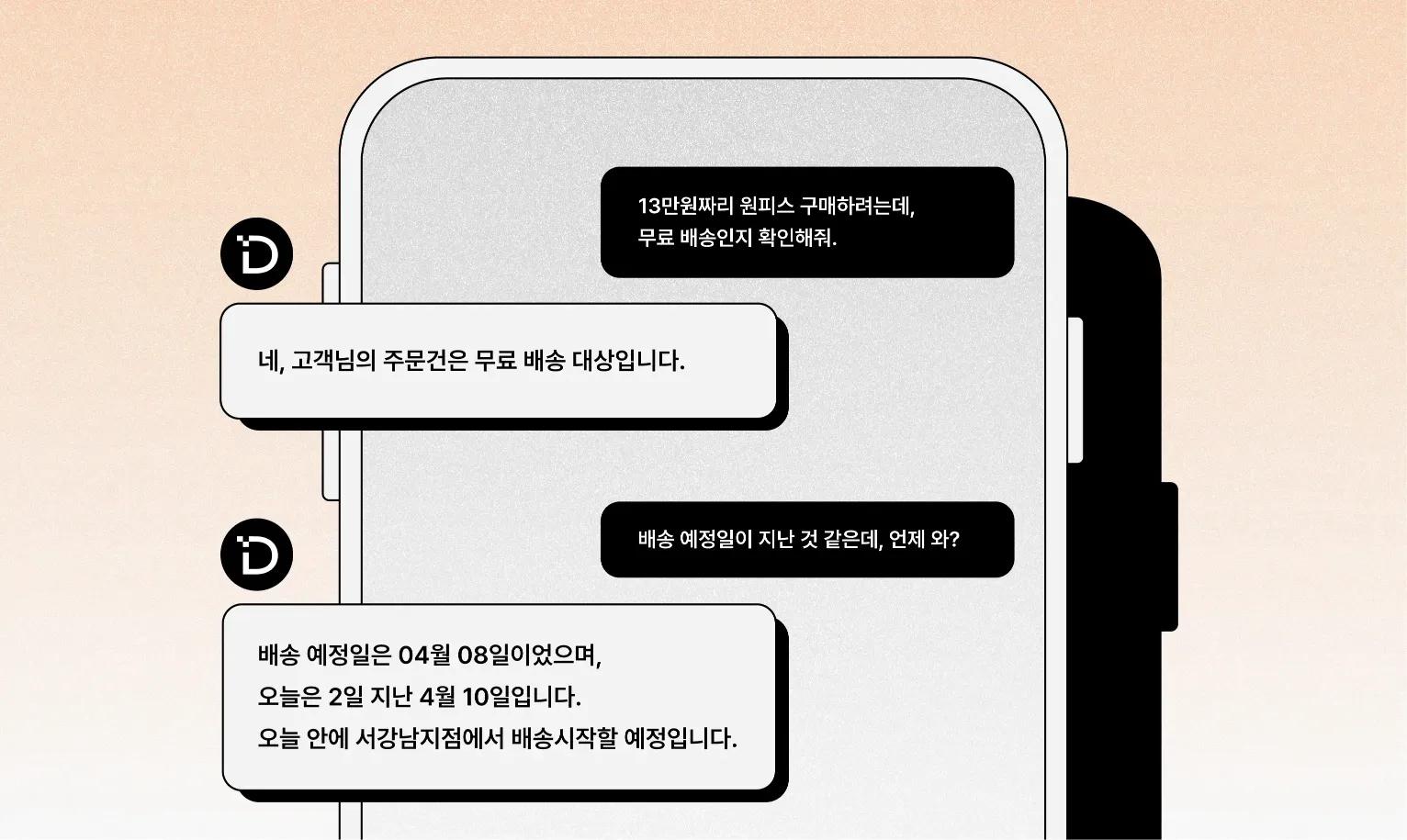
Main Departments
Customer center, CS team, operations team
Purpose of Adoption
Increase real-time resolution rates with 24/7 customer support
Improve agent efficiency by automating simple, repetitive inquiries
Resolve response delays during busy hours
Key Features
Grasps the intent of diverse customer inquiries through natural language processing
Handles real-time data integration for orders/delivery/returns and more
Provides tailored support through customer sentiment analysis
Automatically escalates complex inquiries to an agent
2) Internal-Search Chatbots
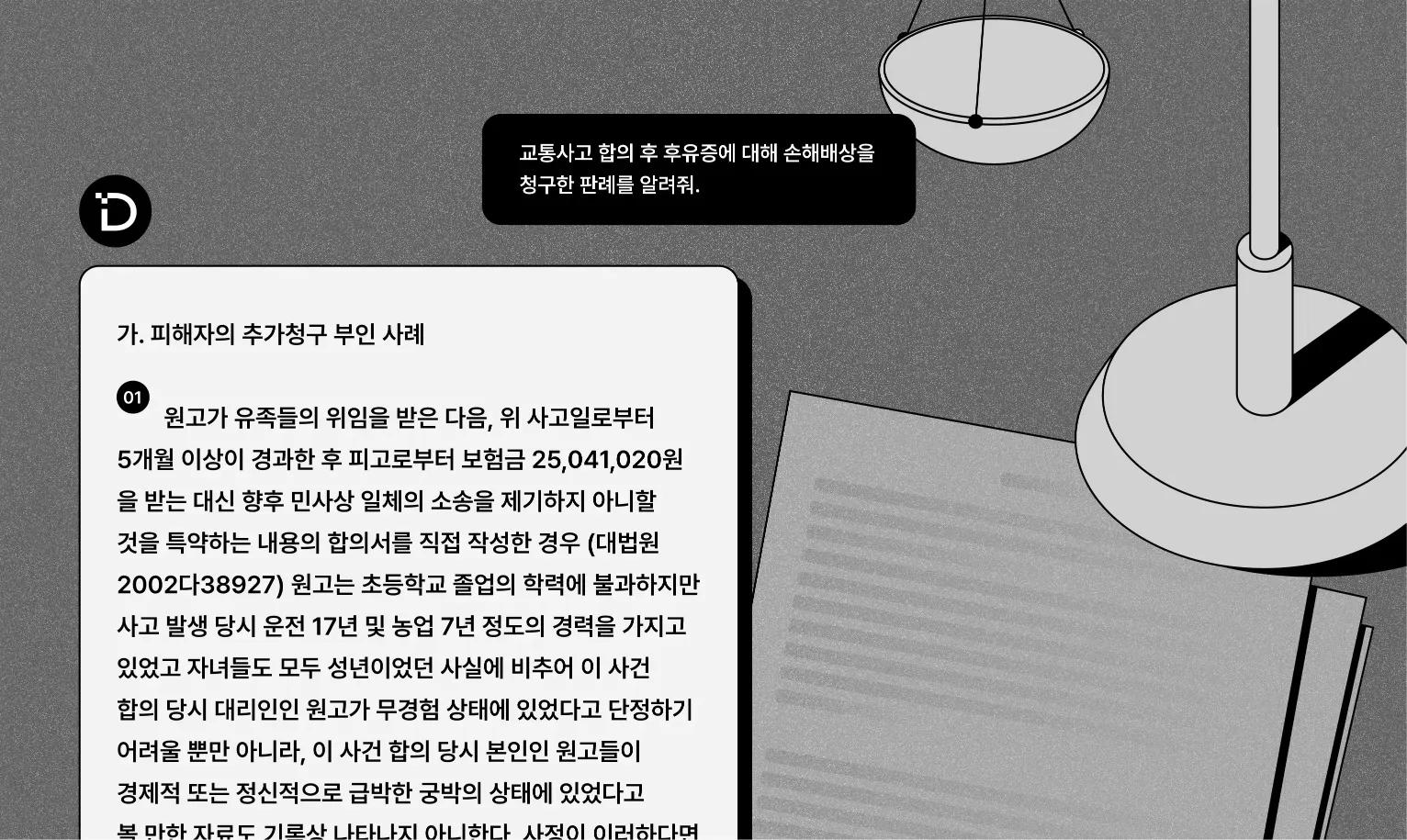
Main Departments
HR team, IT team, general affairs team, all employees
Purpose of Adoption
Improve accessibility of internal information
Automate work processes
Support onboarding of new hires
Key Features
Provides up-to-date information through real-time integration with internal databases
Provides information tailored to each employee's permissions
Search and summary functions for work-related documents
Improves search accuracy by learning frequently sought information
3) Product-Recommendation Chatbots

Main Departments
Marketing team, sales team, CRM team
Purpose of Adoption
Increase purchase conversion rate with personalized product recommendations
One-stop handling from product inquiry to purchase
Derive marketing insights based on customer data
Key Features
Analyzes customer purchase history/behavior patterns
Pinpoints exact needs through real-time interaction
Suggests promotions tailored to each situation
Recommends related products with a high likelihood of purchase
4) Character Chatbots
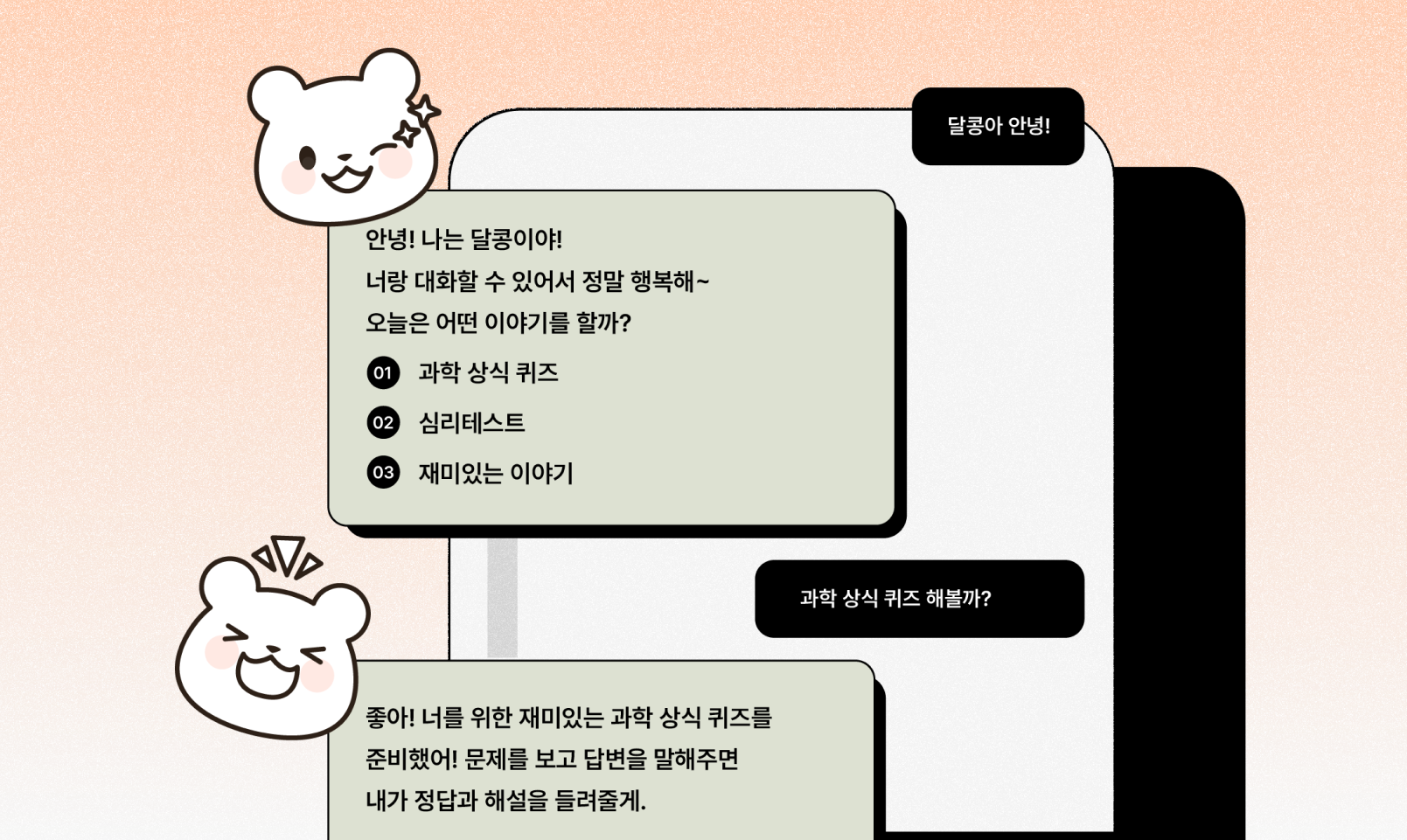
Main Departments
Brand team, marketing team, social media team
Purpose of Adoption
Strengthen brand approachability and distinctiveness
Strengthen customer interaction
Boost brand loyalty
Key Features
A conversational style that matches the brand's tone and manner
Reflects the character's personality and identity
Runs fun events/missions
SNS-linked marketing activities
5) Educational Chatbots
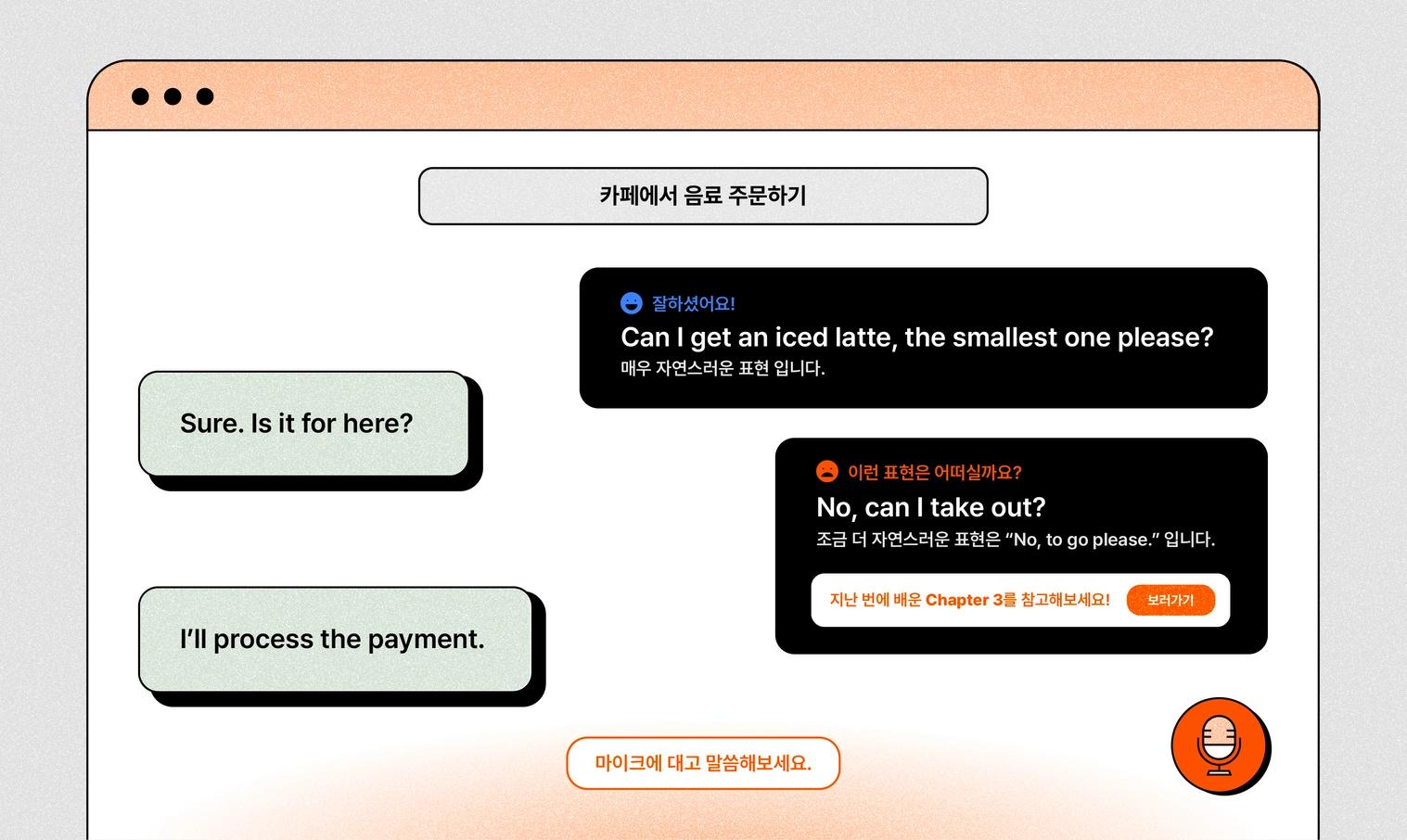
Main Departments
Education team, learning center, research lab
Purpose of Adoption
Provide a personalized learning experience for each individual
Improve learning efficiency and engagement
Reduce education operating costs
Key Features
Provides tailored content by analyzing the learner's level
Gives immediate feedback through real-time Q&A
Identifies areas for improvement by analyzing learning patterns
Can incorporate gamification elements
You can combine the characteristics of each type to build an AI chatbot that fits your company's needs.
For example, you can add character traits to a CS chatbot to deliver friendly customer service, or add an educational function to an internal chatbot to support employee skill development.
The key is to accurately identify your organization's goals and your users' needs, and to implement the right features.
5. AI Chatbot Cases by Industry
Which AI chatbots are most commonly used in your company's industry?
Here are representative AI chatbot cases used across the five industries below.
1) Education Industry Chatbots
⏺️ Education/Learning Chatbots ⏺️
Education companies use education/learning chatbots to provide learners with a tailored educational experience. They can offer an efficient content-discovery environment and provide ongoing learning motivation.
What Was Implemented
It analyzes the learner's interests, learning goals, and learning patterns, and automatically recommends suitable educational content based on them.
Learners can easily explore the content they want and continue learning efficiently in a personalized learning environment.
Based on learning data, the AI continuously improves the learning path to deliver the best possible educational experience.
Success Metrics
Increase in learner satisfaction
Improvement in learning engagement
Content recommendation accuracy
Improvement in learning outcomes
Time spent on the platform
Use Cases
2) HR & Business Industry Chatbots
⏺️ Internal-Search Chatbots ⏺️
Work-efficiency tools that support corporate decision-making become even more powerful with the help of AI. Internal-search chatbots can greatly improve internal work productivity through data analysis and use.
What Was Implemented
It builds an internal search system where you can ask questions in natural language and receive answers in real time.
With a user-friendly interface, you can access the information you want without navigating complex menus.
Even users unfamiliar with data can use it easily, improving overall work efficiency.
Success Metrics
Frequency of system use
Reduction in data lookup time
User convenience rating
Work processing speed
Expansion of data utilization scope
Use Cases
3) Manufacturing Industry Chatbots
⏺️ Internal-Search Chatbots ⏺️
Manufacturing companies use search chatbots to improve access to vast internal data and boost work efficiency. By shortening the time employees spend searching for information and increasing focus on core tasks, they can expect an overall productivity gain.
What Was Implemented
It uses natural language processing technology to instantly provide information matching the user's question.
It can efficiently search vast internal data such as documents and reports.
It learns the user's search patterns to continuously improve search accuracy.
Success Metrics
Time spent searching for information
Improvement in search accuracy
Employee work productivity
Customer response speed
System utilization
Use Cases
4) Commerce Industry Chatbots
⏺️ CS Chatbots ⏺️
Commerce companies use CS chatbots to automate customer service and improve response efficiency. By automating the handling of repetitive inquiries, they cut costs, and with fast responses they raise customer satisfaction. Being able to run 24/7 is also a major advantage.
What Was Implemented
It provides AI-based automatic answers to frequently asked questions such as product usage, delivery status, and refunds.
For complex or special inquiries, the AI analyzes them and automatically assigns them to the right staff member.
It records and analyzes all inquiries and their resolution processes to continuously improve service quality.
Success Metrics
Automatic response rate for customer inquiries
Reduction in average response time
Improvement in customer satisfaction
Reduction in CS operating costs
Agent work efficiency
Use Cases
⏺️ Product-Recommendation Chatbots ⏺️
Commerce companies use product-recommendation chatbots to improve the customer's buying experience and encourage additional purchases. Personalized product recommendations raise customer satisfaction and strengthen brand loyalty.
What Was Implemented
It analyzes the customer's tastes and search history to provide personalized recommendations.
It suggests related products that consider the customer's lifestyle and spatial characteristics.
It runs optimized recommendations that shorten the customer's browsing time and increase the likelihood of purchase.
Success Metrics
Purchase conversion rate for recommended products
Customer time on site
Additional purchase rate
Customer satisfaction
Brand loyalty
Use Cases
5) Platform Industry Chatbots
⏺️ Character Chatbots ⏺️
Platform companies use character chatbots to strengthen brand approachability and improve user engagement. With a conversational style that matches the brand's tone and manner, plus emotional communication, they can deliver a distinctive service experience.
What Was Implemented
It implements a friendly, fun conversational style that reflects the brand character's personality.
It automatically answers viewers' various questions during live broadcasts.
It continuously learns from viewer feedback to raise the quality of communication.
Success Metrics
User engagement
Conversation satisfaction
Brand favorability
Chat response rate
Time spent on the platform
Use Cases
⏺️ Internal-Search Chatbots ⏺️
Platform companies use internal-search chatbots to improve access to vast internal information and cut communication costs. By resolving information asymmetry and boosting work efficiency, they can expect an overall productivity gain.
What Was Implemented
The AI learns the company's policies and data to provide automatic answers.
It provides quick answers to employees' frequently asked questions.
It resolves information asymmetry between departments, cutting communication costs.
Success Metrics
Information search time
Work processing speed
Employee satisfaction
Cross-department collaboration efficiency
System utilization rate
Use Cases
6. 7 Considerations and a Checklist When Adopting an AI Chatbot
✅ Start Small
Start a pilot in a specific department or function and expand gradually. This enables a stable rollout while minimizing the burden of upfront investment.
✅ Give It Enough Time to Operate
AI needs time to learn and improve. Don't rush to expect results—watch the process of data accumulating and improvements being made.
✅ Set a Clear Purpose
Decide on concrete adoption goals and measurable performance metrics in advance. The clearer your purpose, the better the results you'll get.
✅ Prepare Foundational Data
An AI chatbot's performance depends heavily on the quality of the training data. Prepare the data you need in advance and manage it continuously.
✅ Set Up a Team in Charge
Form a dedicated operations team and provide appropriate training. It's important to clearly define each department's roles and responsibilities.
✅ Check the Risk Factors
Prepare responses in advance for risks that may arise, such as privacy protection, wrong answers, and system failures.
✅ Build a Management Framework
Continuously improve through regular monitoring and feedback collection. Use performance metrics to verify the effects.
7. AI Chatbots: The Future and Outlook
Becoming Even More Widespread
AI chatbots are gradually evolving beyond simple customer service into a driver of corporate growth. According to the Korea Enterprises Federation's 'Survey on the Adoption and Perception of AI at Major Companies,' 38% of companies have already adopted generative AI for office-job rolesand Pure Storage's survey found that 73.5% of domestic companies have adopted AI technology or are running it as a pilot.
From deriving insights through customer data to innovating work processes and cutting costs—AI chatbots have established themselves as a core solution that directly affects business performance, and this trend is expected to grow even stronger.
How You Use It Is Your Competitive Edge
From CS chatbots to recommendation chatbots and internal-search chatbots, there are as many ways to use AI chatbots as there are types. Now, beyond simply adopting one, 'how you use it' has become the key competitive advantage.
For example, even with the same recommendation chatbot, recommendation accuracy varies greatly depending on the quality and scope of the training data. With a CS chatbot, the reduction in response time and cost savings vary depending on how efficiently you design the customer support flow. The same goes for internal-search chatbots. Depending on the document classification system and data integration method, search accuracy and work productivity can differ by up to 40%.
How strategically you use AI chatbots will become a company's real competitive edge.
How to Stay Ahead From the Start
Many companies have already begun transforming through AI chatbots. Which AI chatbot is the best fit for your company?
Consult with Dalpha's AI consultants for free. We'll help you with concrete adoption plans, along with success stories by industry.
Dalpha Blog