
How to Grow Sales Without Increasing Ad Spend: Real Sales-Optimization Cases
In the previous series, we covered product planning, inventory optimization, and marketing automation. This time, it's about the final stage of commerce: the AI that maximizes actual 'sales conversion.'
1. Online Sales: Why Is Optimization So Hard?
Online sales look simple, but the reality is complex.
Impression → Click → Product-page view → PurchaseEach stage in this chain has key metrics like CTR, conversion rate, and average order value, and you have to watch them every single day.
What makes it tricky is that these metrics are all interconnected. Change the title and your CTR goes up, but the conversion rate may drop; lower the price and the conversion rate rises, but the margin gets too thin. On top of that, when competitor promotions, seasonal shifts, and trend changes all pile up, the strategy that worked great last month often falls flat this month.
AI analyzes these complex variables in real time, identifies the relationships between them, and keeps learning to find the optimal strategy. So how are real brands actually using it?
2. Sales-Optimization AI in Action
2-1. Listing Optimization: How to Win Clicks in Search Results
Client: a beauty brand
Problem: sufficient product exposure on commerce platforms, but a low click-through rate (CTR) stalling sales growth
Goal: create optimal product titles that drive customer clicks in search results
On Amazon, Coupang, and Naver, when a customer searches a keyword, dozens of products line up in a row.
At that moment, if your product doesn't get the click, it's game over.
One beauty brand poured money into ads and even lowered prices, yet sales didn't grow.
The product was getting impressions but failing to win clicks.
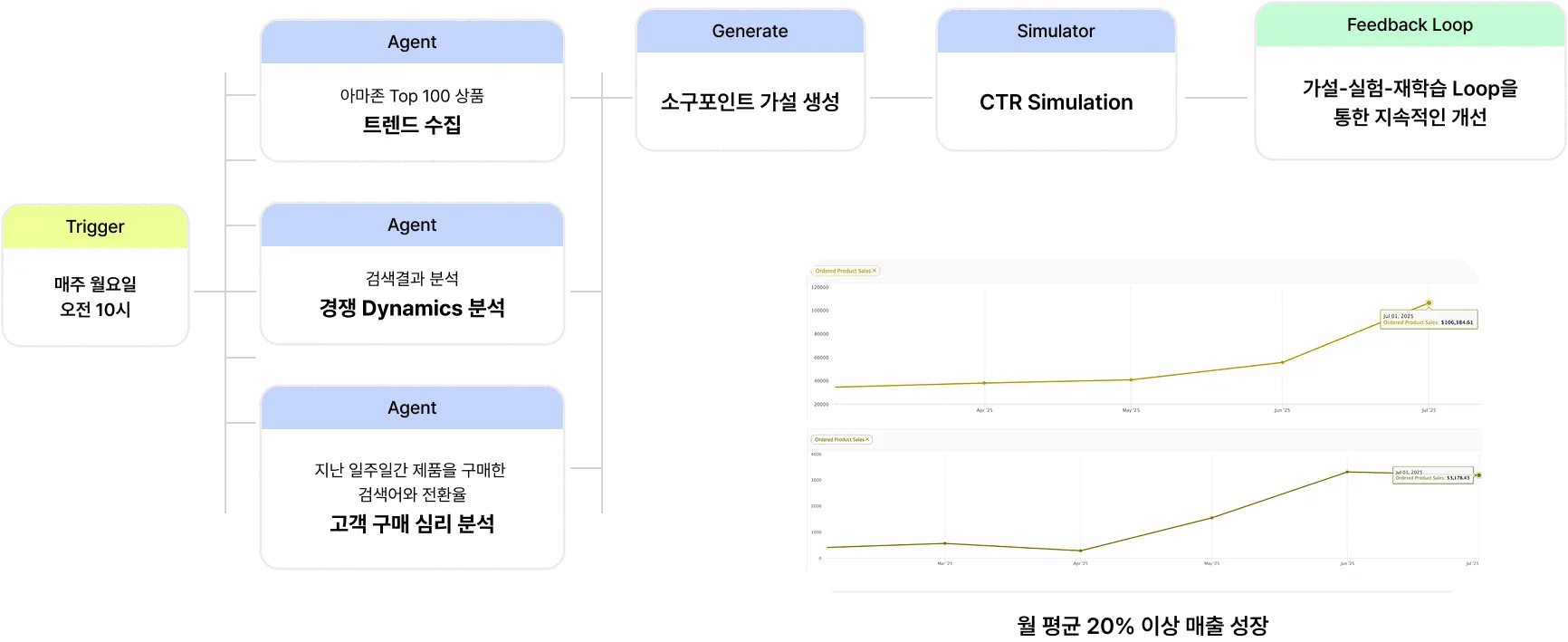
6 Steps of AI Listing Optimization:
Collect market trends: automatically gather titles, keywords, and modifiers from the top 100 products in the same category
Analyze the competitive landscape: identify the price ranges and reviews of competing products that appear alongside yours for a given search term
Analyze customer psychology: analyze the search terms that actually led to purchases and their conversion rates (e.g., if "serum for dry skin" converts better than "hyaluronic acid serum," lean into a benefit-focused appeal)
Generate appeal-point hypotheses: create title candidates across several directions
CTR simulation: simulate the expected CTR of each title candidate to select the best option
Feedback loop: after monitoring actual performance, retrain to improve the accuracy of the next optimization
Result:
Over 20% average monthly sales growth.
Since exposure was already sufficient and only the CTR was low, improving the CTR alone was enough to drive dramatic change.
For a brand whose product itself was solid, more clicks led straight to purchases.
2-2. Dynamic Pricing: The Process of Finding the Right Price
Client: a fashion brand
Problem: setting the initial price for newly launched products and adjusting prices optimally by season
Goal: select the right price to maximize both sales and margin
Pricing is the most sensitive decision of all. Set it too high and customers leave; set it too low and the brand image takes a hit.
One fashion brand had to set prices for dozens of new products, but had no clear sense of which price points would work in the market.
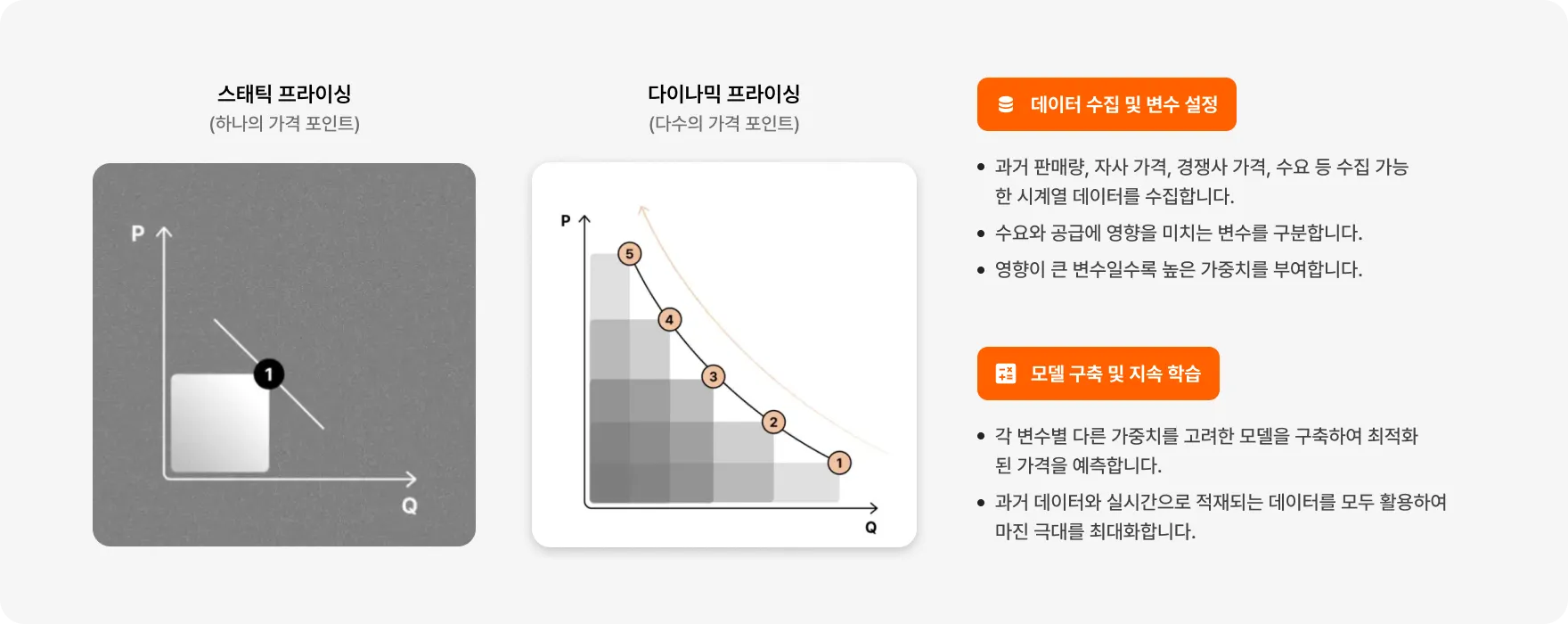
The AI Dynamic Pricing Process:
Set the initial price
Analyze the price distribution and sales volumes of similar categories. For a "wool-blend oversized knit":
Price range of similar products: 49,000–98,000 won
Highest sales in the mid price range (60,000–70,000 won)
Considering brand positioning → suggested initial price: 69,000 won
Monitor after launch
Track daily sales volume, sales velocity, competitor price changes, and inventory depletion rate.
The first two weeks are a data-gathering period—watching how the market responds.
Adjust by season
For this brand, sales were slow at the initial 69,000 won, and the AI suggested lowering it to 59,000 won. Sales jumped sharply; mid-season it was raised back to 64,000 won, and at the end of the season it was dropped to 49,000 won to clear inventory.
Result:
Inventory depletion rate improved by 15% while maintaining the average selling price for the first season. Without a large end-of-season sale, well-timed price adjustments alone cleared the inventory cleanly.
2-3. Promotion Optimization: When and How Much to Discount?
Client: a beauty brand
Problem: running promotions every month, but with inconsistent results and no clear criteria
Goal: run promotions at the optimal timing and discount rate to maximize sales and margin
Discounts are powerful, but used poorly they only damage the brand image. In fact, many brands had the experience of running promotions every month, with some months being huge hits and others falling flat.
The Core of AI Promotion Optimization:
It analyzes multiple data sources at once:
Inventory data: current stock levels, expected restock dates, expiration dates
Sales trends: sales volume over the last 4 weeks, year-over-year growth rate
Competitive environment: competitors' promotion schedules and discount rates
External factors: seasonality, anniversaries, weather
The key is that these data sources are all interconnected. Even with plenty of inventory, if a competitor is planning a major discount next week, it's better to move your promotion up. And even if sales are sluggish, if a seasonal peak is just around the corner, waiting may be the better move. The more context the AI grasps, the more precise its judgment becomes.
A Real Case:
The AI made a suggestion like this:
"Sunscreen inventory is 40% higher than average, the weather will warm up within 2 weeks, and competitors look likely to start discounts next week. Running a 20% discount now will both clear inventory and raise brand awareness ahead of the seasonal peak."
On day 3, when sales took off faster than expected, the AI said:
"At this pace, the inventory will be gone within 7 days. You can scale the discount down to 15% starting on day 5"—and the brand was able to capture more margin in the latter half.
Result:
The average promotion margin rate improved by 12 percentage points, while inventory turnover also rose. It was the result of running promotions strategically instead of discounting blindly.
3. Where Should Your Brand Start?
Step 1: Find Your Pain Point
Getting impressions but no clicks? → Listing optimization
Weak price competitiveness? → Price optimization
Inventory piling up, or promotion results all over the place? → Promotion optimization
Step 2: Prepare a Minimum of Data
Listing: product titles, category info, and (if available) CTR
Pricing: daily sales volume and price, inventory levels
Promotion: past promotion history and results, inventory data
You don't need perfect data. You can build it up one piece at a time as you go.
Step 3: Start Small
Don't touch all of your products at once.
It's safer to test with a few best-sellers or strategic products, then expand based on the results.
Step 4: Verify With Numbers
Define key metrics like CTR, conversion rate, average selling price, and inventory turnover, and verify the improvement in numbers.
Wrapping Up
The core of online sales-optimization AI is 'making decisions with data.' The market moves fast and competition is fierce. AI catches patterns people miss, considers many variables at once, and keeps learning.
What matters isn't preparing perfectly—it's getting started. Changing one title, adjusting a price by 1,000 won, moving a promotion up by a week. These small decisions add up to a difference of hundreds of millions of won in annual sales.
Where will your brand start?
Find the sales-optimization strategy that fits your brand right now.

Minhyuk Choi