Same-Product Matching AI That Cuts Workload and Boosts Productivity
We recommend this for
- Anyone who wants to cut MDs' workload while increasing work speed
- Anyone who wants to learn about the various automation and cost-optimization trends in e-commerce
- Anyone who wants to try out Dalpha's same-product matching AI
Estimated reading time: about 3–5 minutes
If you're busy, at least read this!
- E-commerce has a lot of labor-intensive work that can be optimized, and a representative example is same-product matching, which bundles identical products together. Distributors, resale and secondhand markets, and others where the same products get registered repeatedly perform same-product matching to give users a good shopping experience. Naver Smart Store and Danawa, both famous for lowest-price comparison, have adopted AI technology to automatically bundle many products together.
- Dalpha's same-product matching AI uses all of a product's information—images, titles, product detail descriptions, and more—to precisely bundle identical products. MDs then review the product groupings in the workspace Dalpha provides, and performance continuously improves through retraining.
- Dalpha's same-product matching AI dramatically increases work speed—one partner actually experienced a staggering 71x increase in work speed. And because the database comes to hold information on identical/similar product groupings, it can be used for many services such as lowest-price comparison and improving the online-store experience.
Cost optimization, essential to e-commerce growth
What are the essential elements of e-commerce growth?
There are many important factors—delivering a good customer experience, running efficient marketing, and so on—but to handle heavy traffic and workloads and to grow, it's crucial to optimize the costs used internally. When the time to grow arrives, you need to invest costs, but if optimization hasn't happened internally and costs are leaking, it can hold you back!
As part of cost optimization, a great deal of digitization and automation has taken place in e-commerce, yet many tasks are still done by hand. In particular, e-commerce operations that handle large volumes of products have had to use many MD staff to keep up with traffic, which means spending a lot of time and labor costs.
The structure of e-commerce and distributors' concerns
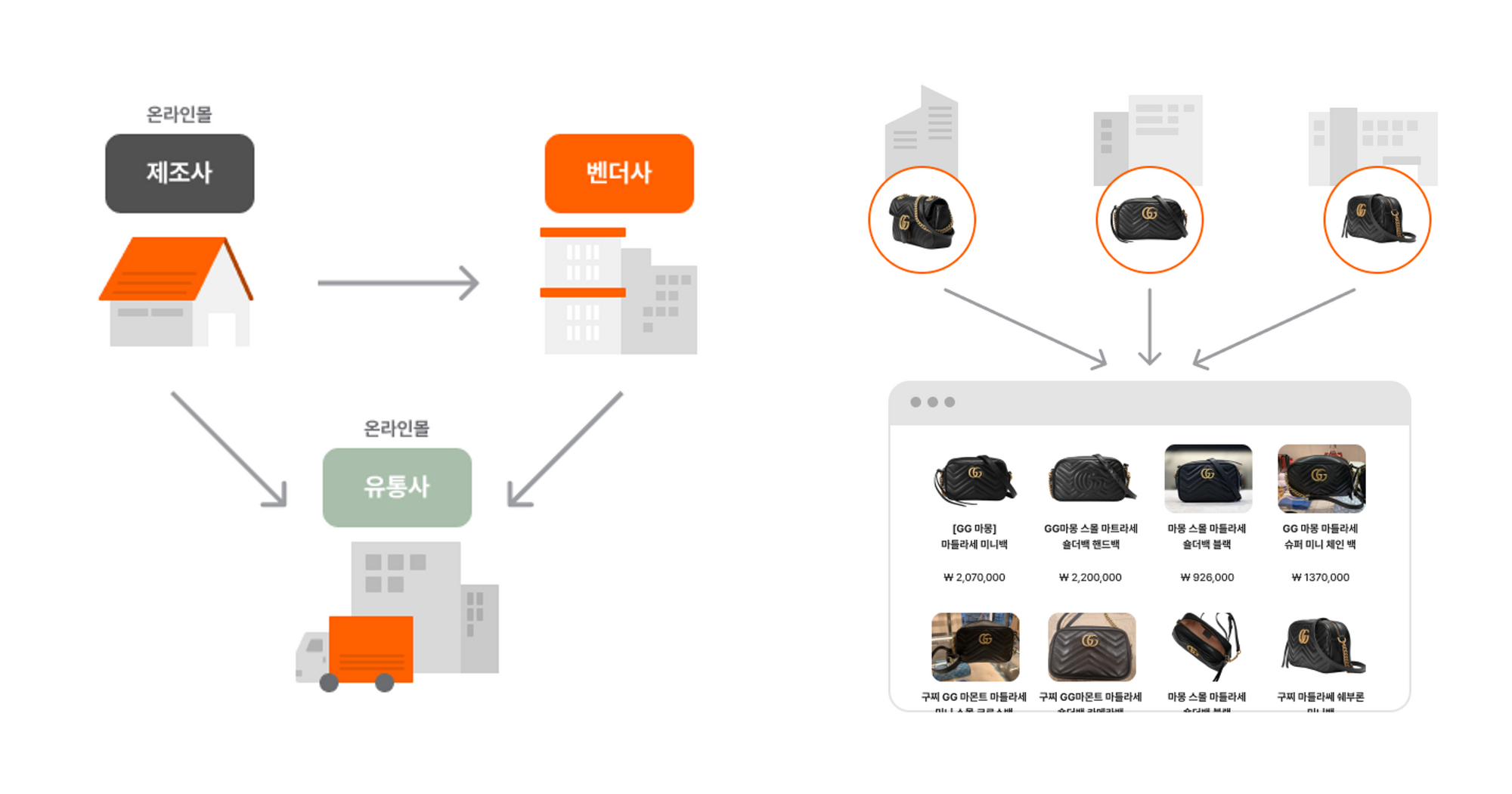
If you think about the structure of e-commerce, it can largely be divided into manufacturers, vendors, and distributors. Among them, the ones in direct contact with consumers through online stores are manufacturers (own-brand malls) and distributors (general malls, open markets). Distributors—general malls and open markets—typically handle far more products than own-brand malls, and these stores often have many listings of the same product at different prices. In such cases, buyers can't see a variety of products and end up with the inconvenient shopping experience of having to search for the lowest price of the product they want themselves.
The 'price comparison service' offered by large platforms
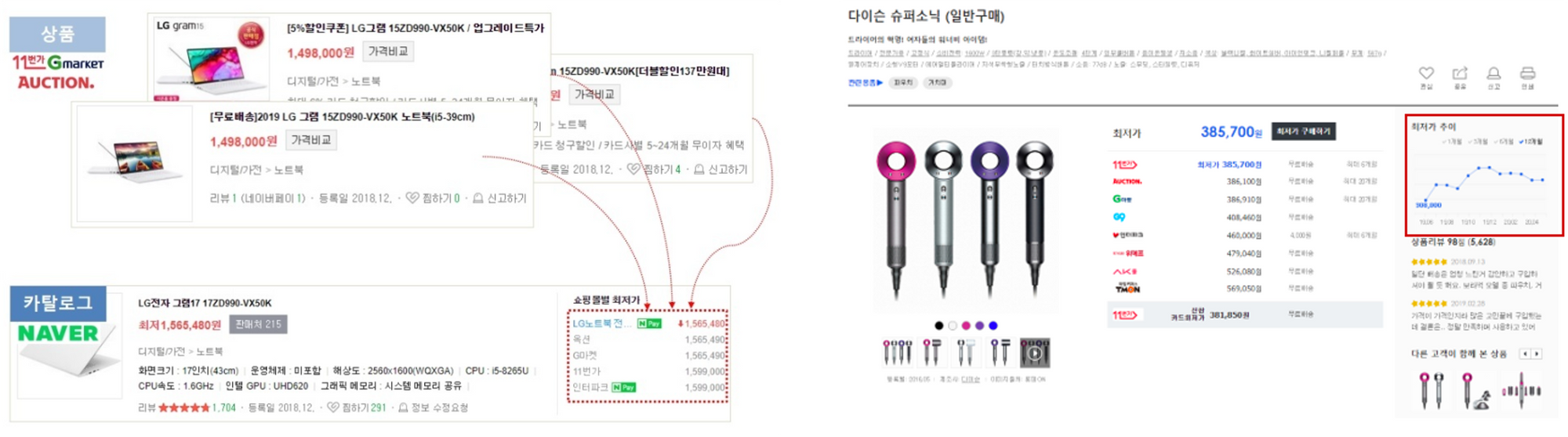
To improve the customer experience, distributors began bundling identical products and presenting them to buyers as a single catalog. In other words, a catalog refers to a product group—or a page—that bundles identical products together, and two large distributors that do a great job of providing such catalogs are 'Naver Smart Store' and 'Danawa.'
Naver Smart Store's feature, called price comparison or original-product matching, bundles the same products to create a product group. Currently, Naver Smart Store uses AI technology to bundle these automatically.
Danawa's main business is lowest-price comparison. In February 2023, Danawa adopted price-comparison AI and now provides the lowest prices for 1.3 billion products collected in real time, and it holds the country's largest set of 20 million standard product catalogs.
The emergence and value of same-product matching AI
Same-product matching used to be done by hand or with rule-based filters. But manual work was slow, so products kept piling up before they could even be properly bundled, and rule-based same-product matching couldn't respond flexibly to exception cases, which led to the limitation of many products being bundled incorrectly. So in the past, there was no way to achieve both the quality of same-product matching and product traffic other than increasing headcount.
But large platforms like the aforementioned Naver Smart Store and Danawa adopted same-product matching AI and built up large product catalogs without relying on manpower, allowing them to seize an advantageous position in the distributor market. Moreover, not just for traditional distributors but also for the rapidly growing resale and secondhand platforms of recent years, users can now compare the prices and vintage grades of secondhand products together, making same-product matching even more valuable.
While the advantages of same-product matching AI are this clear, for many people same-product matching AI still feels difficult and daunting. So how is Dalpha bringing same-product matching AI into e-commerce?
How is Dalpha's same-product matching AI deployed?
Simply put, Dalpha's same-product matching AI is an AI that bundles identical products based on their characteristics. It uses all of a product's information—images, titles, product detail descriptions, and more—pulled from the client's database to bundle product groups. Because it uses all the information, it can precisely bundle identical/similar products!
Once MDs review the AI's results, all the work is done. Dalpha provides a workspace where MDs can review the same-product matching results. For the results the AI judged to be identical products, they simply review 'whether the result is correct' and 'if the result is wrong, what the correct answer is.' Because the review results are automatically tracked, a single review handles service deployment and product-group updates all automatically—very convenient.
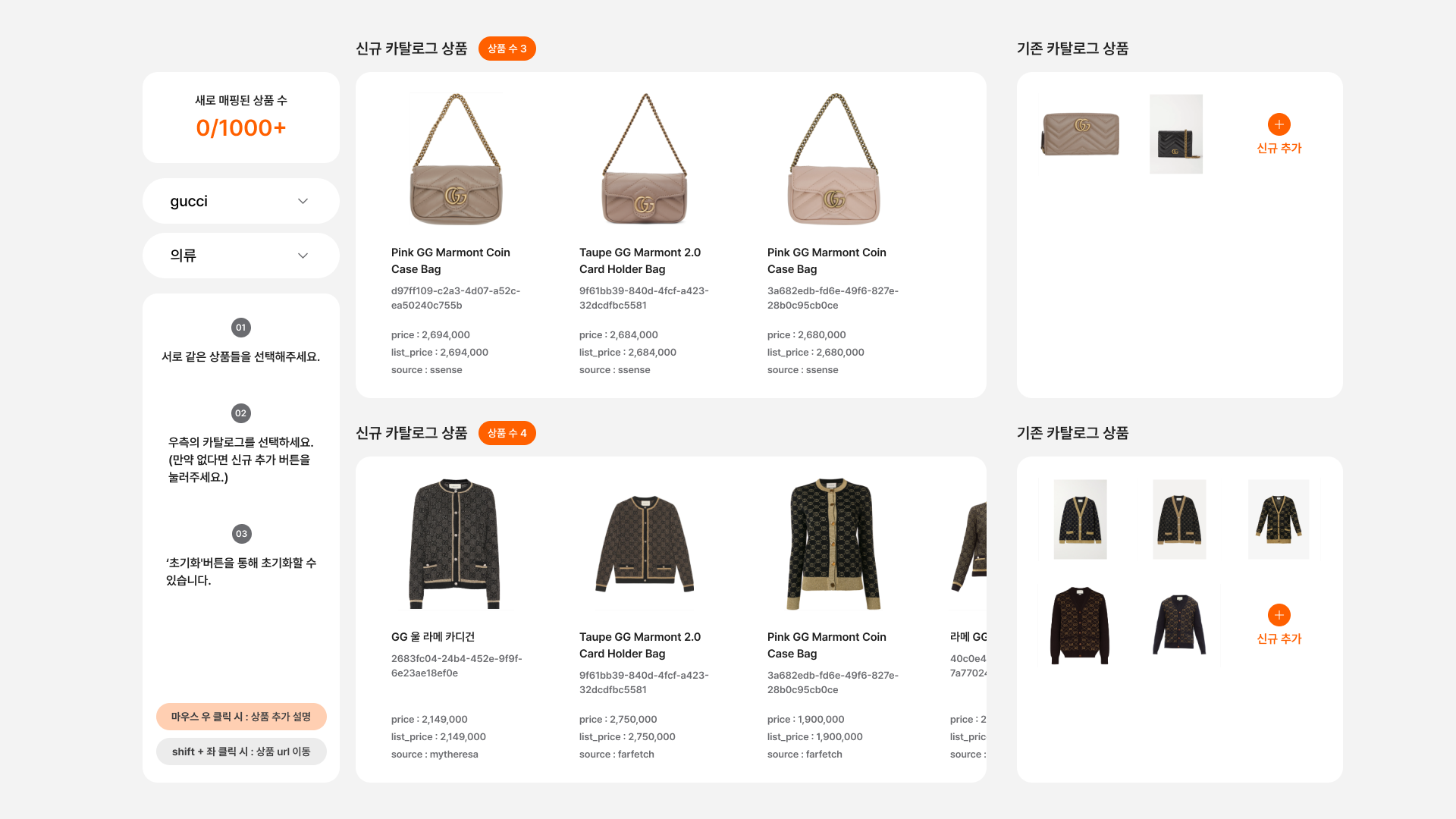
On top of that, the biggest characteristic and advantage of this kind of pipeline is that 'performance continuously improves through retraining.' Based on the review results, the AI is retrained periodically, which improves the AI's performance and tunes it to fit the client. Even for products that previously had no ground-truth data (a reference product), a new client-customized catalog can be created based on the extracted features.
So how do things change when you adopt same-product matching AI?
First, if you've been doing same-product matching by hand, your work speed becomes dramatically faster than before. A partner that adopted Dalpha's same-product matching AI said they experienced a staggering 71x increase in work speed compared to doing it manually! In addition, the more catalogs you hold through same-product matching, the faster same-product matching of new products becomes as you put them to use.
At the same time, as identical products get bundled together, the quality of the product database rises. By bundling identical products and presenting them to consumers, the online store's UI and usability can be greatly improved. Moreover, once the product database holds information on identical/similar product groupings, it can be used to plan new services such as lowest-price comparison. Comparing multiple products is an important value e-commerce should give consumers, so the benefit becomes much greater!
Try Dalpha's same-product matching AI now!

Euijin Kwon