We Asked Industry Professionals Which Jobs Will Disappear Because of AI (ft. Designers, Data Scientists, Finance)
As AI advances, we got curious about which jobs will disappear. We met with practitioners who understand AI well and asked them which tasks they think will be replaced. Here's our first interview series.
Summary
Private equity, consulting : Tasks that process and analyze structured data will likely be done by AI. Being good at winning people's hearts will become far more important.
Data analyst / data scientist : Basic data analysis will be done by AI. I think the number of data analyst positions will shrink a lot.
UX designer : I think demand will grow for designers who can design user experiences using LLMs.
Private equity & consulting intern - Jiho
Background
In Korea, I've worked on a startup strategy team, as a strategy consulting research assistant, and as a private equity intern.
Q&A
Q. Which jobs do you think will be easily replaced by AI?
Tasks that process and analyze structured data will likely be replaced easily. I often scrape disclosure data published on Dart, preprocess it in Excel, and create reports. I find myself wondering why a human is still doing this. Dart's disclosure data follows clear rules, so it would be easy for AI to work with. Likewise, case-law data is also structured, so there seems to be a lot AI could do there.
Repetitive labor like this will definitely shrink a lot. I heard a famous consulting firm built and uses its own AI program to create PowerPoint slides. Another consulting firm outsources its repetitive labor to India. Whether AI shrinks the market for overseas outsourcing will be an important point to watch.
In conclusion, I think the way we work will shift so that AI handles simple repetitive tasks and humans just slightly refine the result at the end.
Q. Are there areas you think will be hard to replace?
I think the essence of social life is winning over other people's hearts. A strategy consulting firm meeting with a client, the CEO of a listed company selling their company to a private equity fund, getting an investment reviewed — these all ultimately come down to winning people's hearts. I think such work will be hard to replace. In the same vein, networking will become even more important going forward. Although in Korea, networking tends to be undervalued, as if it weren't a real skill.
Silicon Valley data scientist - Via
Background
Via works at a tech company in Silicon Valley as a data scientist. She believes the data analyst and data scientist roles will disappear going forward. She predicts the field will polarize into PMs equipped with data-analysis skills on one side, and AI researchers & machine learning engineers on the other.
Q&A
Q. Why do you think data analysts and data scientists will disappear?
In the past, you needed SQL or code to analyze and visualize data, so data roles flourished. But these days, even PMs and executives do basic data analysis. Data analysis tools have advanced so that you can handle data without knowing how to code.
Soon, I think you'll just say 'analyze this data this way and draw me a graph too,' and AI will produce it well. One of the things AI is great at is making things that used to be technically difficult much easier.
I think data roles will split in two going forward. On one side, PhD-level researchers and engineers solving extremely hard problems. On the other side, PMs and marketers who use AI tools to do data analysis themselves will thrive. The data analysts and data scientists who sat in between will disappear.
Q. In the US, can you actually see data analysts losing ground firsthand?
In my experience, data analysts never had that much standing to begin with. Demand was far lower than for developers. They're considered less important than design, product, and sales roles too. It's often vague what a data analyst exactly does. They had a brief moment during the big-data craze, but now those roles are shrinking.
Ex-Google UX designer - David Lee
Background
David has worked as a UX designerat Walmart, GoPro, and Google in the US. Watching AI advance so quickly, he says he personally felt that the role the market wants from designers is changing. He studied coding on his own and switched roles to UX Engineerat Google.
Q&A
Q. Why did you switch from working as a designer to studying coding and becoming a UX Engineer?
I worked as a designer for nearly 20 years. In that time there were about four major trend shifts, and I watched designers who couldn't adapt to them get left behind.
Many people who did graphic design and couldn't make the jump to web design struggled. People who only did web design and never moved into UX got left behind too. And people who only did web UX and couldn't transition to mobile UX struggled as well.
I figured AI would be another one of these life-changing currents. I saw that if I missed this wave, I could get left behind.
Q. In the AI era, what kind of designers do you think will be in higher demand?
I think one of the most important roles of a UX designer is hypothesis validation. I believed that in the AI era, it would become hard to validate hypotheses without using LLMs. Traditional UX designers could fully explain 'when you press this button, it will work like this' with a few images or wireframes.
But in the AI era, to show how real users interact with an LLM, I think you have to actually show users the data, text, video, and images the LLM generates in order to properly validate a hypothesis. Simply having images or wireframes is no longer enough.
The AI-era designer I have in mind isn't simply one who uses AI tools to generate images or build wireframes. Nor is it a designer who builds apps through coding. I think the designer most needed in the AI era is one who designs smooth communication between humans and AI systems — especially large language models.
Q. What skills do you think will become necessary?
I think demand will rise for the ability to build prototypes using APIs, design natural-language-based interfaces, and create prototypes that reflect real interactions — going beyond static 2D designs fixed on a screen. Only with these skills can you validate hypotheses and build meaningful AI products.
AI startup CEO - Geo
Background
As the CEO of an AI startup, he has helped countless companies automate their work with AI.
Q&A
Q. Which jobs do you think will be easily replaced by AI?
AI processes data and handles repetitive tasks far faster and better than humans — including text, images, and video. Tasks where lots of such data has accumulated and that must be processed repeatedly will likely be replaced easily.
Q. Could you give an example?
First, let me take the MD organization of an e-commerce platformas an example. Classifying product categories, repeatedly extracting and uploading product information, and creating and translating detail pages — much of this will likely be replaced.
On the other hand, negotiating prices person-to-person, or work requiring purely intuitive judgment, probably won't be replaced. (Even so, there was news that Walmart uses an AI chatbot in negotiations with its equipment suppliers…)
A performance marketeris another example. Clearly defining a product's core advantages, and making the final budget allocation, will likely remain human work. But much of the repetitive work that comes before that could be replaced — from creating ad banners and short-form videos, to optimizing ad budgets and analyzing marketing metrics.
To sum up…
A common theme was that the importance of person-to-person communication will rise. And repetitive tasks with low barriers to entry, which you could do with just a little training, will likely be replaced by AI.
In the roles you've experienced, what do you think will be replaced by AI? If you're interested in this topic, we'd love to talk more in Dalpha's AI KakaoTalk chatroom.
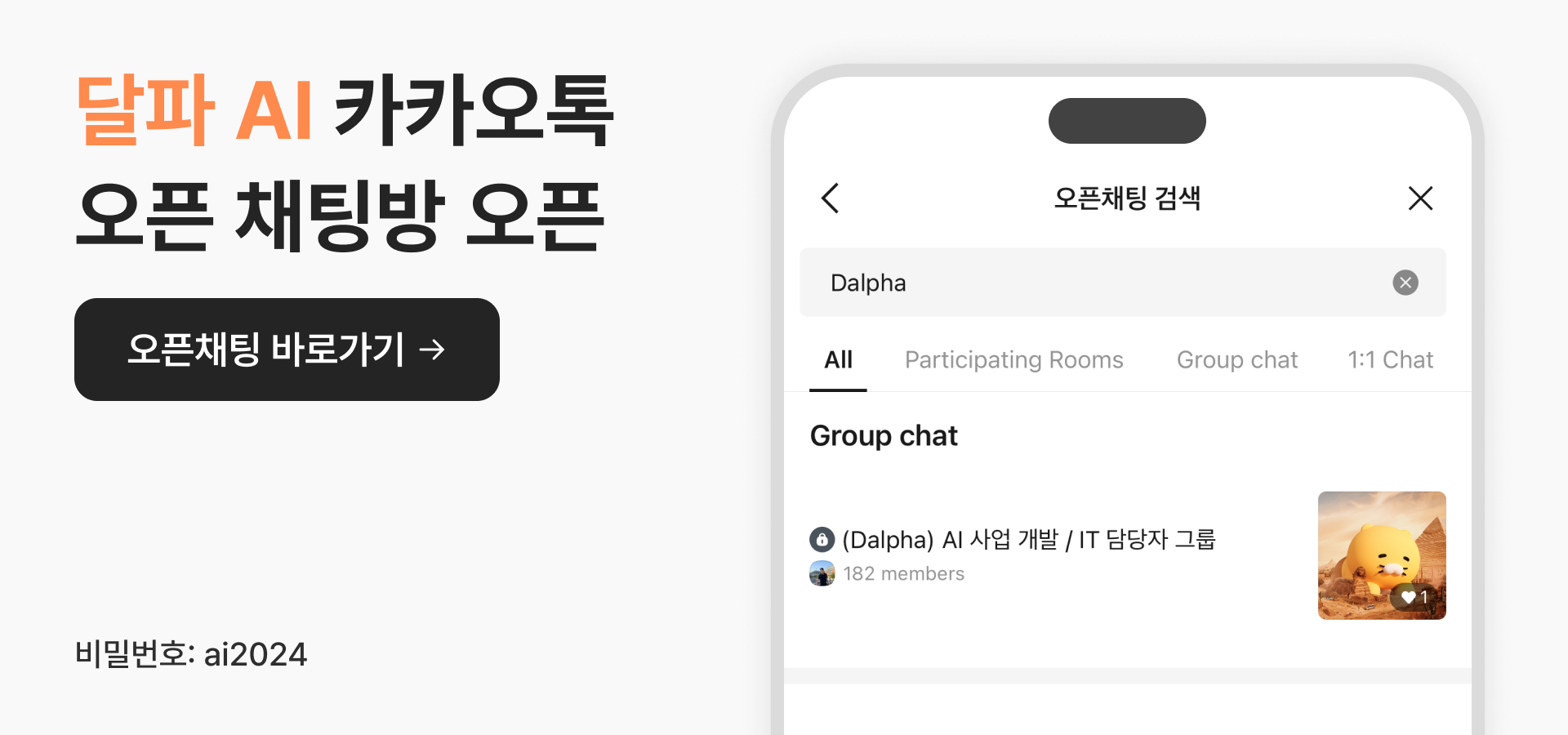
Link : https://lnkd.in/gawYdRBq
Password : ai2024
Curious about which tasks you can automate?
At Dalpha, where AI experts gather, we offer free AI consulting. We'll consult on the AI that's just right for your company and build a solution. Leave us your questions.
We'll get back to you within 10 minutes! ?

kyungsuk chon