AI — So, How Far Has It Come?
Everyone's doing AI these days, and they say the pace of tech advancement is fast —
but do you know exactly how fast it's advancing and what technologies are coming out?
What exactly is AI?
How far can AI go?
As a member of the Sales team, these are the questions I hear most when I meet with clients.
So just how far has AI come now, and how much has it advanced?
Let's find out together!
What is CES?
CES, held in Las Vegas, USA from January 9–12, recently wrapped up to great success.
CES (Consumer Electronics Show) is the world's largest IT & home-electronics exhibition.
Companies across a total of 45 categories — including artificial intelligence, AR/VR, blockchain, fintech, IoT, and more — take part.
This year's CES 2024, held in Las Vegas, drew 4,124 companies.
The Consumer Technology Association (CTA), which hosts CES, each year selects innovative products and services set to lead the future market and awards the CES Innovation Award.
This award is 'CES's highest honor' — that's what it's called.
This year, 379 products from 313 companies across 28 fields — AI, Digital Health, Smart Cities, Robotics, and more — were selected as Innovation Award winners.
Shall we look together at some interesting products that won an Innovation Award in the AI field?
AI Gun Detection System by Bosch

The first is Germany's Bosch Group's world-first Gun Detection System.
Germany's Bosch Group is the world's No. 1 auto-parts maker — a global company that, as of 2019, employed about 400,000 people worldwide with total revenue reaching about 111 trillion won.
The technology this auto-parts maker unveiled is a system that detects firearms based on video and audio AI.
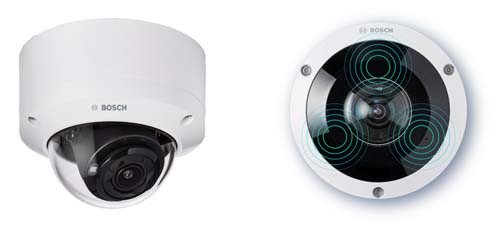
When an armed intruder breaks in, the AI gun-detection security camera detects it.
It then automatically sends a signal to the safety manager and, through audio AI, detects various sounds including gunshots to track the intruder's movements.
In addition, the AI automatically files a report to the police, guides students along evacuation routes, and activates an automatic open/close system that can block the intruder's escape.
In the U.S., an average of 133.8 people die from gun incidents each day. They say the number of gun-incident deaths per year (about 48,000) is greater than the number of traffic-accident deaths (about 45,000).
The most important, central topic at this year's CES was, 'how can cutting-edge technology like AI be used to solve humanity's many hard problems.'
Bosch Group's AI gun-detection system, which gave a clear answer to this question, was selected as the best technology in the 'Human Security for All (HS4A)' category.
Source: U.S. Centers for Disease Control and Prevention (CDC)
AI Flood Alert System (WaterAI) by JJNET Co., Ltd.
Among humanity's many hard problems, one that can't be left out is the environmental issue caused by global warming.

Due to climate change, flash floods are occurring all over the world, and in the U.S. the resulting damage approaches 32 trillion won.
According to the Korea Meteorological Administration and the APEC Climate Center, after the 2060s, Korea's heavy-rainfall amount could increase by more than 70%.
There's a company that developed an AI that can warn in advance of floods caused by such climate-change-driven heavy rain.
It's JJNET Co., Ltd..
JJNET, an AI specialist in the disaster-safety field, developed WaterAI as a national project with the National IT Industry Promotion Agency, the National Information Society Agency, and the Gyeonggi-do Business & Science Accelerator.
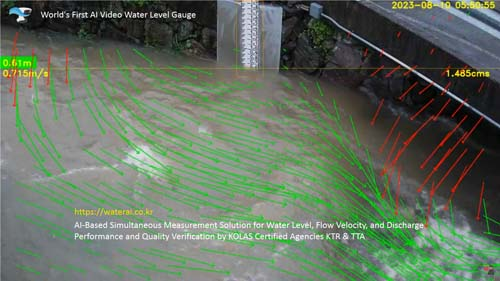
WaterAI is a system in which, through CCTV video information and deep-learning technology, AI assesses the flood-risk level and can automatically issue an alert.
Beyond this, AI uses external agencies' weather-related data to identify flood-related risks and automatically controls access-control barriers and floodgates to prevent the dangers of flooding.
Not only can it measure water level, flow velocity, and flow rate simultaneously from video alone, but it overcame the previously noted limits of measurement speed and the need for water-level sensors with AI trained on some 380,000 images.
Beyond man-made disasters, AI that can also prevent and prepare in advance for natural disasters is arriving.
AI Smart Mirror (BMind) by Baracoda Daily Healthtech
Have you heard the phrase 'mirror of the soul'?
Not as a figure of speech — a mirror that can actually look into the soul has appeared.

As people are exposed to various stresses amid the complex living environment of modern society, mental illness has become a rising headache for modern people.
France's Baracoda Daily Healthtech developed this AI smart mirror.
Using computer vision and a large language model (LLM), it interprets expressions, gestures, and language, and, matching the user's energy level, responds through light, sound, and display to help the user feel at ease.
The AI adjusts the lighting to the user's mood and even provides meditation coaching to help improve a depressed user's mood.

Baracoda has also drawn attention in recent years by showcasing innovative health-tech products at CES.
A real-time health-tracking watch strap that needs no charging; a bathroom mat that measures your weight and body balance the moment you step on it, warning an elderly grandmother of fall risk and a middle-aged couple about spine health — like this, it tackles modern people's interest in health technically, through AI.
Pet Heart-Health Monitoring AI (Minitail) by Invoxia
Not only modern people's mental health, but even pets' health, AI is now watching over.
According to global market-research firm Euromonitor, the pet population in 60 major countries worldwide was 1.87 billion as of 2020, and about 67% of all U.S. households keep a pet.
Accordingly, AI is being adopted in the rapidly growing pet-conomy industry too. It's France's Invoxia that showcased it at CES — Minitail.

This product is a wearable device that, equipped with Heartprint Technology for heart-health monitoring and real-time GPS location tracking, can track dogs' and cats' health and location through AI.
The patent-pending Heartprint technology can measure pets' breathing and heart data with 98% accuracy and provide heart-health monitoring.
Using AI developed in collaboration with Cornell University, it detects atrial fibrillation — an arrhythmia that is common yet very dangerous in pets.
In closing
We've looked at how far AI has technically advanced, through the products that won Innovation Awards at CES 2024.
Unlike the frightening way it's depicted in sci-fi films, AI is a big help in solving humanity's many hard problems and driving progress.
Many people still feel that AI — which is gradually melting into our daily lives like this — is difficult and far away.
Amid the rapidly growing AI market, Dalpha will, until the day every company can quickly and easily encounter, understand, and adopt AI, do its best at the forefront of this market.
Thank you for reading.
Dalpha Blog