From Manual to AI: A Beauty Brand’s Transformation Case
In previous articles, we shared how consumer brands can leap forward as more innovative companies.
In this article, we will look closely at a real case from beauty brand K, which worked with Dalpha, and explore how a similar approach can be applied to your organization.
Beauty brand K’s Monday morning meetings always began in much the same way.
“Why is this data missing from the sales performance report?”
“How is inventory looking this month?”
“Why did the last campaign perform so differently across channels?”
There were many questions, but no clear answers.
Each team came with its own materials, and a few Excel files were always open in the middle of the meeting room.
By the time the meeting ended, the conclusion often sounded like this.
“Let’s go with this for now.”
[1] The reality brand K faced: scattered data and inefficient decision-making
From the outside, brand K looked like a company growing at explosive speed.
It launched new beauty products steadily, and active marketing had built strong awareness.
Inside the company, however, the reality was different.
“Why is decision-making always difficult when we have so much data?”
The biggest issue was that teams kept making decisions from different datasets. As a result, the company was being run in an ad hoc way.
The person in charge of new product planning wrestled with the same concern every time.
They reviewed market reports and trend materials, but when the moment came to decide whether to move forward with a product, the decision always became cautious.
The operations team faced an even more complicated situation.
Inventory was scattered by SKU, and the next marketing schedule could only be confirmed by messaging the marketing team.
The marketing team was frustrated as well.
The last influencer campaign had clearly worked, but when asked to explain why, the answer became vague.
“This influencer seemed to do a good job.”
“Maybe the content timing was good too...”
The problem was not that anyone was working carelessly.
The team’s judgments simply were not connected to one another.
That meant brand K’s biggest challenges were to:
integrate scattered data so teams could see it in one place, and
use that integrated data to help each department make decisions more efficiently.
So how did all of this become possible, and what changed as a result?
[2] The first change: integrating fragmented data
Brand K’s problem was not a lack of data. It was that the data was not connected.
Sales data lived in the ERP, inventory data in the WMS, and marketing performance across individual platforms. Each department made decisions based only on the numbers it could see.
Answering a single question meant moving across multiple systems and stitching together Excel files. That had become routine.
The direction brand K chose was not simply to load more data into a database.
The key was to reconnect the data around how the brand actually makes decisions.
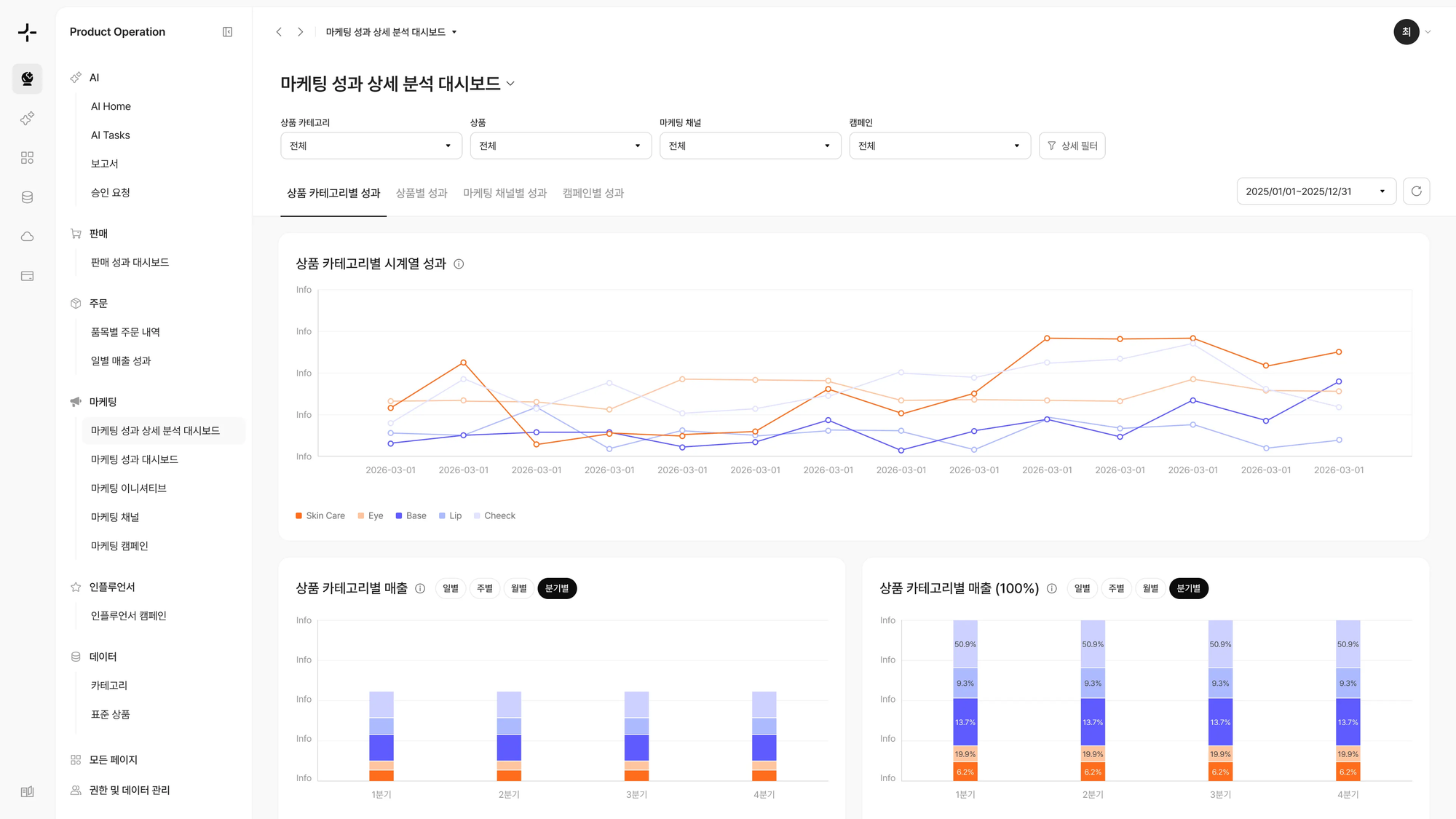
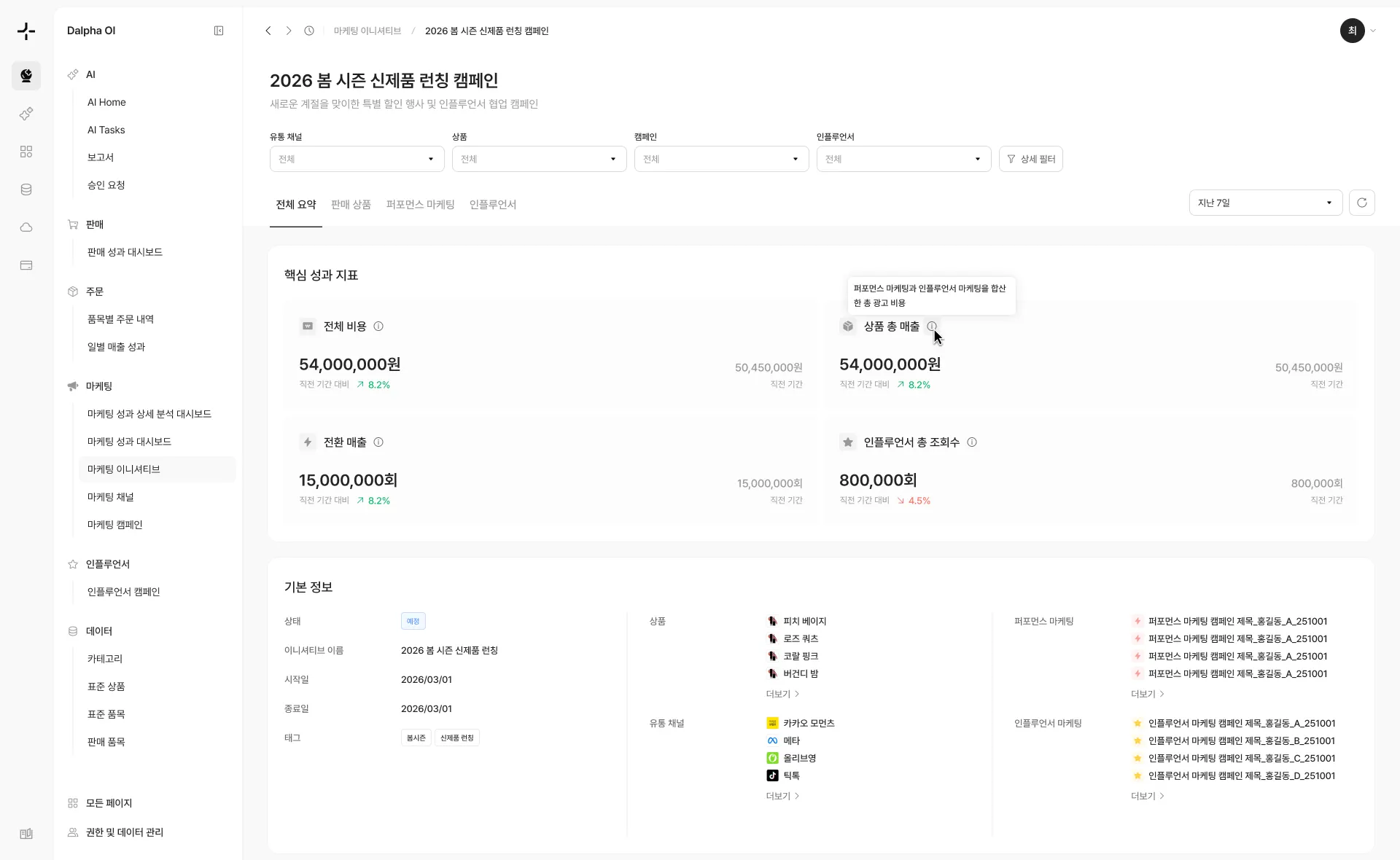
The company redefined its structure so product, inventory, sales, and marketing could be understood not as separate numbers, but as one connected context.
For example, sales volume was no longer treated as a standalone revenue number. It was connected to marketing execution → customer response → inventory depletion speed. Inventory was no longer interpreted as current stock alone, but as quantity viewed through future demand and lead time.
Once the meaning and relationships between data were organized, AI gained a structure that could explain why outcomes happened, rather than merely showing individual metrics.
After this change, brand K’s data stopped being numbers for reporting and started functioning as a language for decision-making.
That became the starting point for innovating ordering strategy, marketing operations, and more with AI.
[3] The second change: maintaining the right inventory level
Once data was connected into one flow, the first area the brand revisited was inventory.
For a beauty brand, inventory management was especially important. New product cycles are short, trends change quickly, and SKUs can increase rapidly by color, size, and lineup.
The old ordering process was relatively simple, but it created real problems.
Quantities were set based on past sales and a sense of “this should be safe.” Marketing schedules and influencer collaborations, which had a major impact on brand K’s inventory, were often considered only after orders had already been placed.
As a result, some products sold out immediately after marketing campaigns, while others received weaker-than-expected responses and remained as long-term inventory.

AI-based order quantity optimization changed that process. Instead of looking only at past sales, it introduced a more advanced way of making the decision.
It considered product-level sales velocity, seasonality, promotion plans, influencer content exposure timing, and the time required for inventory to sell through.
One particularly meaningful shift was that the criteria used at the moment of placing an order changed.
Orders were no longer based on “how much has sold,” but on “when and why this is likely to sell in the future.”
As a result, brand K was able to create a more stable balance between stockouts and excess inventory.
[4] The third change: restructuring influencer marketing
Once the ordering process became more stable, brand K began redesigning influencer marketing, an area that had long been one of its greatest strengths and yet one of the most intuition-driven parts of the business.
Previously, influencer marketing depended heavily on the manager’s know-how.
The team repeatedly searched for a limited pool of influencers by hand, selected them based on follower count and past collaboration examples, sent DMs, and organized the results.
The problem was that this process required significant time and effort, while making it almost impossible to predict actual performance in advance.
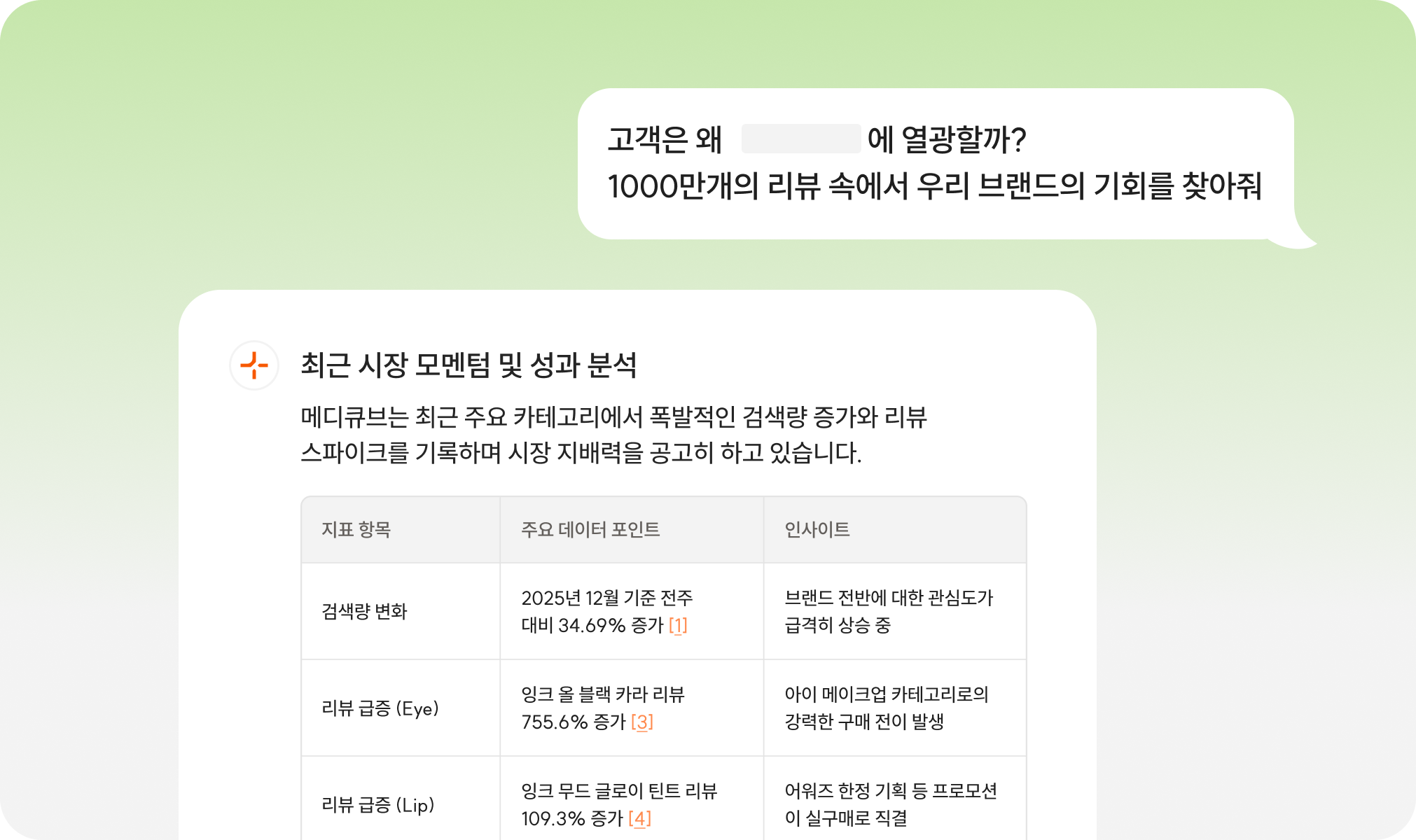
With AI, the structure changed completely.
AI collected a broad pool of influencers from social platforms, analyzed content topics, engagement, and follower response patterns, and selected influencers whose style matched the brand’s products.
At the content planning stage, it also analyzed high-performing past content structures and messages, then proposed content synopses based on which points had driven stronger responses and even predicted expected reactions.
DM sending and follow-up communication were automated, allowing the manager to focus on comparing performance and adjusting strategy instead of repetitive work.
Influencer marketing was no longer an intuition-led attempt. It became a system operated through data and prediction.
[5] The change that numbers alone cannot explain: innovating how the brand operates

After adopting AI, the biggest changes at brand K were that the team could:
make better decisions based on data, and
explain why those decisions were made.
In the past, a good sales result was remembered as a good decision, and a poor result as a disappointing one.
But the reasoning behind those judgments often depended on individual experience and instinct.
Once data was integrated and AI began supporting decision-making, the team could discuss decisions based on expected scenarios and evidence.
Performance also became learning data for the next strategy, and operations grew more precise over time.
Most importantly, people’s roles changed.
Freed from repetitive organization and judgment work, team members could spend more time on strategy and direction.
Ultimately, the real meaning of adopting AI was not simply better numbers. It was that the way the brand works had evolved by one level.
Every brand faces a different situation and operates in a different way.
For some brands, the core issue is inventory. For others, it may be the structure of marketing.
What matters is not copying a fixed answer, but designing AI in a way that fits the flow of your own brand.
Talk with Dalpha about how your brand can transform the way it operates.

Yongchan Park