Only Analyzing Ad Click-Through Rates? The Data That Truly Grows a Brand Is Somewhere Else
📊 Now It's Time to Analyze Customer/Product Data
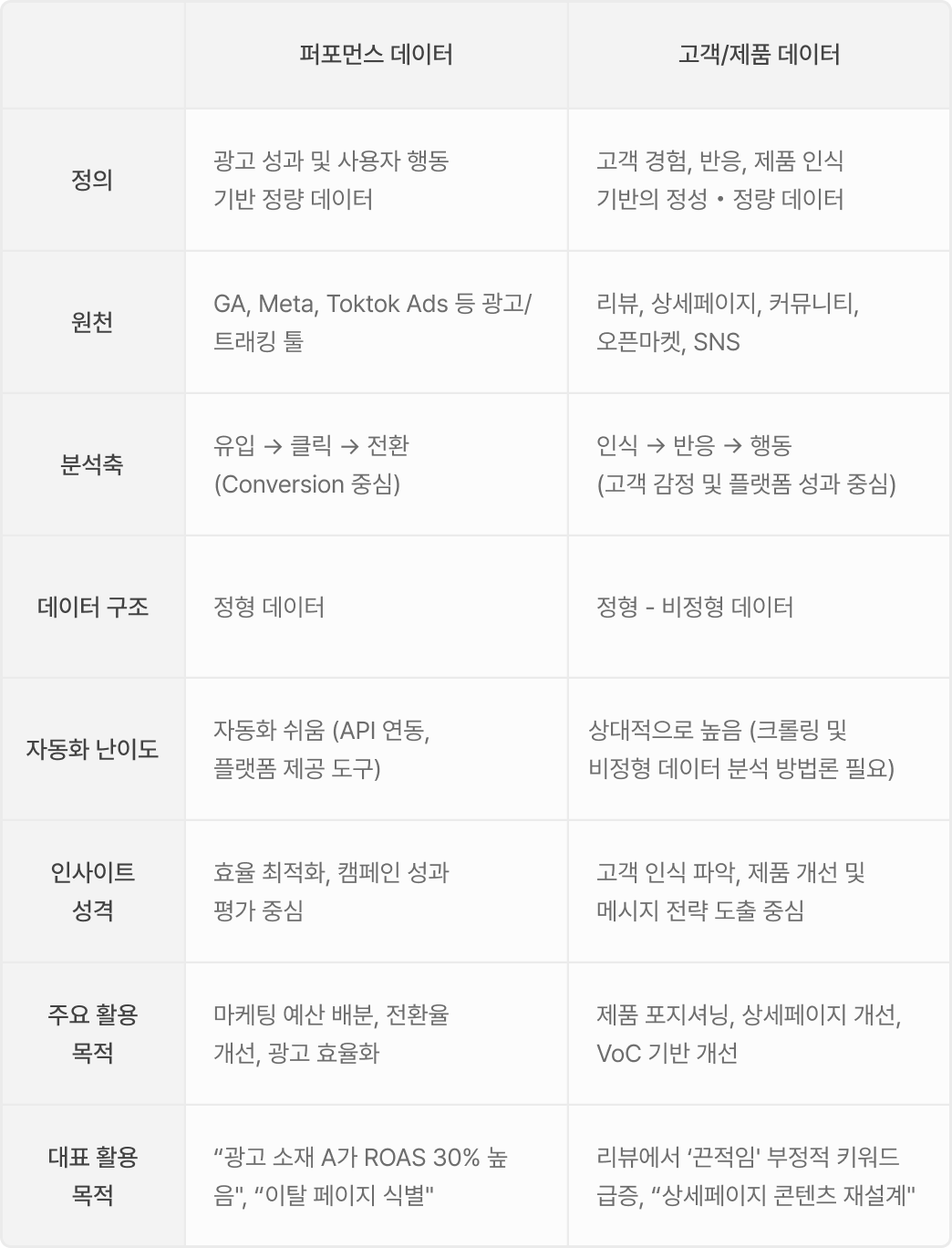
Everyone knows how important data analysis is for a brand's growth. Many brands analyze performance data such as ad click-through rates and GA data.
But is analyzing performance data alone enough? The 'reason' a brand grows doesn't come from performance data. To find out why a brand succeeds or fails, you need to analyze customer/product data.
Customer/product data is data that captures customers' experiences and reactions, as well as their perceptions of a product. For example, this includes the "disappointing points" buried in the reviews customers leave, the real assessments they mention when comparing our product with competitors' products, and the rapidly shifting trends and reactions in the market.
In truth, analyzing customer/product data isn't easy. That's because it isn't a matter of simple number-crunching—it's hidden inside unstructured data like customers' words and images. To analyze it properly, you need a system that collects and interprets diverse data such as reviews, detail pages, and social media content in an integrated way.
Fortunately, as AI has advanced, this difficult task has become much easier.
In this article, we'll walk you step by step through how brands can collect and analyze customer/product data.
Learn how to make key decisions—product improvements, positioning, detail-page content strategy, and more—based on the real voice of the customer. 🚀
🔍 Customer/Product Data Analysis Starts With 4 Types of Data
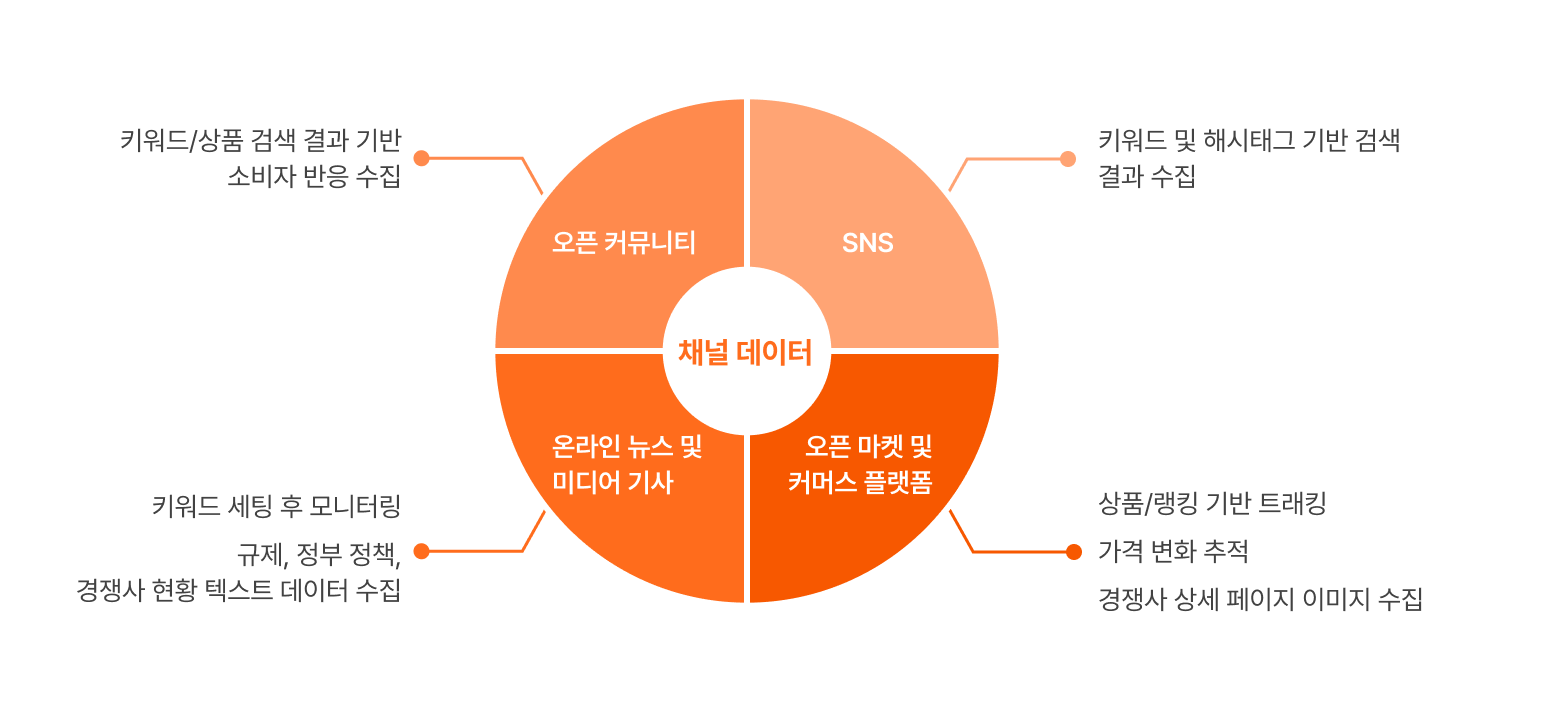
Customer/product data can mainly be collected from four external channels that capture 'real customer experiences': social media, communities, news, and open markets.
Below, we've organized the representative insights you can gain from each channel and the ways to collect them.
1. Social Media Data
Social media channels like Instagram, TikTok, Threads, and X are spaces where consumers' spontaneous reactions appear in real time. Through hashtags, comments, likes, share counts, and reactions to influencer content, you can quickly capture trends.
💡 Insights you can gain:
Track consumer reactions to influencer seeding campaigns in real time
Improve content strategy by analyzing the characteristics of and reactions to each piece of content
Set brand positioning direction by analyzing changes in mention volume for your own brand and competitors
🔎 Representative collection methods:
Manual method: A practitioner directly visits the website to copy and organize the information they need. It can serve as a supplementary approach for quickly grasping trends or gathering reference data. However, the volume and quality of data are limited, and errors are more likely to occur.
Using official APIs: Through APIs provided by some platforms, you can systematically call and automatically collect data—making this suitable for regular data accumulation and building an automated analysis environment.
Direct crawling: This method uses a self-developed program to automatically navigate web pages and collect the data displayed on screen. Its collection scope is the broadest and most flexible, enabling multidimensional market analysis not only of your own brand but also of competitors, categories, and keywords.
2. Open Community Data
Blogs, cafés, and online communities are channels where consumers spontaneously share their experiences and opinions without any advertising or marketing intervention. The posts and comments collected here provide more realistic and honest feedback about brands and products. You can gain insights that are hard to capture with quantitative data—shifts in mindset before and after purchase, repeatedly mentioned complaints, and user-perspective product comparisons.
💡 Insights you can gain:
Diagnose unconsciously formed consumer perceptions and brand positioning
Reflect fresh expressions in your marketing messages
Deeply understand the context of customer needs and complaints through sentiment analysis
🔎 Representative collection methods:
Manual method: Monitor directly and organize the data.
Direct crawling: Crawl community reviews and the like to analyze product perceptions or grasp trends.
3. Online News and Media Articles
Online news and media content are materials that reveal the larger flows of the market and industry. By checking competitors' coverage, industry trends, and regulatory issues, you can grasp where your brand stands now and what you need to prepare for next.
💡 Insights you can gain:
Respond proactively to industry regulations and trend changes
Analyze and benchmark competitors' messages and strategies
Measure PR performance and prepare crisis responses by analyzing your own coverage volume and tone
🔎 Representative collection methods:
Manual method: Find, copy, and organize the information you need yourself.
Direct crawling: Crawl news and media articles directly to collect and analyze large volumes of text data.
4. Open Markets and Commerce Platforms
Open markets (Coupang, 11st, etc.) and commerce platforms are the channels where you can most objectively confirm how your brand is being evaluated in the market. Prices, reviews, ratings, discount histories, and detail-page layouts are all results of accumulated interactions between consumers and the brand.
💡 Insights you can gain:
Compare detail-page layouts and messaging strategies between your own brand and competitors
Collect review-based feedback and derive directions for product improvement
Analyze timing-based data such as discount timing and changes in review counts
Identify your market position—popularity ranking within a category, market share, etc.—and make decisions
🔎 Representative collection methods:
Manual method: Find, copy, and organize the information you need yourself.
Using a platform business center/data center: Through the business centers provided by major platforms, you can download data related to your own brand. The accuracy and stability of this data are high.
Direct crawling: Crawl open-market detail pages and reviews to analyze product perceptions or track market changes.
📊 2 Ways to Analyze Customer/Product Data
Once you've collected your customer/product data, now it's time to analyze it.
Customer/product data is different from performance data, which consists solely of numerical (structured) data.
It's a mix of numbers (structured) and text and images (unstructured).
Therefore, you need to apply structured-data analysis and unstructured-data analysis methods separately.
1. Structured Data Analysis: Reading Flows and Causality Based on Numbers
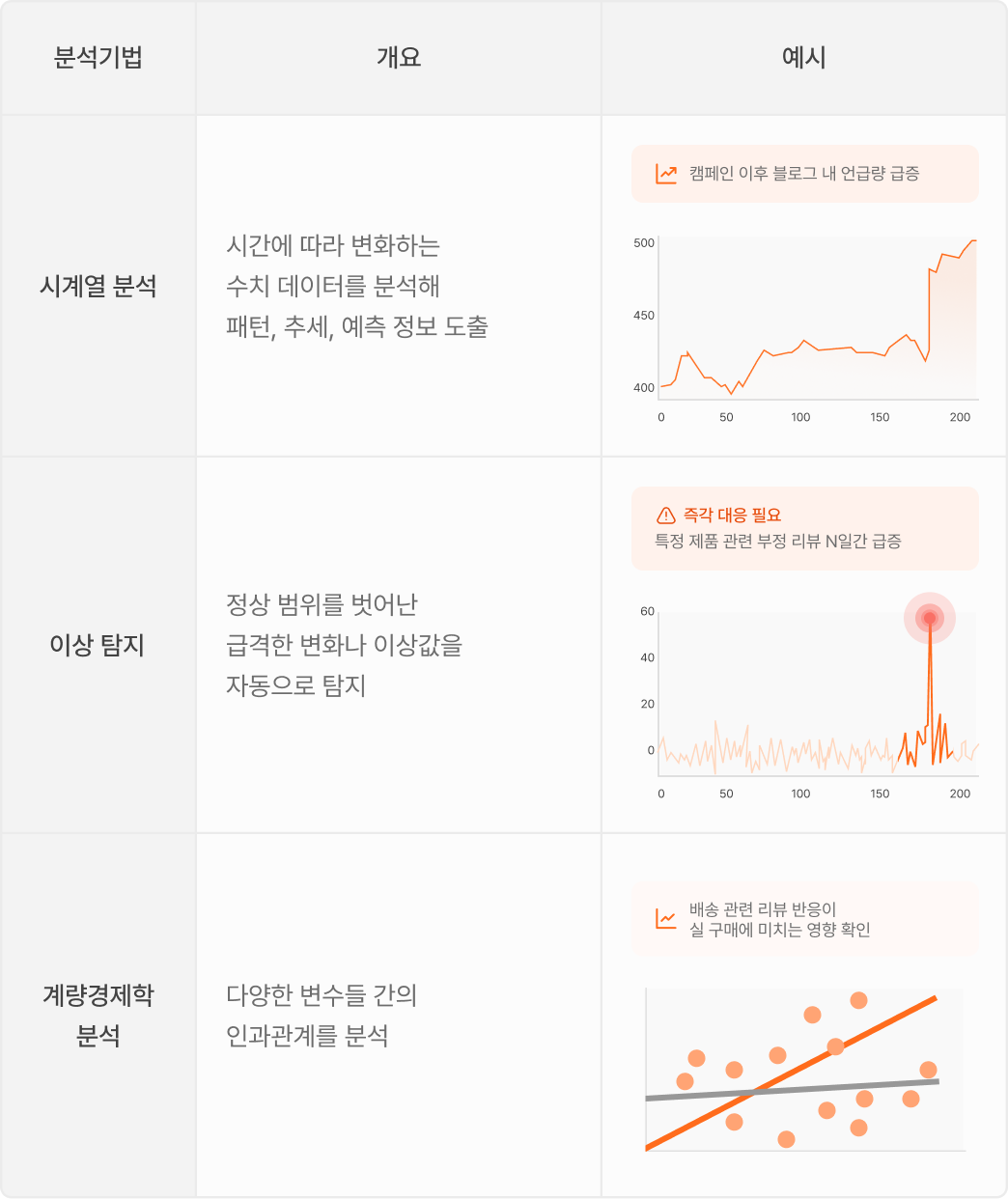
Structured data is numerical data organized in table form, such as review counts, click counts, purchase rates, and conversion rates. Brands generally use it when verifying hypotheses based on values that change over time or by certain criteria. When analyzing this kind of data, you'll mostly use statistical techniques or mathematical models. Here are the representative methodologies.
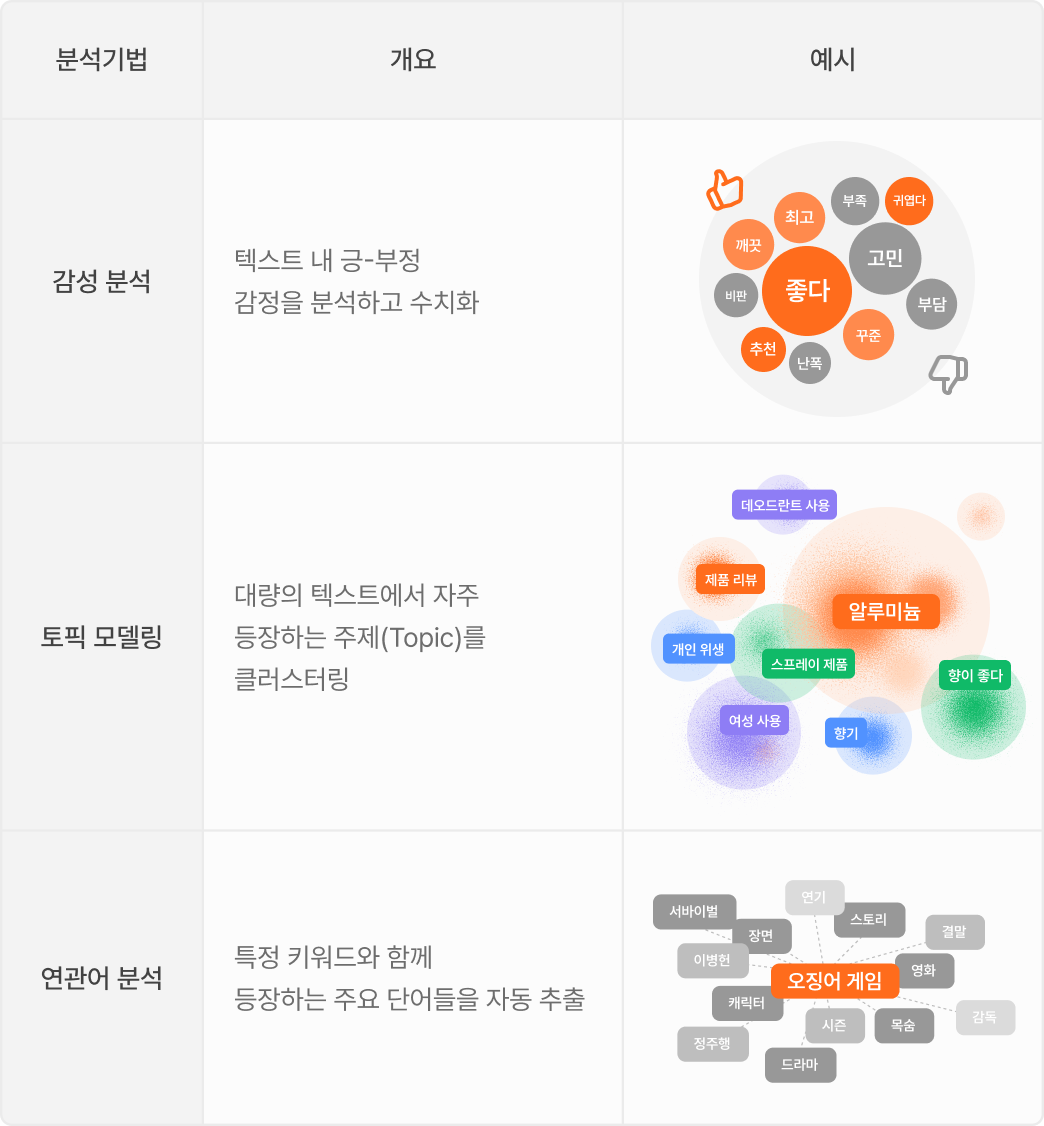
2. Unstructured Data Analysis: Quantifying Emotion and Context
Unstructured data is data with no fixed format or structure, such as text, video, and sound. Its defining trait is that it isn't easily divided into rows and columns and has no consistent schema—reviews, comments, photos, videos, voice, and other things that carry qualitative context. To analyze this data, AI goes through an 'Embedding' process that converts text or images into quantitative values a computer can recognize. After that, it can extract meaningful insights with AI through various analytical methodologies. For example, related-word analysis is possible, which automatically extracts the main words that appear alongside a particular keyword.
3. Turning It Into Reports With AI
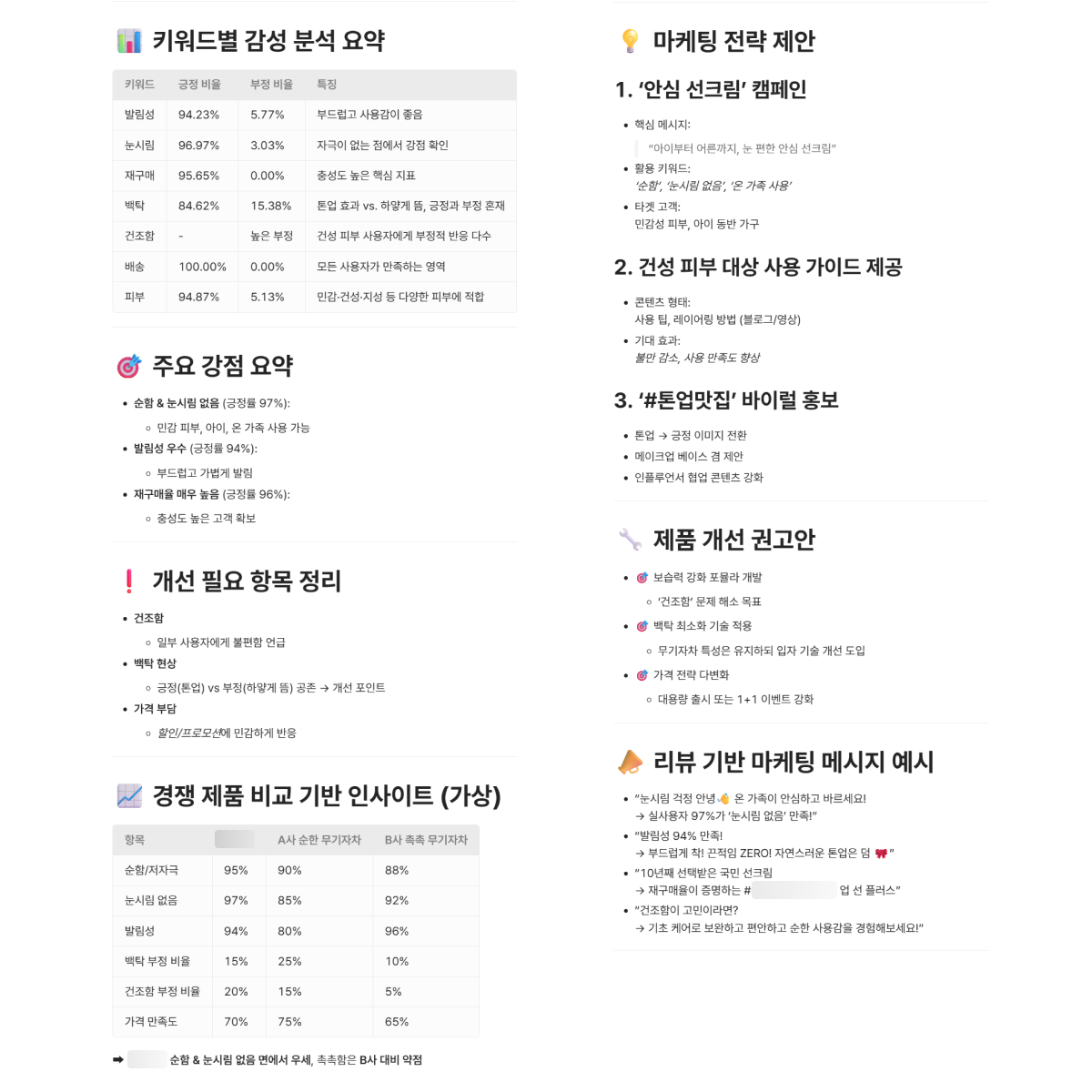
For analysis results to actually impact the business, they need to be processed into a form that decision-makers can quickly understand and immediately put to use.
Try creating reports with AI. Beyond simple numerical summaries, AI can even generate reports that interpret context and suggest strategic judgments.
Since the approach differs for each type of data, keep these four general points in mind as you create your reports.
Structuring the prompt
Logically designed instructions tailored to the analysis goal, not just simple questions
Data integration
Accurately linking the necessary filters and formulas so the LLM interprets within the correct scope
Designing for context comprehension
Generating responses that reflect the meaning behind the numbers, the brand's perspective, and existing history
Automating report composition
Document automation that includes summary comments, data visualizations, and key insights
💡 Take a Look at 3 Representative Use Cases
Through three representative use cases, take a closer, more concrete look at how you can leverage customer/product data.
Korean Beauty Brand G
After launching a new product, Company G wanted to pinpoint exactly what consumers actually felt were the strengths of its products.
Through AI-based review analysis, it gained the insight that 'color' and 'spreadability' were receiving overwhelmingly positive evaluations compared to competitors.
In response, to highlight those strengths, Company G partnered with influencers to intensively produce viral content centered on 'skin-finish Before/After,' and planned a 'blind test (comparing spreadability with eyes closed)' campaign—achieving a significant increase in brand mention volume and campaign participation rates on social media.
Mid-Sized Domestic F&B Company K
Company K was preparing an influencer seeding campaign as it launched a new health functional food.
Noting that the industry had recently been trying various campaign approaches—'characters,' 'AI models,' 'real influencers,' and more—Company K wanted to objectively verify the actual effectiveness of each approach.
After analyzing social media and community data with AI, it confirmed that a seeding campaign using a 'character' delivered the highest effectiveness in terms of consumer reaction and brand preference compared to other approaches. By intensively producing character-centered content, it was able to significantly raise product awareness and the sales conversion rate.
Domestic Fashion Retailer H
Company H was seeking points of differentiation from powerful competitors in Korea's outdoor fashion market.
Through AI-based data analysis, it consistently tracks competitors' weekly new-product launches along with those products' reviews and community-mention data.
In particular, it compares and analyzes customer reactions to 'size' and 'fit' by its own brand and by competitor, striving to reflect them in product improvements and detail-page messaging during strategy/planning meetings.
Clear results haven't yet become visible, but the company continues with practical, data-based execution to gradually raise customer awareness.
📚 Start Analyzing Customer/Product Data Right Now.
So far, we've looked at the customer/product data analysis methods essential for brand growth, along with real application cases.
Customer/product data analysis is now an unavoidable core of competitiveness.
Visit the page below to find information that helps with more concrete own-brand/competitor comparisons, trend diagnostics, and more.
Get the Brand Data Insight Report 2025
Get a free demo
Get a free 1:1 consultation with an expert who will help analyze your brand's customer/product data
Secure your competitive edge now with a forward-looking data strategy and practical ways to put it into action.
Dalpha Blog