4 Ways to Advance Education Services with AI: Tailored Course Recommendation, Tutoring Chatbot, Competency Assessment, and Course Search
How are you solving the chronic problems education companies face?
If you run an education service, you've probably had concerns like these at least once.
You want to suggest the perfect course for a learner, but there are so many courses that recommending isn't easy.
You want to help learners quickly find the course they want among hundreds of programs, but the search function is limited.
You need a channel where learners can immediately ask about things they don't understand during a lecture, but immediate response is hard in reality.
After education ends, you want to measure learning outcomes and reflect them in the next round, but existing assessment methods have limits.
These concerns are actually tied to the funnel stages of an education service.
Understand the funnel, and apply AI
An education service usually follows the flow of discovery → learning → post-completion assessment.
The problems mentioned above are also representative difficulties of these funnel stages.
Until now, improvement wasn't easy because of operational resources and technical limits.
But recently, you can improve these four much more efficiently through AI technology.
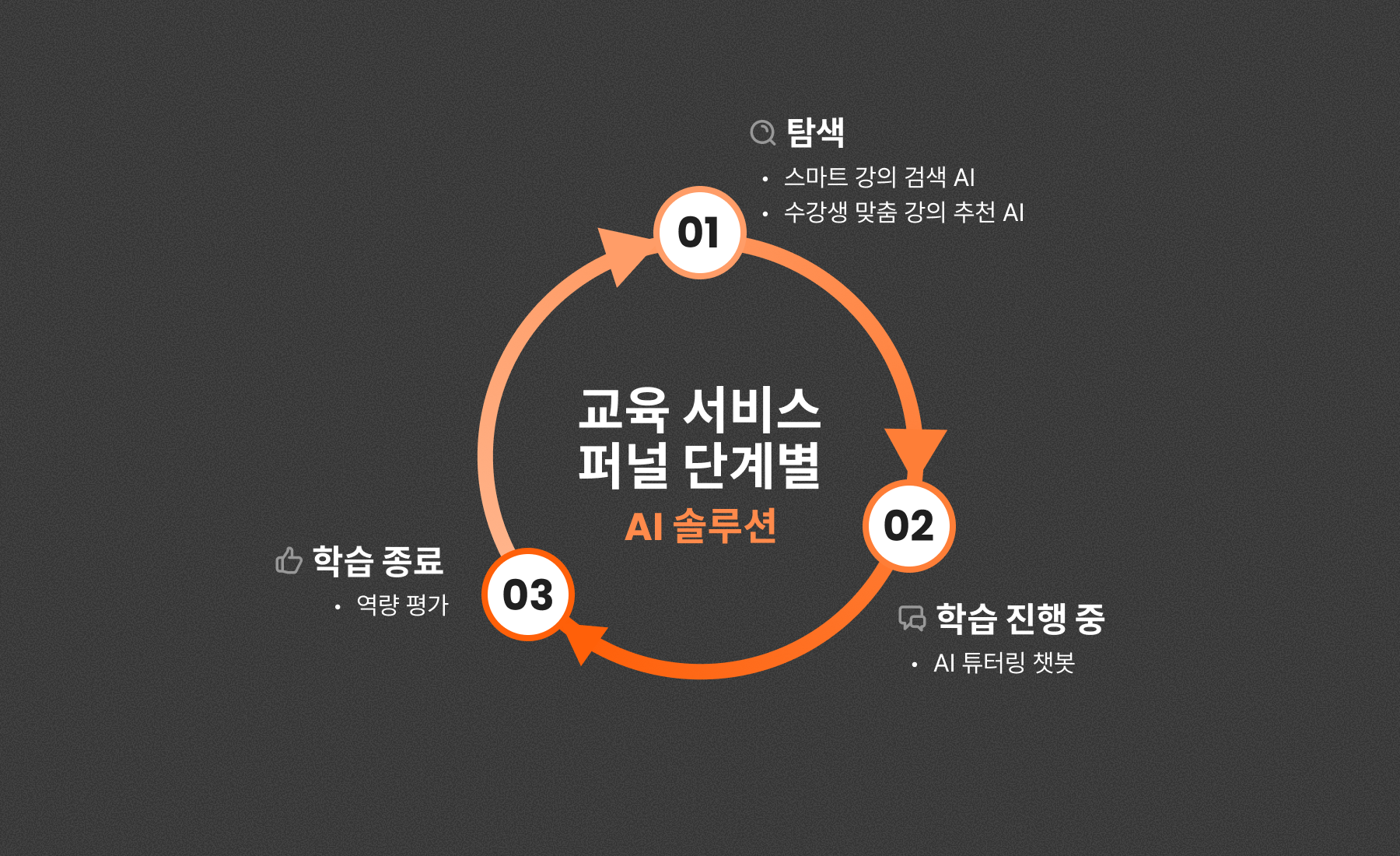
In the discovery stage, smart search AI helps learners easily and quickly find the course they want, and personalized recommendation AI proactively suggests courses matched to the learner's level and goals.
In the learning stage, instantly resolving where learners get stuck during a lecture, an AI tutoring chatbot raises learning immersion.
In the post-completion stage, competency-assessment AI lets you quantitatively evaluate the actual degree of learning. As this competency-assessment result is reflected back into the 'discovery stage', the learner gets recommended a next course matched to their level.
When you apply AI solutions at each funnel stage, the learner experience advances, and as a result learning efficiency rises and learner retention naturally improves.
Let's look at how real education companies are adopting these AI solutions, through 4 cases.
🎯 Solution 1: Learner-tailored course recommendation AI
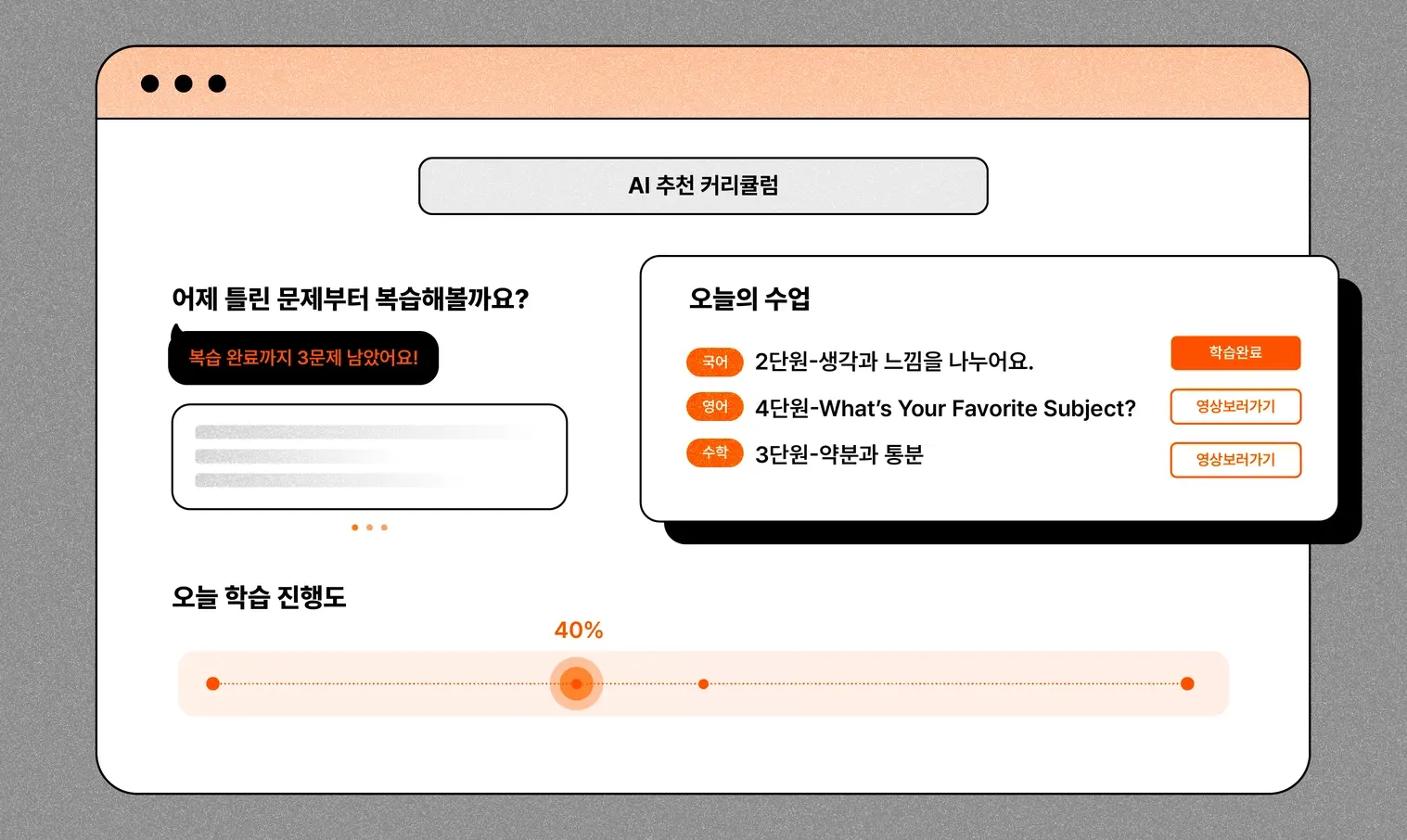
BEFORE: Learners can't get a grip on 'what to take'
Learners find it hard to find a course matching their situation and goals on their own.
In the end, they put off the choice, or take an unsuitable course and waste time and money.
In this process, learning motivation drops and outcomes fall short of expectations.
Burden of course selection: even with a long list, it's hard to judge which course fits you
Wasted learning opportunity: time/cost lost on unsuitable lectures
Mismatch with goals: lower outcomes because it doesn't match the learning direction
AFTER: Now, AI shows the 'perfect course' first
AI comprehensively analyzes the learner's history, interests, and learning patterns to recommend the optimal course.
Without rummaging through the whole list, you can see the right lecture right on the first screen.
Also, the recommendation list auto-updates based on the learner's progress and performance data, always providing the latest, optimal learning path.
Simplified selection process: check a tailored recommendation list with no complex comparison
Higher accuracy of the first choice: take a lecture matched to your level and goals from the start
Maintaining goal-centered learning: maximize outcomes with courses aligned to your direction
📌 Custom AI points
✔️ Recommendation-logic design optimized for the company's lecture categories/types
✔️ Based on a learner-classification system (interests, learning style, etc.), granular recommendation-criteria setup
✔️ When a new lecture is registered, automatic identification of suitable learners and notification sending
✔️ Considering the learner's enrollment history, similarity, and personal traits, recommendation-message generation
Real DALPHA case — e-learning specialist, distance-education institution
Before
E-learning specialist Company B tried to recommend courses by analyzing learner behavior data on its website, but the existing system only went as far as simple 'related-course exposure.'
Because the recommendation criteria were fixed, it was hard to reflect the latest courses or recent changes in learners' interests, and the recommendation-exposure area was also limited.
Also, because data collection and processing for recommendations were handled manually, the recommendation cycle grew long and the burden on operations staff was heavy.
After
Now, when a specific action (search, enrollment, material viewing, etc.) occurs, AI analyzes that learner's meta information and behavior patterns in real time to automatically recommend N courses.
The recommendation results are automatically reflected in various slots on the website (main banner, related-lecture area, My Page, etc.).
(1) By customizing recommendation logic per lecture type, it analyzes even content codes, course overviews, and keywords to provide tailored recommendations per education category.
(2) With granular recommendations per learner segment, by weighting recent behavior data, recommendations centered on the 'field they just showed interest in' became possible.
With this, the recommendation cycle shortened to real time, exposure opportunities for new and popular lectures increased, and the enrollment conversion rate improved greatly.
Learner-tailored course recommendation AI helps learners start learning naturally without dropping off at the first stage. It takes responsibility for the most important moment that opens the door to the learning journey.
🔍 Solution 2: Smart lecture search AI
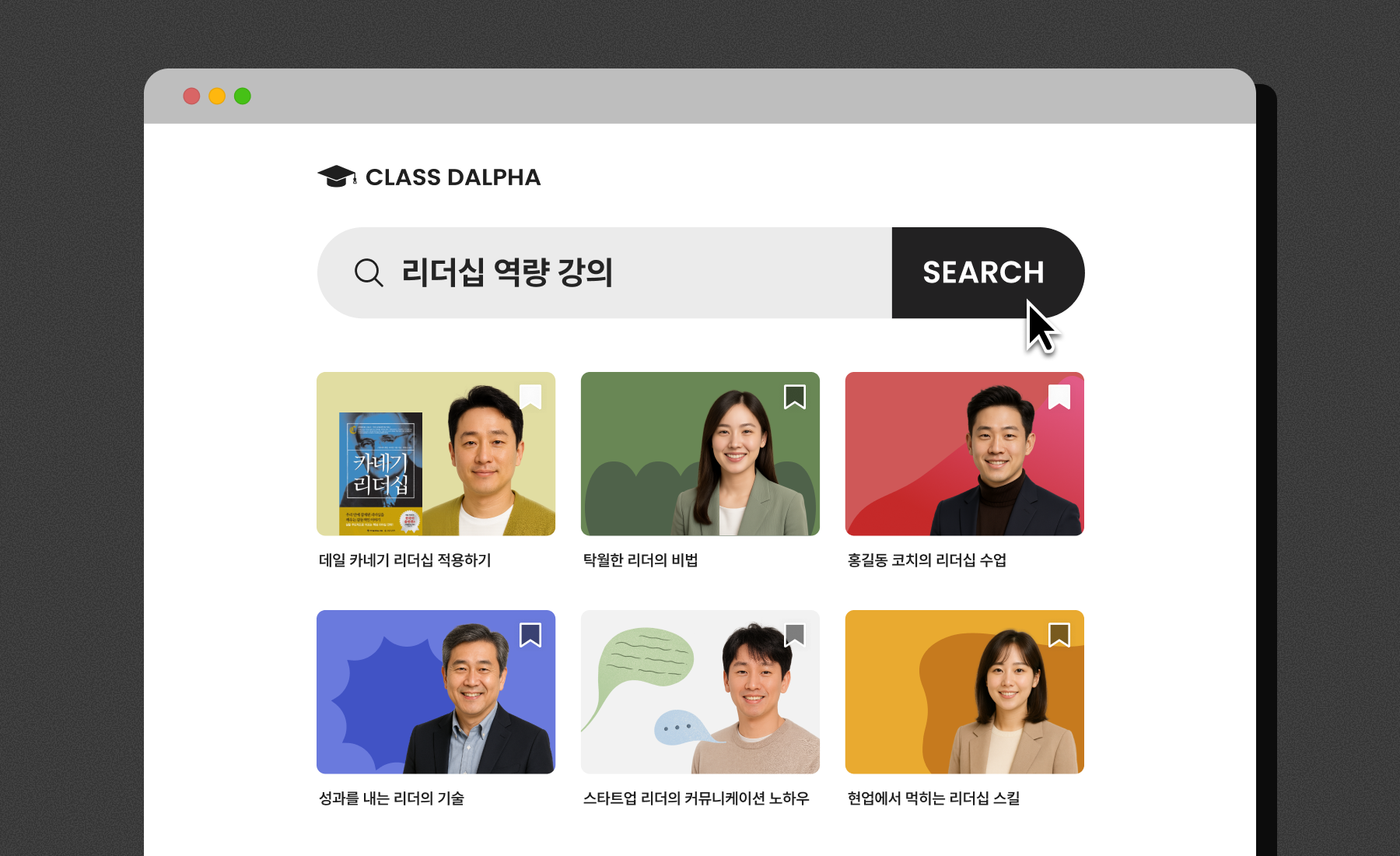
BEFORE: Searching by keyword alone makes it hard to find the lecture you want
Even with hundreds of lectures on an education platform, the search function is often simple or limited.
Building a traditional search engine is costly and the maintenance is burdensome, so many education companies have offered only minimal keyword search.
As a result, learners wander through several menus to find the course they want, and often miss beneficial lectures without finding them.
Hassle of course exploration: you have to move through menus and pages several times
Limits of simple keyword-centered search: with simple keywords, the lecture you want doesn't show up well
Loss of discovery opportunity: beneficial lectures get buried, losing enrollment opportunities
AFTER: Now, it finds suitable lectures even for a search like 'I want to build leadership'
AI-based search can be adopted at much lower cost than building a traditional search system, and delivers performance optimized for course search.
It understands not only simple keywords but also abstract requests like 'I want to grow my leadership skills — where should I start?', and selects lectures fitting that intent.
It also presents related courses along with search results, so learners can discover the 'course they need' quickly and broadly.
Shorter exploration time: check results right away with no complex menu navigation
Intent-based search: AI search that understands abstract, goal-oriented requests
Expanded discovery range: shows related lectures too, widening the range of choice
📌 Custom AI points
✔️ Based on the learner's enrollment history, priority exposure of tailored lectures
✔️ Fitting the company's education categories, dedicated filter configuration
✔️ Reflecting even typos and synonyms, search-optimization logic
✔️ For new/core courses, automatic application of priority-exposure rules
Real DALPHA case: AI lecture exploration (advanced course search)
Before
E-learning specialist Company C offered hundreds of courses on its online platform, but the search function stopped at simple keyword matching, making it hard for learners to find the lecture they wanted.
Specific but broad requests like 'Is there education that helps me prepare to expand overseas?' didn't return proper results, and searches with typos or synonyms almost always failed.
Because of this, learners often wandered through several menus, or left without finding the lecture they wanted.
They tried to build a dedicated search engine to advance search, but the development/operation cost burden was big, so the project was delayed, and minimal search was maintained without using existing data (course descriptions, keywords, video materials, CS data).
After
Now AI analyzes the entered search text and returns multiple courses with high semantic similarity.
It raised search accuracy by analyzing not only existing course names/overviews, but also lecture-video STT data and CS data.
(1) With intent-based search optimization, it understands abstract or wordy questions and recommends the most suitable lecture. For example, enter 'skills needed to prepare for overseas expansion' and lectures on import/export, global marketing, and local regulations are presented together.
(2) With cost-efficient search advancement, it implemented AI-based search at much lower cost than building a traditional large-scale search engine, and it auto-reflects whenever course data is updated, with no maintenance.
With this, learners find the lectures they need faster and more accurately, and the institution expanded exposure for new/popular lectures and raised the enrollment conversion rate.
Smart lecture search AI prevents learners from leaving because they can't find the lecture they want. By discovering the needed course at the start, the learning journey continues without breaking.
💬 Solution 3: AI tutoring chatbot
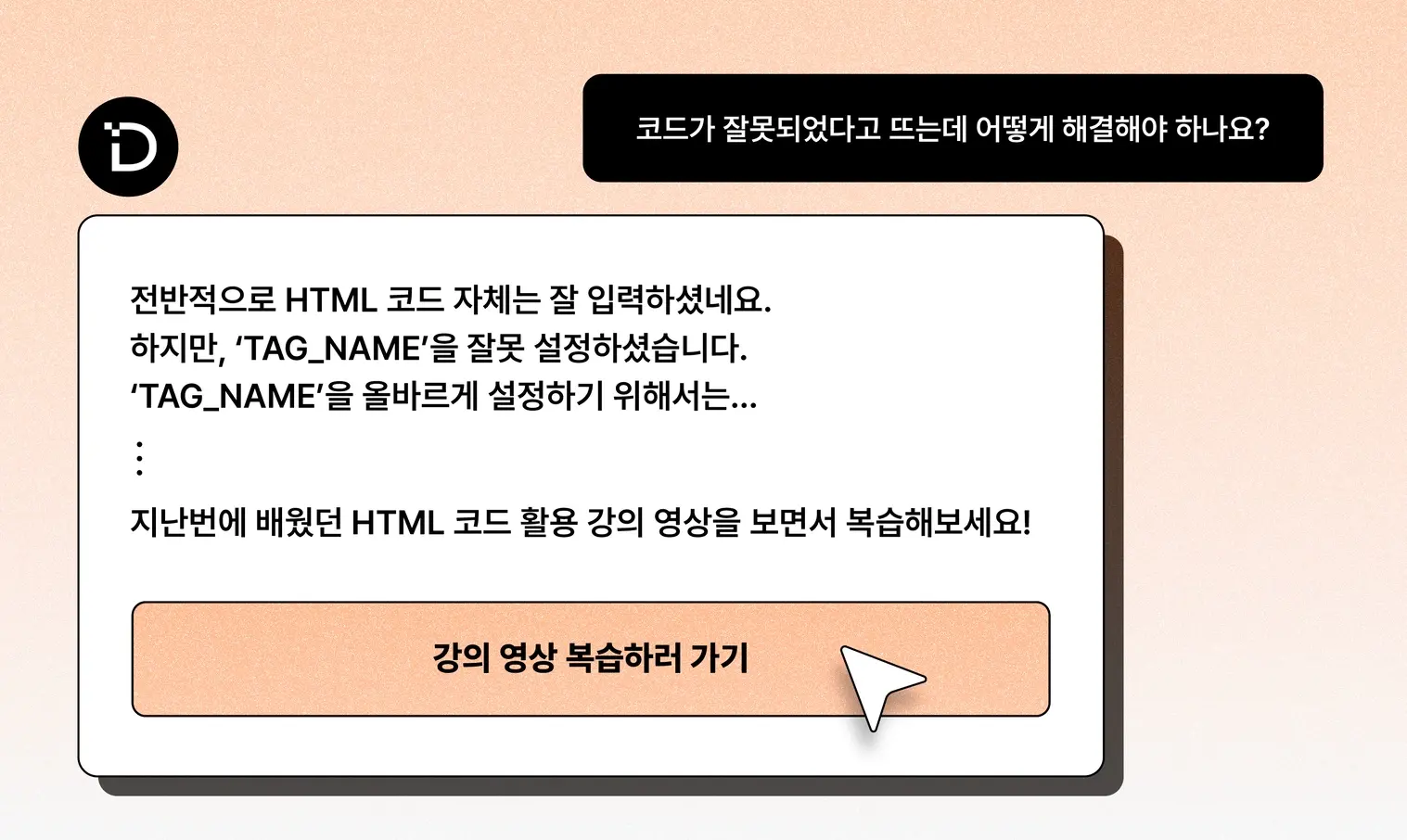
BEFORE: It's hard to resolve questions that arise during learning right away
In online/remote education environments, even when learners hit something they don't understand during a lecture, they often can't get an immediate answer. Meanwhile, learning motivation drops, and they move on to the next content with their question unresolved, lowering learning effectiveness.
For the operations team too, as identical or similar questions repeat, manpower has to be put in each time and response speed inevitably slows. Especially with limited operational resources, it's hard to respond quickly to every learner inquiry.
Learner-side problem – lower learning efficiency: focus and immersion drop while waiting for an answer
Operations-side problem – higher manpower consumption: resources wasted responding to repetitive inquiries
Variance in response quality: inconsistency because each person's answer speed/content differs
AFTER: Now, AI provides instant answers so you can get fast feedback
AI learns lecture materials, textbooks, and the Q&A database, and provides an answer immediately when a learner asks.
It guides simple definitions or fact checks right away, and for advanced questions it presents related materials and reference links too.
The operations team can break free from repetitive Q&A and spend more time on high-value work like tailored learning consulting or developing new courses.
Learner-side effect – maintained immersion: questions resolved in real time, so the learning flow continues
Operations-side effect – work efficiency: AI handles repetitive questions, easing the manpower burden
Standardized response quality: always fast, accurate answers by the same standard
📌 Custom AI points
✔️ Per-lecture/per-topic Q&A models run separately to maximize accuracy
✔️ Reflecting the company's exclusive education materials and technical terms into the knowledge base
✔️ Based on learning progress, accuracy rate, and question patterns, automatic generation of tailored feedback
✔️ Original lectures, lecture plans, teaching materials, and more — high-quality answers applying various types of learning materials
Real DALPHA case 1: AI tutoring chatbot for an elementary/middle-school workbook learning-management/recommendation service
Before
Company S, which runs a workbook learning-management/recommendation service for elementary and middle schoolers, found it hard to respond immediately due to operational resources, even when a student asked things like 'Recommend a workbook suitable for grade-7 math' or 'Tell me what I'll learn from this workbook.' From the student's side, delayed answers broke the learning flow, and they often wasted time and motivation by choosing a workbook unsuited to them. As such, important feedback for service growth wasn't delivered quickly, leading to much customer dissatisfaction, and response quality and speed were inconsistent.
After
AI analyzes the service DB and registered workbook data to provide tailored answers and recommendations immediately.
(1) Educational-milestone tutoring: presents the next learning step and goal based on learning level and history
(2) Workbook detail Q&A: guides core concepts, learning points, and even similar problems of the registered workbook
(3) Online-teacher tone & mood: friendly, encouraging conversation at the eye level of elementary/middle schoolers
With this, students keep learning even when stuck, and experience seamless tutoring from the first choice to the next step. On the operations side, repetitive-inquiry handling is automated, raising service satisfaction with stable quality and fast responses.
Real DALPHA case 2: AI tutoring chatbot for a design-career education platform
Before
Design-career education platform Company L offered various programs, but every time learners asked detailed questions during practice, the operations team or instructors had to answer directly.
Especially when finding how to use a design tool or re-locating example material in a lecture, learners had to replay the video themselves, and it took instructors a long time to find and deliver the relevant material.
Also, program recommendations or providing in-depth design knowledge were hard to handle in real time due to manpower limits.
After
With the AI tutoring chatbot adopted, learners can now immediately search and check a specific explanation or practice example within a lecture.
(1) By converting education videos to text via STT and turning them into a DB, when a learner enters 'show me the example for this feature again,' the explanation can be provided immediately.
(2) By analyzing education metadata, enrollment history, and similar-learner data, the chatbot recommends a personalized program in real time and even suggests external design-specialist content.
With this, learners check needed information immediately even during practice, and don't miss follow-up learning opportunities suited to them.
The AI tutoring chatbot gives an instant answer every moment a learner gets stuck. It helps keep the flow from breaking, making them continue learning to the end. Now every learner gets a 'personal tutor.'
📊 Solution 4: AI competency assessment
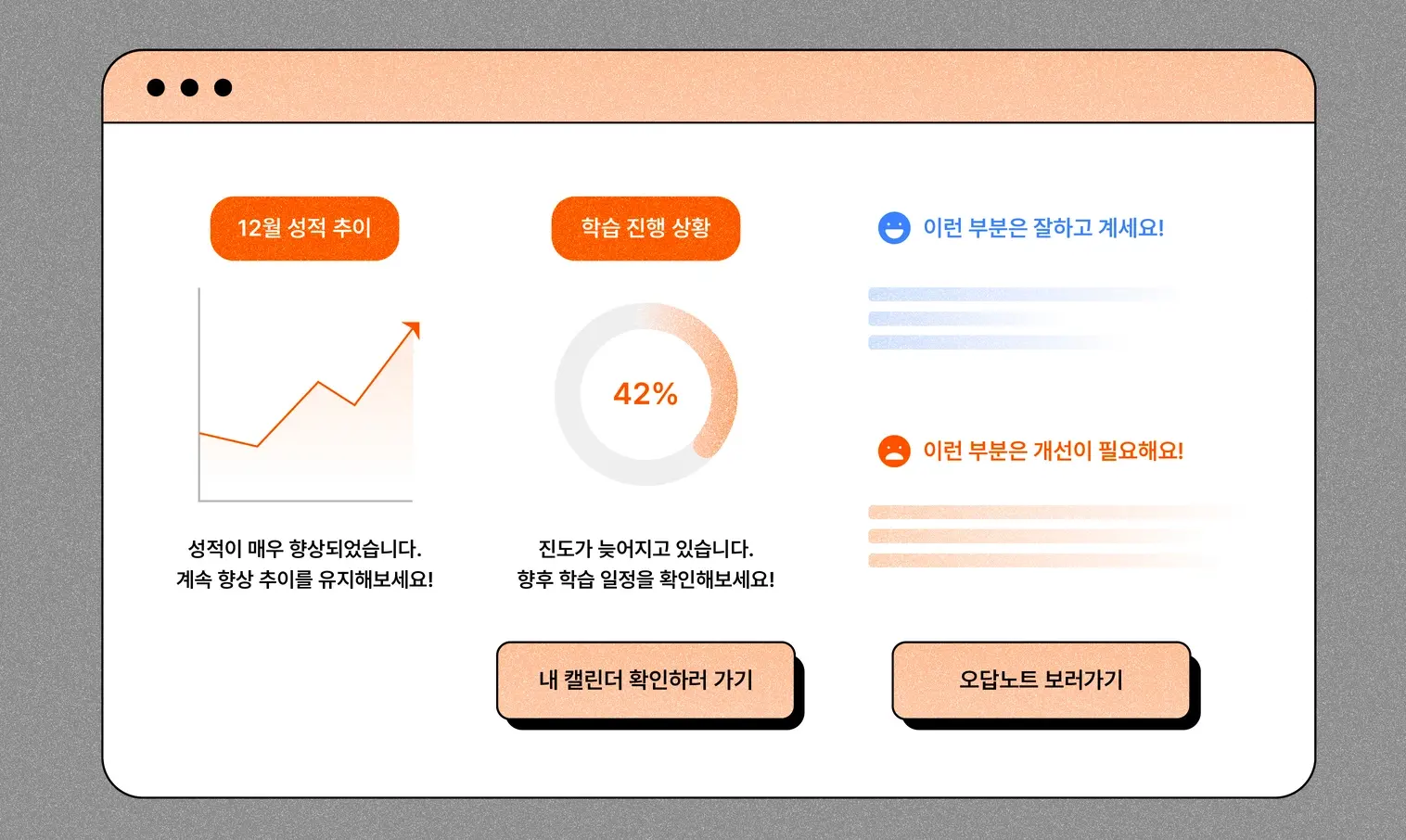
BEFORE: 'Completion status' alone makes it hard to judge learning outcomes
Many education companies manage learner outcomes only by 'completion status' or 'simple scores.'
But this approach doesn't properly show actual competency change or applicability on the job.
Also, because assessment criteria differ by instructor and course, grading consistency is low, and it's hard to present concrete improvement directions to each learner.
Limits of performance metrics: lack of competency-change data beyond completion rate/scores
Lack of assessment consistency: grading criteria differ by instructor/course
Insufficient personal feedback: hard to present each learner's strengths/areas to improve concretely
AFTER: Now, AI provides 'accurate competency assessment' with objective data
AI analyzes various learning outputs — exams, assignments, project deliverables, etc. — to show at a glance not only scores but competency change, strengths, and areas needing improvement.
It standardizes assessment criteria so grading uses the same standard even across different instructors or courses, and connects results to learner-tailored feedback and follow-up learning suggestions.
Multi-layered performance analysis: provides competency change and behavior metrics beyond simple scores
Standardized assessment: secures result reliability with AI grading criteria
Personalized feedback: improvement directions and follow-up learning recommendations suited to the learner's situation
📌 Custom AI points
✔️ Reflecting the core-competency model the company defined into the assessment criteria
✔️ Fitting job and course characteristics, customizing the assessment-item/scoring structure
✔️ Based on assessment results, automatic design of each person's growth path and course recommendations
✔️ In the needed format — follow-up lecture recommendations, guidance on areas needing improvement, etc. — competency-assessment deliverables made to order
Real DALPHA case: AI competency assessment/analysis
Before
B2B education specialist Company M, while running client-tailored education, struggled to measure learners' competency change or learning outcomes before and after education.
Even when running pre/post tests, result collection and analysis were all done manually, and because assessment items and methods differed by client, it was hard to compare by a consistent standard.
Also, it was hard to quantitatively show which competency the education actually affected and by how much, so writing client reports took a lot of manpower and time each time.
As a result, it was hard to objectively prove education effectiveness, which constrained renewals and follow-up course proposals.
After
Now AI automatically analyzes pre/post test data and instantly generates competency-improvement reports at the individual, team, and organization level.
(1) By reflecting the core-competency model, it applies the competency system each client defined directly to the assessment criteria, enabling company-tailored analysis.
(2) With the assessment-item/scoring-structure customization feature, flexible assessment design fitting job and course characteristics became possible, and based on results, AI even auto-recommends each person's growth path and follow-up courses.
With this, Company M provides client-tailored reports in a short time and can objectively prove education outcomes, leading to long-term contracts and higher re-enrollment rates.
AI competency assessment presents not just a simple score, but a learning direction along with the numbers. By quantifying learner growth and designing the next learning journey, it turns 'a one-time completion' into 'continuous growth.'
Now focus on core education outcomes and the learner experience
So far, we've looked at how education companies can advance the learning funnel stages with AI — from course recommendation to search, tutoring, and competency assessment.
AI isn't simply a technology that raises operational efficiency — it designs continuous growth.
It's a companion that helps learners — who 'may not want to take a lecture' and 'may not want to study' — receive the information they need at each stage quickly and accurately, and keep learning without interruption.
If you're curious how far you can optimize your company's education operations with AI, click the button below and briefly leave your current situation.
We'll propose a custom AI education solution, with real cases.
Dalpha Blog