AI Playbook Chapter 2 — An AI White Paper for Commerce Companies
An Overflow of Online Shopping Malls
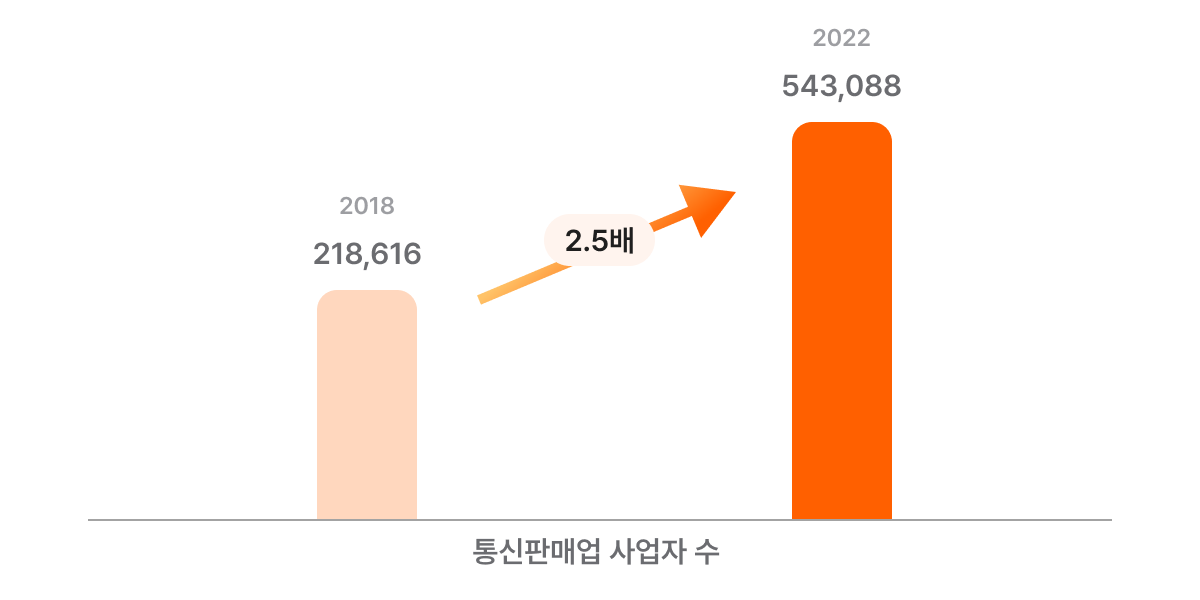
543,088…
is the number of businesses registered as mail-order sellers in Korea. I recently learned this while talking with Dalpha's Sales team about just how many commerce companies there really are in Korea. Of course, not every registered mail-order seller is an e-commerce company, but it's true that the number of companies running online shopping malls in Korea has grown rapidly. Coupang holds an overwhelming first place, but vertical commerce players specializing in particular fields are also steadily growing.
As the number of commerce companies has grown, competition has intensified, and it has become hard to survive on a good product alone. Paradoxically, a world overflowing with information has made it harder to get information noticed, and product prices have steadily dropped, leaving more and more companies in the red.
AI, Now a Must-Have
To overcome losses, you need the right marketing and cost reduction. Various methods have emerged to solve these two problems of marketing and cost reduction, and the one that has delivered the most successful results over the past few years is AI. AI-powered marketing has achieved remarkable purchase conversion rates never seen before, and AI-powered product management has dramatically reduced time and cost.

Through building and consulting on AI for countless commerce companies at Dalpha, I too have helped many of them grow, while also learning how market-leading commerce companies use AI.
And through this post, I'd like to introduce all of the AI that commerce companies use. AI related to marketing was nicely covered in the previous post, so here I've focused mainly on the AI used in product management ☺️
AI Services for Online Shopping Malls
Automate Product Registration 100%
Setting Product Categories
AI can be used from the very process of registering products. It shows its true value especially when you have a large number of products.
0:00
/0:14
1×
Demo video of the product-category automation AI
The very first task when registering a product is setting its category. It's a truly easy task when you register one at a time, but as the number of products grows and categories diversify, it takes a long time. That's why a category structure, once set, is really hard to overhaul. Changing countless already-registered products all at once is, quite literally, "a task no human can do."
In such cases, using the product-classification automation AIeasily solves the problem. The AI, which infers a product's category based on its name and image, is extremely accurate. It's useful not only when running your own-brand mall but also when syncing products to various open markets like Coupang and Naver Shopping.
Try the product-classification automation AI
Writing Product Details
After entering basic information like product category, name, and price, you need to enter the most important information of all: the product details. Using various AI, you can automate everything from creating product details to registering them.
To create product details, you need to photograph the product. If you have too many photos, you can use an image-classification AIthat sorts the photos by product option and arranges them appropriately. Conversely, if you have too few photos or the quality is poor, you can use an image-generation AI. From changing the aspect ratio of a photo, to naturally swapping a product photo's background for a beautiful studio shot, to changing colors—most of what you can imagine is possible.
Once the photos are sorted and arranged, you can use the MD comment-writing AIto add natural copy introducing the product and complete the product details.
0:00
/0:14
1×
Demo video of the MD comment-writing AI
The Gold Standard for PLPs
Once you've registered good products, you have to somehow get customers to click on a product from the PLP page they first land on when visiting your shopping mall.
Unifying PLP Images
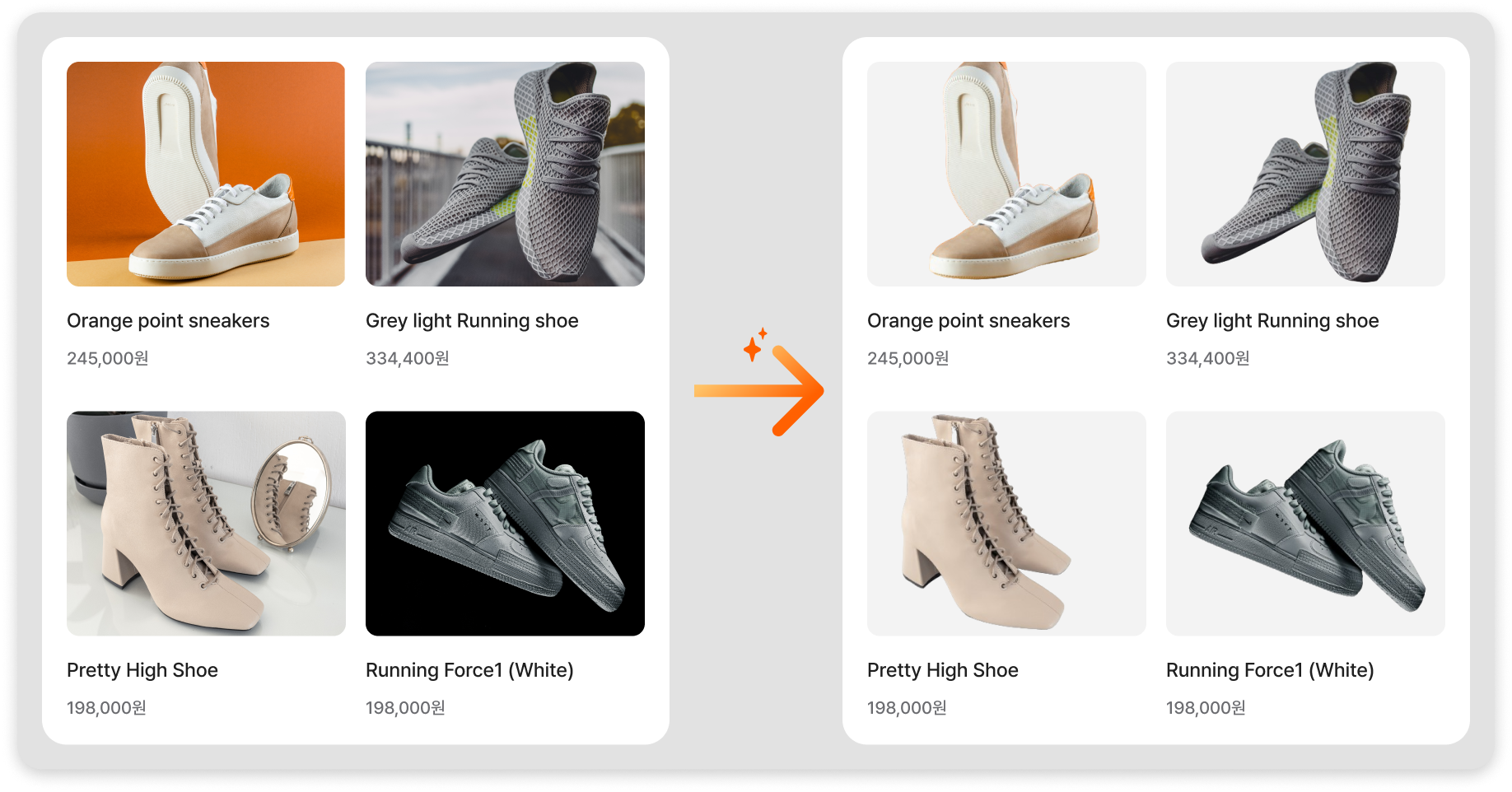
The very first thing to do is to make the PLP page clean. It would be best to shoot every product's PLP image in the same studio, but in most cases you have photos taken against various backgrounds for each product. On a product list page with countless products lined up, however, images that are all over the place create a negative experience for consumers.
In such cases, using a background-removal AImakes it easy to solve the problem. A background-removal AI finds the most important subject within a single photo and makes the rest transparent or fills it with a specific color.
Creating Main Banners
0:00
/0:14
1×
This is a demo video of creating an ad banner using the banner-creation AI. You can switch it to a product-banner-creation AI for banners to place at the top of your shopping mall.
Once you've cleanly organized your product images, you need to create eye-catching banners and place them in the right spots. And you have to change the banners periodically to drive consumer clicks. Because they need to be produced constantly, creating banners gradually becomes a chore. Developed to solve this problem, the banner-creation AIedits and generates product images at the right size, then creates a catchphrase that drives purchases based on the product information, ultimately producing the final PLP banner.
Arranging Products Well
Once you've created suitable product images and banner images and rounded out your PLP, you need to think about product placement so that the products consumers need get as much exposure as possible. The AI that handles this product placement automatically is covered in detail in Chapter 1 of the AI Playbook.

Search: The Heart of a New UX
Whereas the AIs above felt like they replaced tasks people used to do, search AI provides a user experience that didn't exist before. Previously, the typical way to use an online shopping mall was for consumers to browse the mall themselves to discover the products they needed, or to look through the category where they expected the product to be. There was a search function, but you couldn't find a product unless you typed in a search term included in its name—so it was hard to use unless you were a consumer who came specifically to buy an exact product.
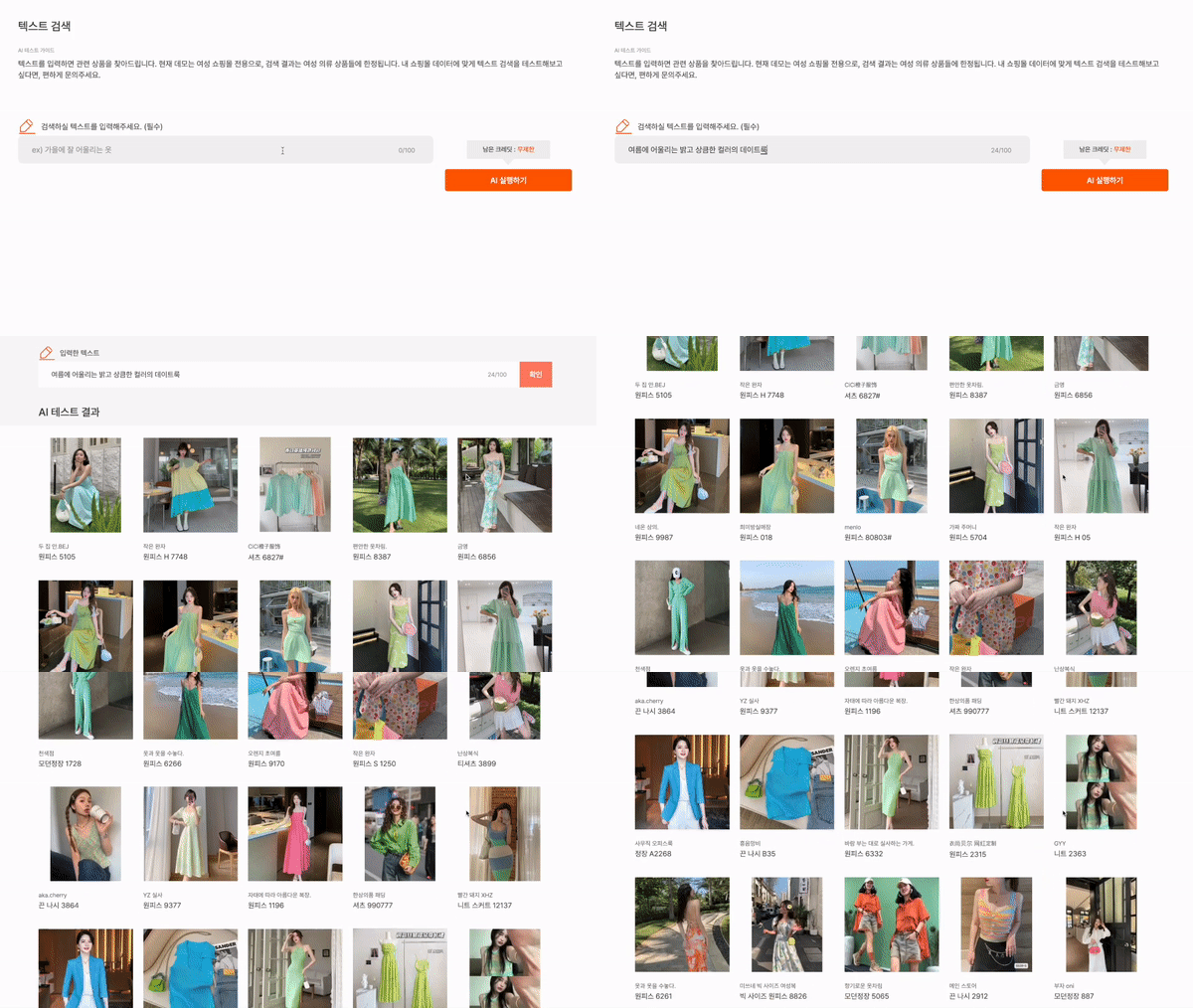
But since the advancement of AI, the search function offers a user experience that is a complete 180 from before. It finds products even when you don't enter the exact keyword, and it even recognizes product images to find products. Even if you enter a sentence with various conditions, it understands the sentence and finds the matching products; and if you enter a question, it finds the right products that answer it. You can experience AI-powered search at the link below.
The evolution of search doesn't stop at text search. Multimodal search—where, when a consumer directly uploads a photo containing a product, it finds the product in the photo—has also been drawing a lot of attention lately. I've gathered all kinds of information about multimodal search in the post below, so give it a read.
Escape Inquiry Hell
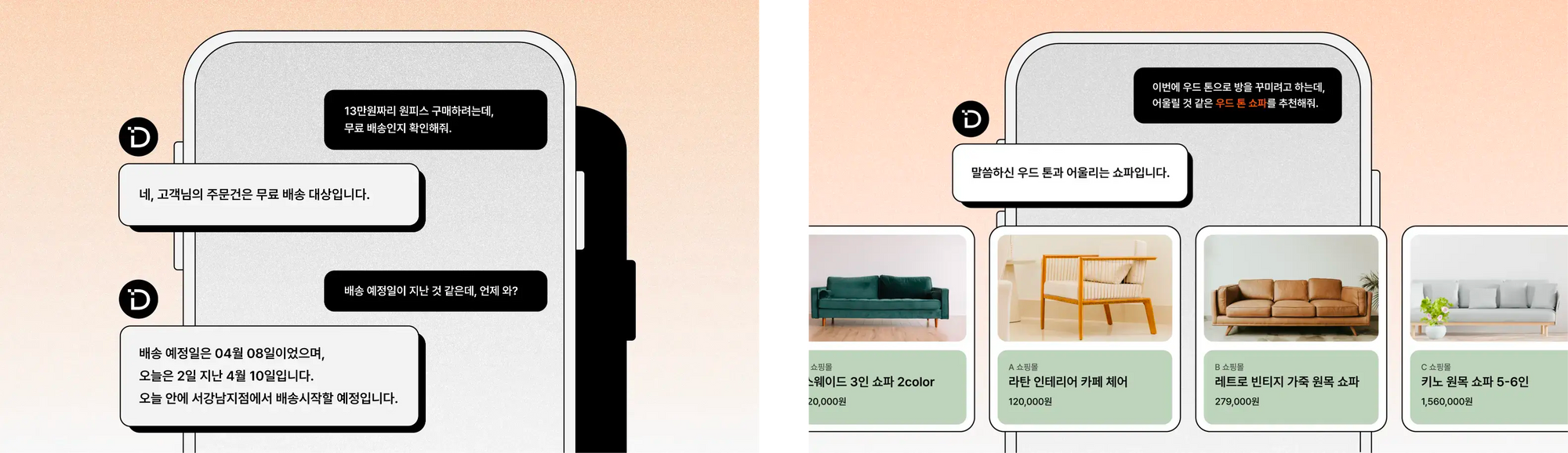
When running an online shopping mall, the task that consumes the most time is, by far, customer support. That's why, ever since ChatGPT appeared, countless companies have tried AI customer-support chatbots for online shopping malls—but the phenomenon of giving false answers made real-world adoption difficult. Recently, however, through various workarounds and technological advances, many shopping malls are adopting them. At Dalpha, too, we've developed and now offer a CS automation chatbotthat responds naturally and accurately to any customer inquiry and supports various channels like KakaoTalk, Channel Talk, and Naver TalkTalk. If needed, you can also add a product-recommendation chatbot feature. Check out the link below for details!
Try the AI customer-support chatbot
Try the product-recommendation chatbot
See Your Customers' Reactions at a Glance
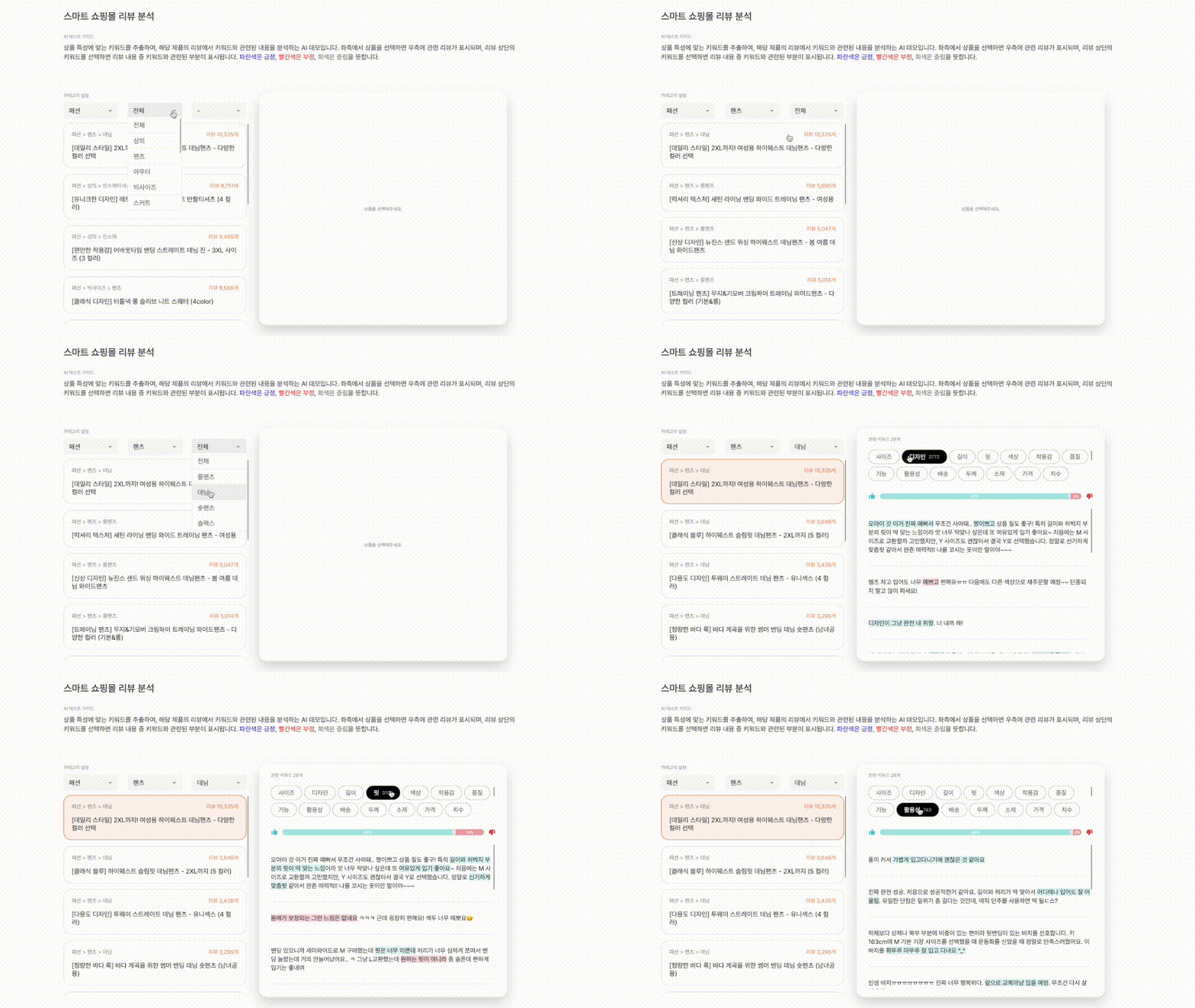
Using a review-analysis AI that analyzes customer reviews, you can create a smart review service that lets customers filter and view only reviews about a specific keyword among countless reviews, as well as a product review report that quantifies customer reviews to analyze customer reactions to a product quantitatively.
Beyond the AI introduced above, the AI Store holds a wide variety of AI that you can try out for yourself. Visit the AI Store, experience the many AI, and build the AI that's the perfect fit for the service you run!


Jinsu Choi