Smarter Influencer Marketing, Powered by AI
[1] High-growth brands run influencer marketing.
In the consumer goods market, the days when “a good product simply sold itself” or when “running ads well was enough” are already behind us.
In the past, a company could succeed by making a good product and running efficient ads. Today, differentiated marketing has become important enough to determine whether a company wins or loses.
That is why consumer brands are increasingly focusing less on TV and banner ads and more on marketing through influential individuals on social media: influencers.
The reason is clear.
Consumers trust content recommended by real people more.
Platform algorithms accelerate the spread of influencer content.
Natural experience-sharing can create a stronger message than ads produced directly by the brand.
This strategy is not just about visible exposure. It is designed to connect content credibility with purchase behavior.
In fact, social-based influencer marketing has shown higher ROI than traditional ads when compared with simple exposure, which is why many brands now use it as a core strategy.
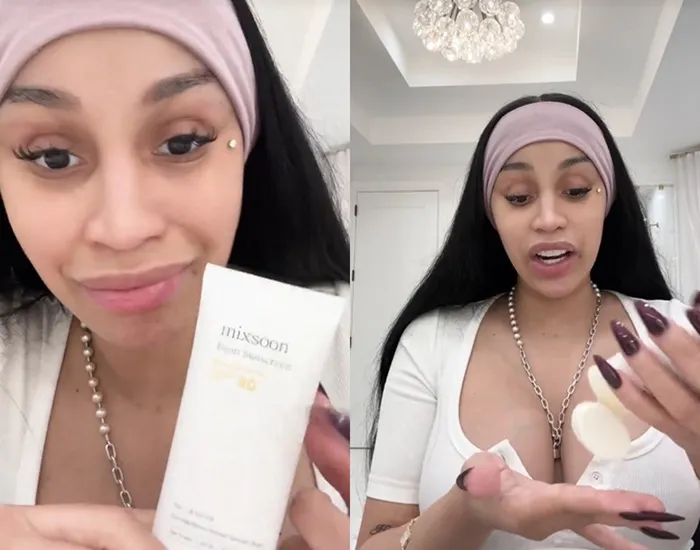
One example is Cardi B, who naturally exposed mixsoon skincare products on her TikTok channel by using them herself and sharing a positive experience.
That personal experience-led content drew follower interest, quickly increased product awareness, and accelerated expansion into major global online channels and offline retail.
As consumer trust and purchase conversion rose together, sales surged. The case shows just how powerful influencers can be in marketing.
In other words, influencer marketing has evolved from simple advertising into a strategy that appears naturally in consumers’ everyday content and helps guide purchase decisions.
The basic structure of influencer marketing
Most brands follow this basic flow when running influencer marketing:
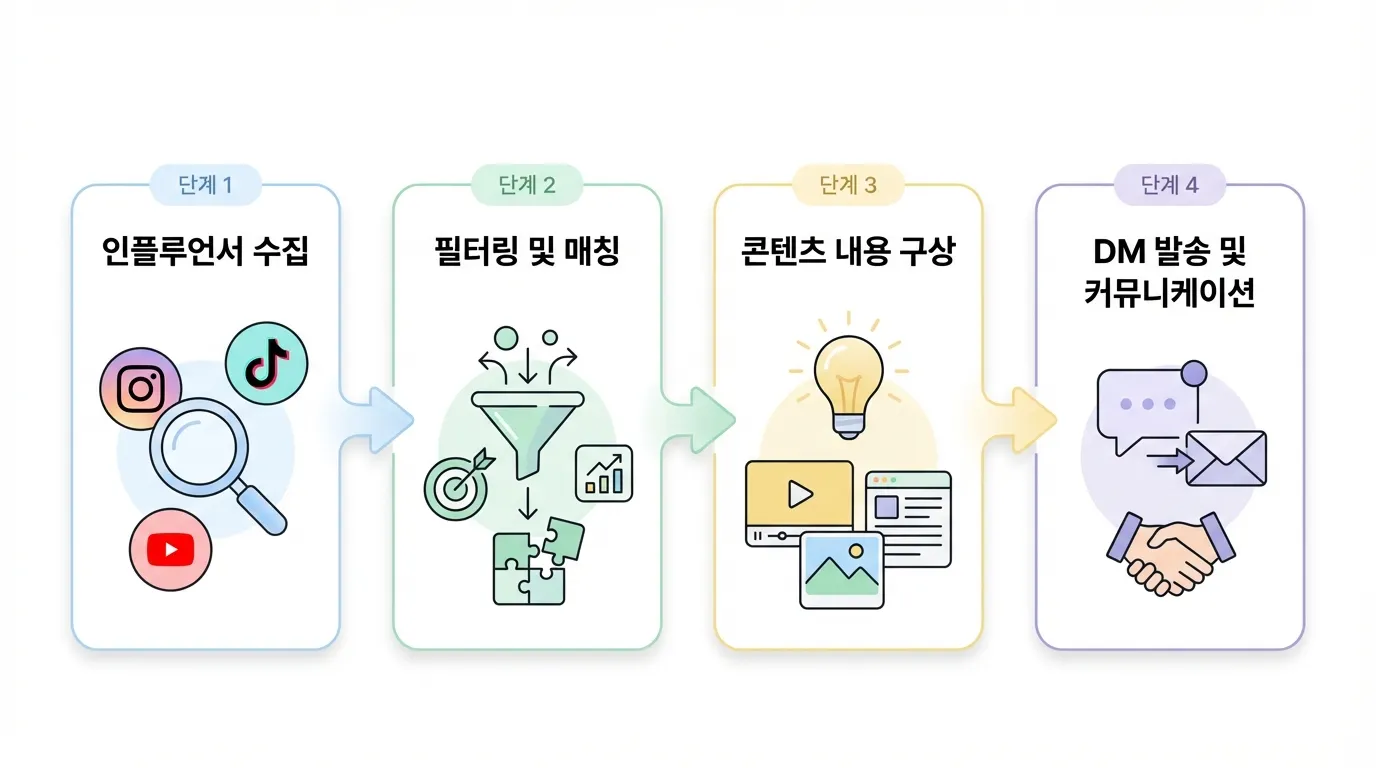
Influencer discovery: Build a candidate pool based on social channels, platforms, and existing data.
Filtering and matching: Select influencers suited for seeding by considering follower characteristics, content style, and past performance.
Content planning: Plan what content should be created in line with the campaign direction.
DM outreach and communication: Share campaign details with selected influencers and coordinate terms, rewards, and schedules.
On the surface, this looks simple. In practice, however, these four steps often fail to create sustainable performance.
[2] Influencer marketing is not easy for everyone.
Many brands try influencer marketing, but not all of them succeed.
That is because the following structural problems exist.
1. There is a limit to how much information people can process.
When preparing influencer marketing, brand managers need to consider all of the following:
follower count and growth trend
content tone and manner
past collaboration history
comment reactions and engagement rate
fit with the brand image
The problem is that people have to review, compare, and judge all of this information by hand.
In the end, managers make decisions within limited time based on only partial information from a limited number of influencers.
Many candidates who may have been a better fit are excluded from consideration before they are even reviewed.
2. Brands can only reach a limited number of influencers.
When people manually build lists, check content, and write messages, the number of influencers they can actually contact is far more limited than expected.
instinctive judgments such as “this should be enough”
the burden of sending DMs and managing replies
the difficulty of trying again when there is no response
For these reasons, many brands end up repeatedly asking a small group of influencers to run campaigns.
But that narrows the range of experimentation and increases performance volatility.
3. Selection criteria become increasingly simplistic.
At first, teams consider many different criteria. Once execution begins, however, the criteria quickly become simplified.
Does this person have many followers?
Is this influencer trending recently?
Have we worked with them before?
These criteria improve execution efficiency, but they are not enough to find influencers who truly fit the brand and product.
4. Results remain, but learning does not.
After a campaign ends, brands can collect one-dimensional results such as views, likes, and comments.
But those results are rarely organized into a structure that explains how they should be used in the next campaign.
Why did this influencer perform well?
Which content elements had an impact?
What should we change next time?
Teams end up asking these questions from scratch every time.
Ultimately, influencer marketing remains repetitive manual work rather than a repeatable system.
[3] AI influencer marketing goes beyond human limitations.
AI does not solve these pain points through “automation” alone.
The core value is redesigning the marketing workflow itself around a structure that makes difficult human work possible.
1. Influencer discovery: Building a comprehensive AI-based pool
Traditionally, collecting influencer lists takes time and leaves many gaps.
AI-based crawlers can collect large volumes of influencer and related information from multiple platforms.
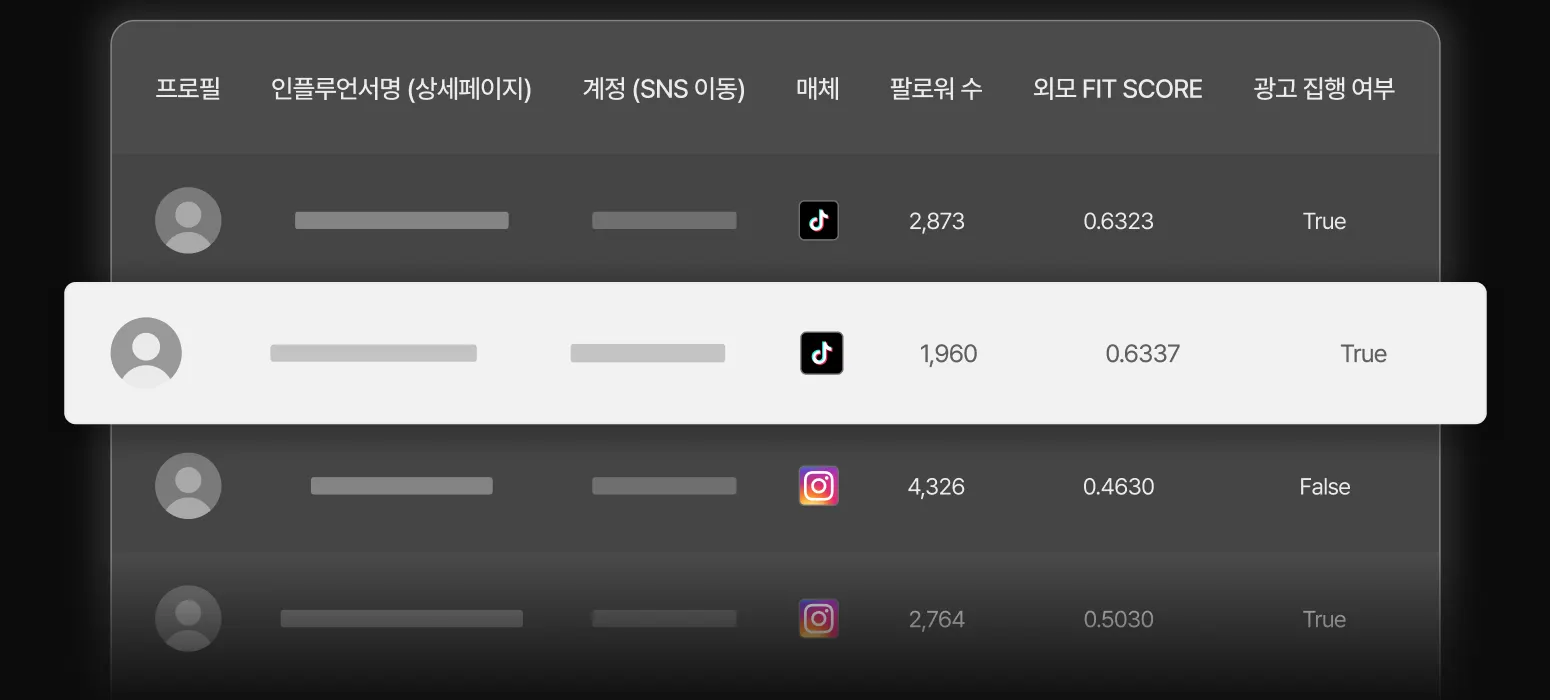
follower count and growth rate
information about uploaded content
personal influencer information, such as eyelash style or eyelid type
As above, the metadata needed for strategy planning can be collected automatically and enriched with AI.
Information about uploaded content and the influencer can also be extracted and used by analyzing the images and audio in the influencer’s posts with AI.
2. Influencer filtering and matching: Finding the right fit from a large pool
Collected influencers do not remain as a simple list.
Based on influencer metadata such as follower characteristics, content type, response rate, and past performance metrics, AI can score the best matching candidates for a brand’s products.
This makes it possible to select an efficient candidate group that includes high-potential influencers who could easily be missed by human intuition alone.
3. Content planning: Data-based insight
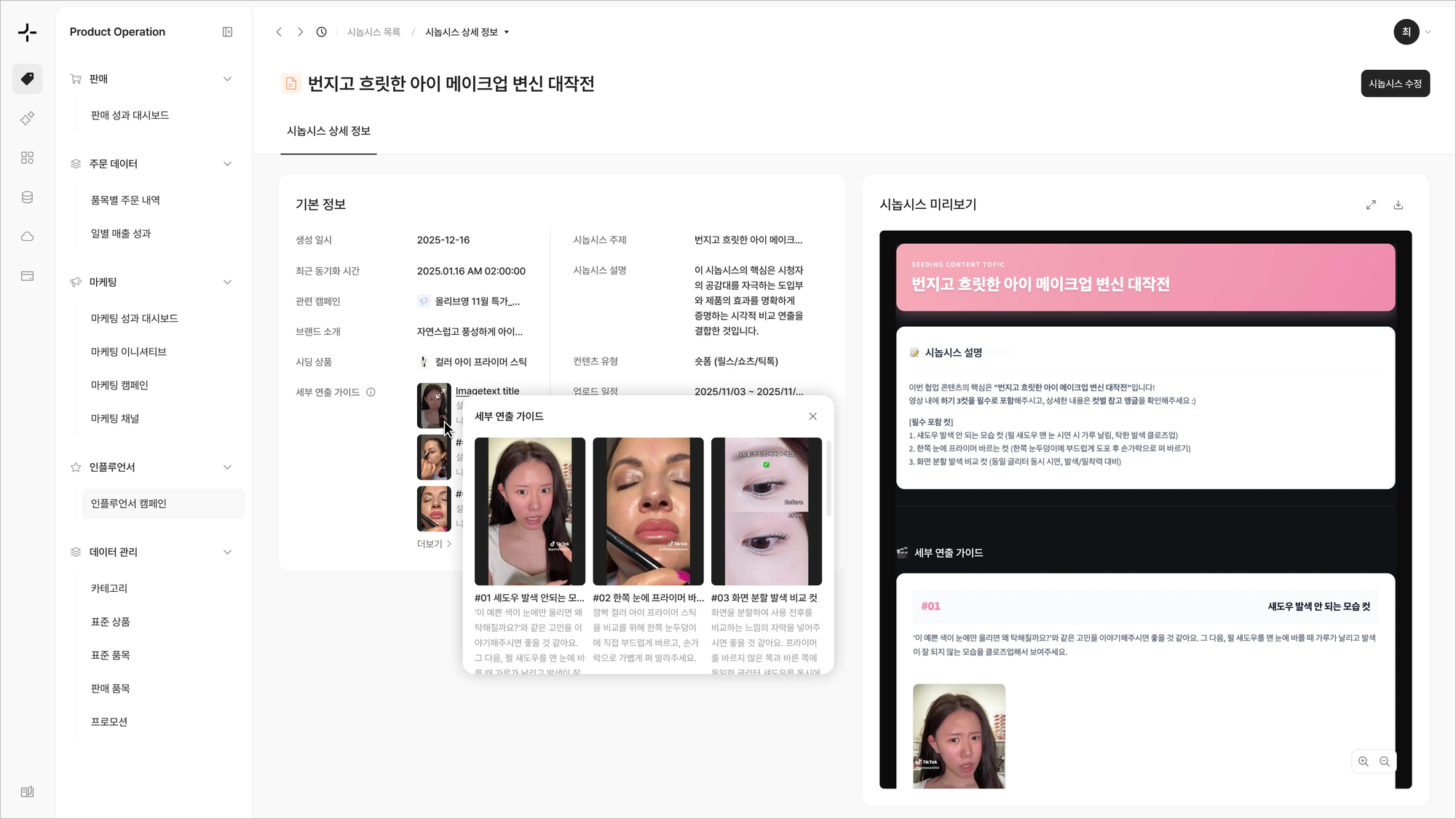
By combining brand data, competitor data, and market trend data, AI can propose popular content synopses and planning ideas, and even apply models that predict how much response each piece of content is likely to generate.
The model can be structured in the following sequence to create content synopses that improve views:
Analyze videos across platforms such as TikTok and Instagram to extract characteristics of high-view content.
Use the video characteristics extracted in step 1 to generate a synopsis that includes content themes, guides, and video cuts.
Use a view prediction model to select the final influencer-synopsis pair for seeding.
Through this approach, brands can provide influencers with precise, data-based content synopses.
4. DM outreach: Automation plus human-centered communication design
Once the influencer-synopsis pairs for seeding are complete, RPA can automate DM sending and the collection of terms.
This is not a simple chatbot-level process. AI designs and sends messages that fit the brand tone and campaign context.
personalized messages
automated triggers for each case
copy testing and A/B probability-based sending
This approach minimizes wasted human resources and time, instead of merely automating repetitive tasks.
[4] Closing: A new standard for brand planning that starts with AI
Influencer marketing is no longer just a strategy brands choose. It has become a growth engine for brands.
When used well, AI can structure work that is difficult for people to handle alone, based on data.
When the full flow of discovery, matching, execution, and validation is connected as an AI workflow, brand competitiveness moves up another level.
If you want to turn your brand’s influencer marketing into a repeatable performance system, now is the time to seriously consider an AI-based workflow.
If your brand wants to run smarter influencer marketing with AI, you can start a light conversation with DALPHA.

Yongchan Park