Influencer Marketing: Social Media Crawling Is Now a Must
This article is for
- Brand/agency marketers interested in influencer marketing
- Practitioners who want to run influencer selection and evaluation with objective metrics- Those who want to monitor and analyze
competitors' social media marketingA keyword that never gets left out when talking about marketing these days is 'influencer marketing'
.Since you take on multiple influencers as collaboration partners at once, concerns like 'who should we pick?' and 'is the sponsorship actually performing?' inevitably grow.If you use AI to automatically collect and analyze vast social media data, you can run everything — from influencer selection to outreach to evaluation — with objective criteria, quickly and at
minimum cost
for maximum impact.<CONTENTS>🌟 Influencer selection
1. Finding influencers optimized for your brand
2. Selecting strong influencers by viral metrics
💭 Evaluating marketing impact and setting strategy
3. Evaluating influencer-sponsorship performance
4. Analyzing competitors' influencer-marketing trends
🌟 Influencer selection
1. Finding influencers optimized for your brand
① Hashtag and keyword analysis
By crawling and analyzing social media posts and hashtag data, you can find keywords suited to your brand's concept and direction, and
list up influencers who use these keywords often.
Influencers selected this way are likely to have many of your brand's potential customers
among their followers.ExampleWhen we analyzed overseas short-form social media, the keywords frequently used alongside #KoreanBeauty were as follows.
glass skin, glowy skin, korean skincare, skincare routine
Even without directly using the keyword 'K-beauty,' an influencer who frequently uses words like Glass Skin — and their followers — can be considered
likely to be interested in K-beauty
.If you're a Korean makeup company targeting the global market
, including influencers who actively use such hashtags as sponsorship targets would raise ad impact even more, right?② Image analysis
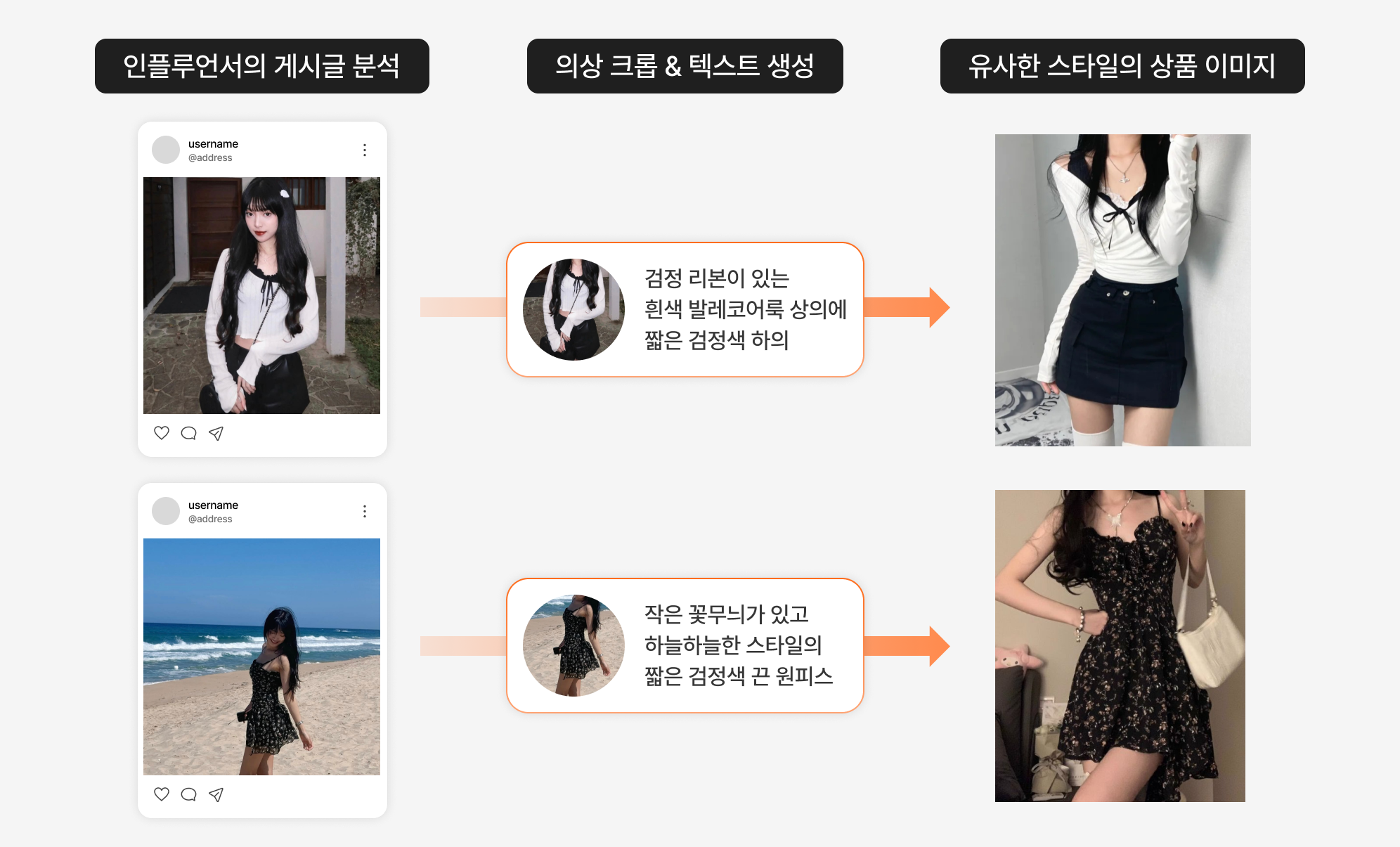
By collecting multiple influencers'
image data to analyze their style, you can automatically find similar product images among your own products.
Based on the organized data, you can compare each influencer's style and choose suitable sponsorship targets.
AI can even recommend sponsorship products that fit an influencer's account character on its own.
Example
If you're a brand that mainly sells 'simple business casual,' collaborating with an influencer who enjoys 'flashy, feminine looks' may not yield the performance you expect. Their followers' interests are different. So accurately grasping an influencer's usual style and account character is important.
If you're a platform selling clothes of various styles, you'll get far more synergy by matching balletcore-style products to an influencer who often wears balletcore, and hip products to a hip-style influencer.
③ Influencer outreach, all at once!
Through profile crawling, you can build an influencer database and automate the contact process.
After selection, the influencer-outreach process becomes much more convenient.
2. Selecting strong influencers by viral metrics
① Reaction data such as views, likes, and comments
Through social media crawling, you can collect quantitative reaction metrics like views, likes, and comments, and objectively analyze and compare multiple influencers' usual influence.
Even if they aren't widely known to the public, you can discover influencers with big influence in a specific field, or 'rising stars' with few sponsorships so far but high growth potential, and expect high marketing impact at low cost.
You can also analyze the positive/negative sentiment of comments to grasp in advance whether — and why — there are many malicious comments, reducing the possibility of harm to your brand image.
② Qualitative post evaluation
Beyond just looking at numbers, AI can analyze post content to check qualitative metrics.
For example, even for an account that frequently does sponsorships or testing campaigns, you can identify accounts whose posts don't follow the guidelines or are written carelessly.
It automatically monitors whether posts are written properly even after sponsorship, greatly reducing the marketer's workload.
💭 Setting influencer-marketing strategy
3. Let's evaluate marketing impact and set strategy
① Evaluating influencer-sponsorship performance
After sponsorship, AI takes views, likes, comments and other viral metrics, in real time, collecting and comparing them to show each influencer's performance at a glance.
By comparing influencers with good metrics against those with low reactions, you can analyze various factors like content and account character.
You can continue or scale up collaboration with the former, seek improved ways of collaborating with the latter, and efficiently allocate budget and resources.
② Setting future marketing strategy
Looking at the data AI collects, you can get quantitative evidence for which post format (photo, video, live, etc.) had the best reaction, and which keywords/hashtags drive virality.
For instance, if videos that frequently mention the latest trend keywords stand out in likes and views, you can gain the insight that you should focus more on trend-keyword monitoring in the next campaign.
4. Let's grasp competitors' influencer-marketing trends
① Finding competitors' influencers
By automatically crawling posts tagging a competitor's products/accounts, you can check in real-time data which influencers they're collaborating with and what strategy of content is being posted a lot.
Through this, you can gain marketing ideas — setting a strategy differentiated from competitors, or finding ways to target a similar customer base.
② Analyzing competitor mentions
Even if content mentioning a competitor's products is scattered across various social media, automatic crawling can gather it in one place for analysis.
By examining the key keywords frequently mentioned in sponsorship/review posts related to a competitor, it's easy to grasp what strategy the competitor is using and what aspects consumers feel are strengths.
You can also reference the traits of competitors' content that goes viral to gain insights for complementing or differentiating your brand's marketing strategy.
In closing
Influencer marketing has now become not a choice but an essential strategy.
Use social media crawling and AI solutions to run everything — influencer selection and outreach, collaboration, and objective measurement of marketing performance — one-stop. You'll be able to get ahead with minimum cost and maximum impact!
At Dalpha, through 1:1 consulting, we plan and build influencer-marketing AI systems specialized for each company and product.
Free consultation — if you're interested, reach out anytime!
Inquire about the marketing AI solution

Serin Choi