How can you do prompt engineering efficiently?
A rapidly changing AI market
In today's AI market, OpenAI's influence is literally enormous.
Unlike the many AI products that came before it, ChatGPT—released in November 2022—quickly worked its way into our lives thanks to its practicality and performance.
Through a string of impressive moves—the launch of the more powerful GPT4, and the unveiling of GPTs that let anyone build a chatbot easily without coding—it brought a major shift to the chatbot market on January 10 by launching the GPT Store, where you can sell your own custom-built chatbots and share in the revenue.
Dalpha works hard to keep up with these changes as quickly as possible, and we are constantly thinking about what kinds of services we can build with the newly added features.
No matter how easy it becomes to build a chatbot, building a high-performance service that can solve problems like work automation still requires coding skills and insight.
In particular, it has become essential to have the skills to guide an AI so that it always follows a set format and, in most cases, gives correct answers without errors.
What is prompt engineering?
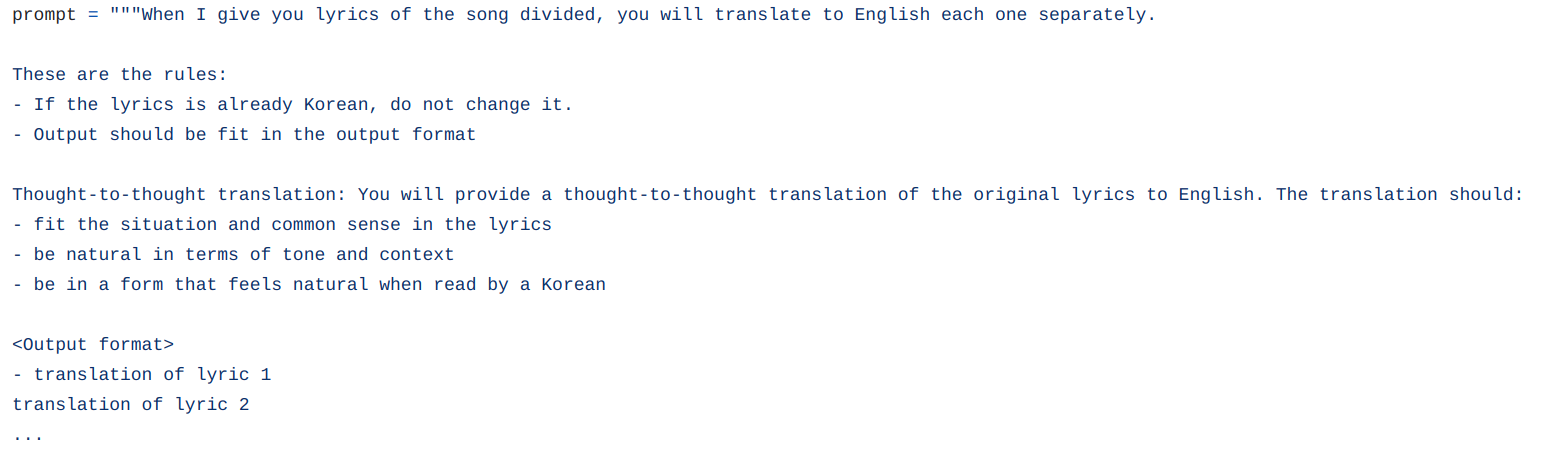
The act of writing instructions that guide generative AI to produce the best possible results is called Prompt Engineering .
You might think, "Can't you just throw any random instructions at it until you get good results?" But just as the word 'engineering' suggests, it requires knowledge, skills, and know-how across many different areas.
Beyond writing prompts by understanding how the AI works, what kind of training data it has, and which words it knows, it also requires the coding skills to extract only the information you need for your service from the generated output and restructure it.
At Dalpha, we have carried out many projects using GPT.
A novel-generation AI that writes the rest of a story based on its opening, an information-extraction AI that reads and understands Excel files or PDFs to summarize them, and a CS-response AI that understands and answers users' questions—we developed these and even applied them to live services.
Each one was a fun project, and as we developed various kinds of AI, we gained many insights—both ones we learned online and ones unique to Dalpha.
Let's build a Dalpha-only prompt repository!
Dalpha's next question was 'How can we effectively share the insights we've gained with our team members?', and 'How can we easily receive our team members' insights?'.
GPT is a service that can be put to good use in a wide range of projects, and the prompt engineering needed to use it well has already become one of our core skills.
However, the GPT prompts and variables used in past projects weren't being properly shared among team members, and sometimes we even ended up doing prompt engineering from scratch on similar tasks that could have been almost entirely reused.
Given Dalpha's system of building various AI products in parallel at the same time, we desperately needed a way to reduce each person's repeated trial and error and boost productivity.
We also needed to free up room to improve performance in areas beyond GPT. We sought a way to accumulate insights at the team level rather than individually, and before long we reached the conclusion: 'It would be great to have a prompt repository of our own!'.
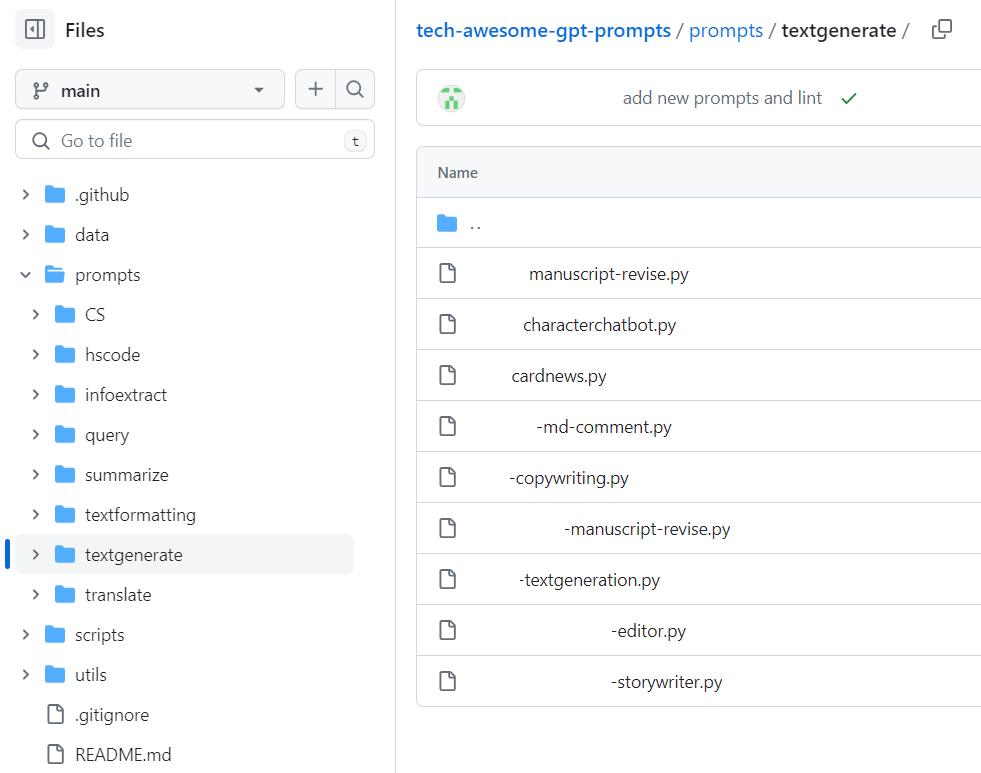
Once we'd decided on the approach, we quickly fleshed it out and put it into action, and that's how a repository called 'tech-awesome-gpt-prompts' was created on our internal GitHub.
'tech-awesome-gpt-prompts' was built with the goal of gathering all our insights on GPT-based projects to quickly secure productivity and stability.
The first thing we did was group all the projects we'd done so far by similarity.
We divided them into 8 categories by purpose—CS response, information extraction, summarization, translation, generation, and so on— and classified dozens of prompts.
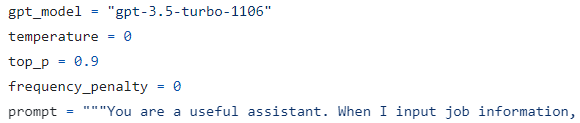
We included not only the prompts but also the models used and the various parameters you need to set when using GPT, so that other engineers could test them right away.
Looking at prompts that play similar roles, there's a lot of overlap, but the wording that reflects each AI engineer's individuality stands out.
When we asked 'why did you write it this way?' there was always a reason, and a surprising number of those reasons turned out to be helpful. In fact, through this process the prompts in many projects were improved, and we were able to provide better services.
In this way, by looking at the differences between each other and sharing ideas that might otherwise have been scattered to improve our own work, and by steadily growing the shared overlap so we could make 100% use of GPT's potential, each engineer's intellectual satisfaction was fulfilled and the company's Sales benefited too.
It doesn't stop there—we also share code-level insights.
When the OpenAI server suddenly becomes unstable and the API throws errors or result delivery is delayed, or when the output doesn't come out in the desired format, we posted Skeleton Code that figures out how to handle these various exceptional situations to provide a stable service.
It's no exaggeration to say that exception handling like this is what gives engineers the biggest headaches when developing a service, and sharing these insights prevents service instability in advance while also reducing AI engineers' unnecessary waste of resources.
The importance of sharing AI insights
To sum up, the benefits of sharing insights can be boiled down to the following three:
Fulfilling engineers' long-term growth and intellectual satisfaction
Increasing product productivity and improving service performance
Securing live-service stability and preventing unnecessary waste of resources
We put a lot of thought into our members' productivity and growth, and 'tech-awesome-gpt-prompts' is one of those efforts.
We actively encourage team members to share not only GPT-related insights but also a wide range of topics such as data cleaning, AI model training, the latest AI trends and papers, and the use of external tools.
If you're wondering what to do to help your development team grow, an internal sharing process like this could be a turning point.
We hope you'll build a great team by laying the groundwork for long-term growth while keeping it in balance with the project work you're handling right now.
Thank you for reading this long post!

Yongchan Park