Dalpha (DALPHA) vs. Company S: A Comparison of Keyword and Trend Analysis Tools
Keyword and trend analysis—which tool is the right fit?
A quick summary for the busy reader
Company S
- When you want to quickly grasp overall market trends
- When major platforms like blogs and Instagram are enough
- When you want to start lightly without any extra setup
Dalpha's social/review analysis AI
-When you don't want to miss the 'real reactions' of customers to your product
- When you want to know not just the numbers, but the 'reasons' behind changes and the 'direction to respond'
- When you want to reflect and use the data you want—open markets, overseas channels, and more—in real time
Many brands and companies want to know why customers buy their products, and why they leave.
So keyword and trend analysis often becomes the starting point for company-wide decision-making.
As consumer reactions have recently poured in from a variety of channels—social media, communities, reviews—how to collect, refine, and meaningfully analyze this vast amount of data has become a major challenge.
In this article, we compare the trend analysis tool Company S with Dalpha's 'social/review analysis AI', which is drawing attention as a new alternative.
Rather than simply listing features, we focused on the differences felt in actual practice and their impact on day-to-day work.
Comparison item
Range of collectible sites
Context-based filtering
Action-based insights
Ongoing usability
Conclusion: Which tool is really the right fit?
1. Range of collectible sites
"I'd love to see customer reactions on this site too…"
Company S collects data mainly from major platforms familiar to domestic users, such as Naver Blog, Instagram, and YouTube. It has the advantage of letting practitioners quickly check reactions on key channels. However, depending on the nature of the product or target customers, it has limitations when you also need to check specific communities, your own shopping mall, or overseas consumer reactions.
When a certain beauty brand was preparing to enter the Chinese market, it wanted to check not only Weibo but also the vivid reviews on Xiaohongshu (小红书), which local consumers frequently use—but it was difficult to quickly add this data with existing tools.
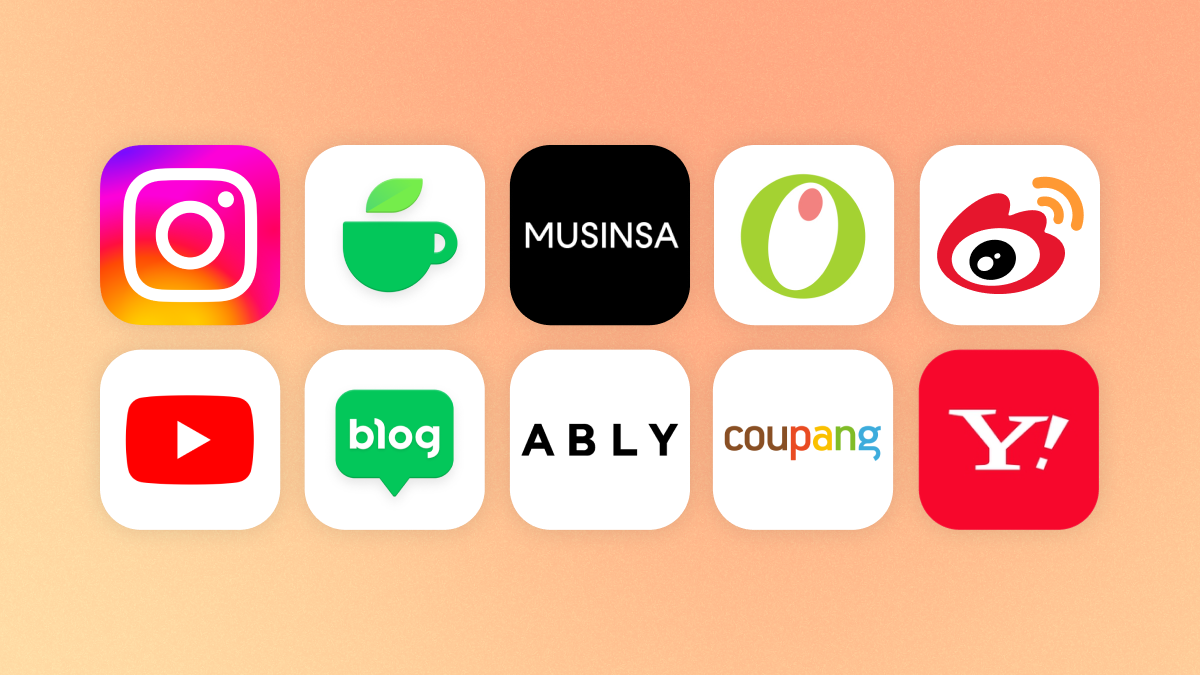
Beyond major SNS, Dalpha's social/review analysis AI flexibly collects from customer-tailored channels such as communities, app reviews, and overseas channels. It can quickly expand the collection scope around the platforms a user requests, securing even the easily missed voices of customers.
Beauty brand A, which entered the Japanese market, requested @cosme, Ameba Blog, Yahoo Japan, and more, and Dalpha completed the collection setup within a few days. Thanks to this, Brand A was able to accurately identify the keywords, expressions, and satisfaction/dissatisfaction points that actual Japanese consumers use.
2. Context-based filtering
"Is this data really the voice of our customers?"
Company S collects data centered on the keywords a user enters directly. For example, if you search for 'vegan cosmetics,' it scrapes most posts containing that keyword. In this process, ads, sponsored reviews, and entirely unrelated contexts can be collected together.
To make up for this, Company S provides include-word and exclude-word filters. While the ability to set filters flexibly is an advantage, it remains a burden for practitioners, who must keep figuring out which words to filter out and set them repeatedly. It's also hard to fully judge context, so there's a high chance unwanted posts get mixed in.
Dalpha's AI understands context on its own and automatically filters out promotional content, copy-pasted reviews, event-participation posts, and the like. For example, if there's an expression like "This post was written with sponsorship," the AI judges it as an ad and automatically excludes it from analysis.
As a result, users can immediately see analysis results centered on highly reliable, pure customer reactions—without having to set up filtering over and over.
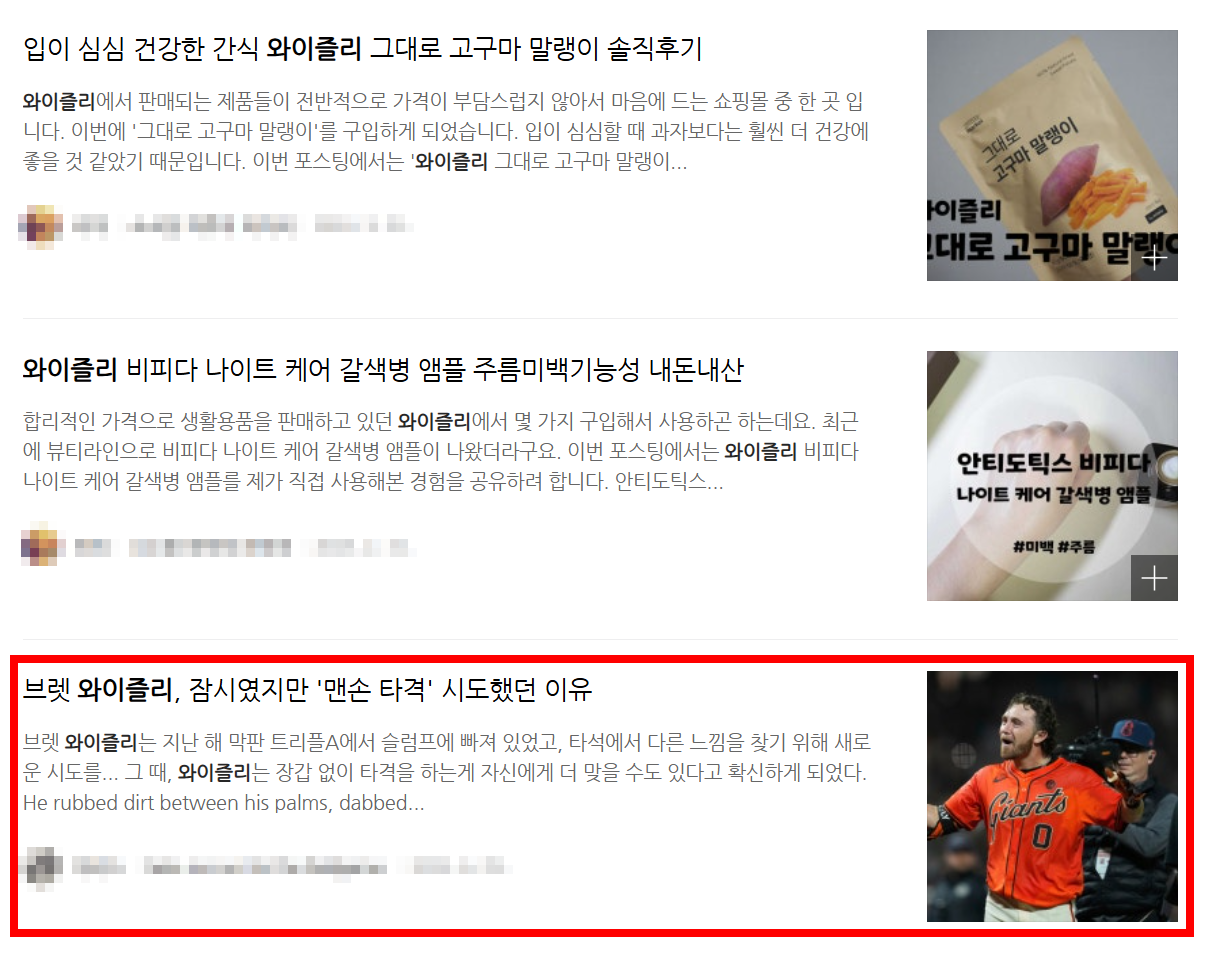
When analyzing the startup 'Wisely,' Company S includes data on the baseball player named Wisely, who shares the same name, but Dalpha's social/review analysis AI can filter this out. In Company S, accomplishing this would require additional filtering work with words like 'baseball,' 'player,' 'baseball player,' and so on. In Dalpha, however, the AI gathers and collects only the information about the startup Wisely.
3. Action-based insights
"There's plenty of data, but so what should we actually do?"
Company S provides visualization charts centered on changes such as sentiment ratios and keyword buzz volume. It has strengths in letting practitioners quickly check the numbers and grasp trends. However, information that simply says 'there are many positive mentions' or 'buzz volume has increased' is not enough to plan products or build marketing strategies.
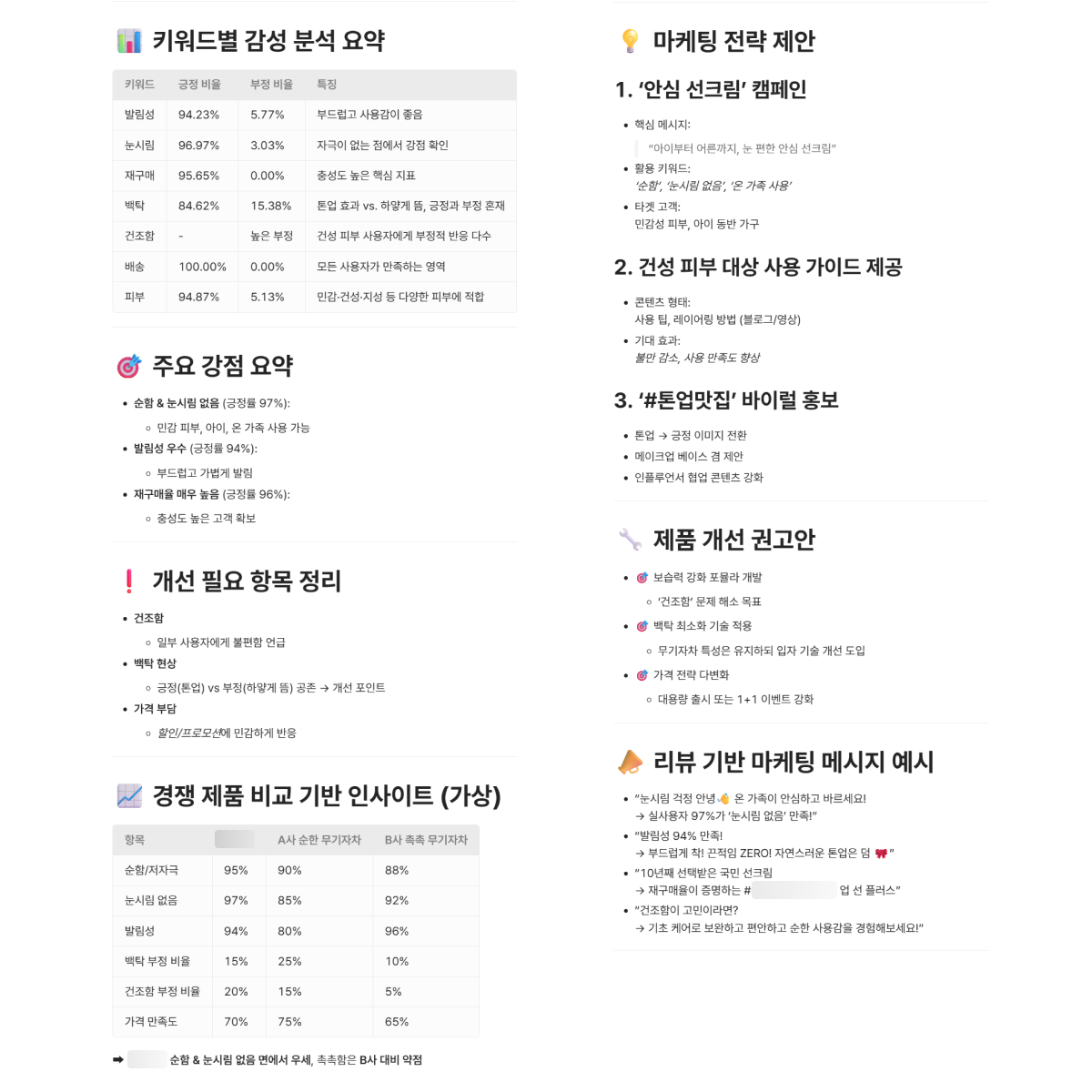
Like Company S, Dalpha also provides visualization charts. But Dalpha additionally provides an AI-based report, which doesn't stop at 'organizing' the data but leads to action. The AI collects data in real time, discovers changes, and presents both the meaning of those changes and the actions to respond with.
A change means there's a 'reason' for it. If the change is positive, you should analyze its cause and turn it into a repeatable success formula; if it's negative, you should be able to respond quickly before losses grow. Dalpha automates this process.
In practice, across various industries, this kind of action-focused analysishas led to real strategic changes.
Tracking changes by time period
It analyzes shifts in sentiment trends or mention volume over time, answering questions like "Why did negative reviews suddenly increase?".
Beauty brand A discovered that female customers in their early 30s were continually mentioning the complaint, "The spreadability is good, but it rubs off too easily onto masks." That feedback was reflected in the new-product planning stage and led to a product improvement: strengthening the mask-proof feature.
Automatic anomaly detection
It automatically detects sudden keyword spikes, surges in reviews, and the like, alerting you in real time to "What's happening right now?"
Fresh-food brand D caught a surge in reviews like "the vegetables were wilted" and "the delivery temperature was off" in a specific region. Through this, it immediately identified a malfunction in the logistics center's refrigeration equipment, halted deliveries in that region, and sent an apology message—after which negative mentions quickly declined.
Capturing new keywords customers are paying attention to
It automatically groups expressions and words that customers have newly begun to mention, showing you "What keywords are customers paying attention to these days?"
Appliance/furniture brand C, based on phrases that repeatedly appeared in reviews—"I was surprised at how easy it was to assemble", "It's perfect for someone living alone"—set its ad copy to "The best furniture even an assembly beginner living alone can put together easily," and drove SNS engagement with card-news content that visualized actual reviews.
4. Ongoing usability
"What if you only check it the first few times and never again?"
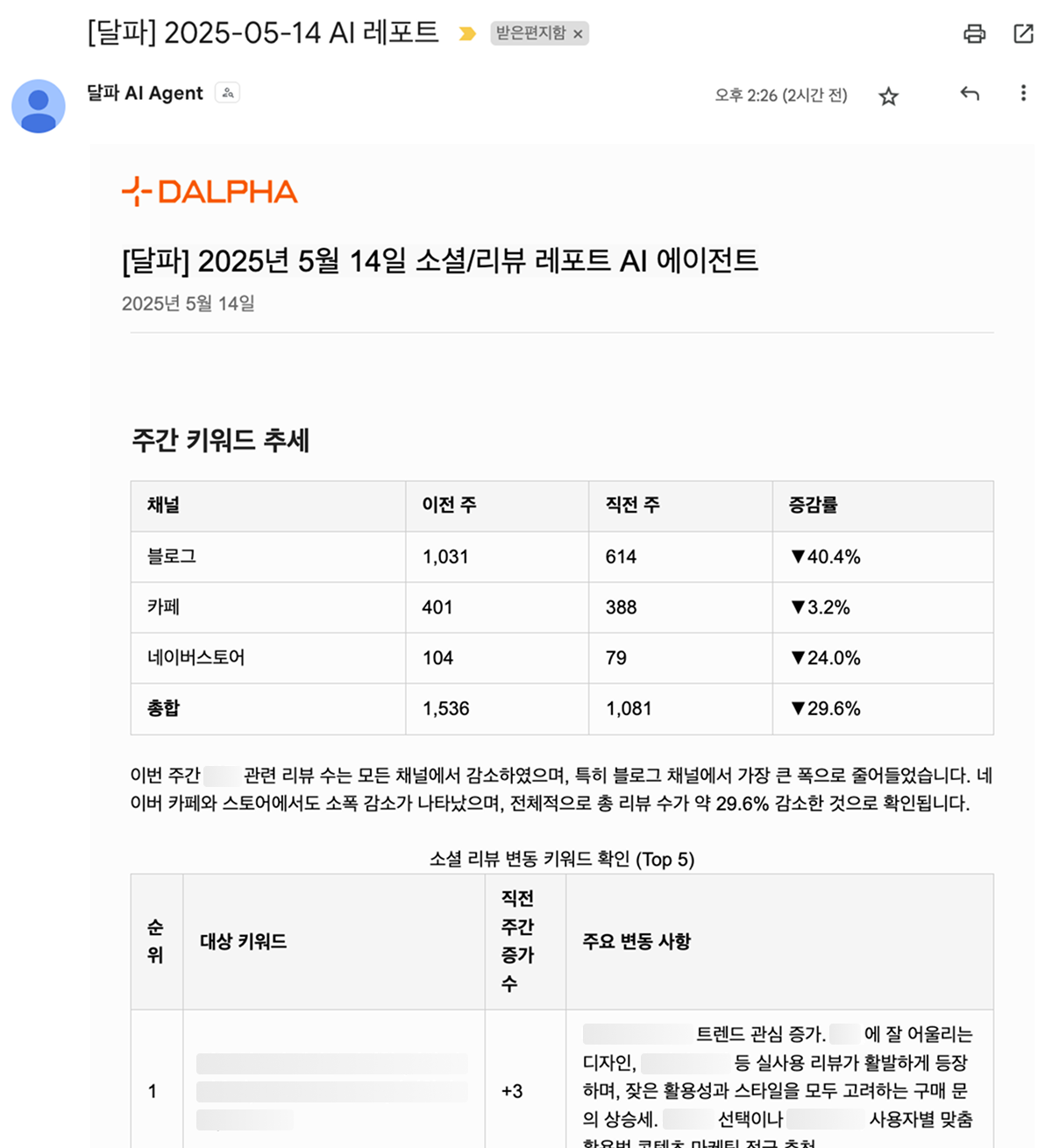
With Company S, you can only check the analysis results by logging in yourself. But the biggest drawback of this kind of analysis tool is that, over time, you stop logging in. Why is that? There are largely two reasons. First, it's a hassle to go into the tool. Second, even when you do go in, if there's no big change, there's no real need to look.
Dalpha delivers AI reports regularly via email, Slack, and more. Rather than a structure where the person in charge has to go check the tool themselves, it's a structure where insights come to you on their own. Because they're automatically delivered to your channel of choice—email, Slack, etc.—the information you need arrives 'on its own,' as if there were one more data analyst on your team. Since it's structured to pinpoint and notify you of only the key changes—without repeated logins—it helps practitioners use it continuously without any burden.
Company D's strategy office starts its weekly meeting every Monday based on Dalpha's email report. Without logging into the tool directly, they can immediately check key consumer reactions and competitor trends, so company-wide usage naturally increased as well.
Which tool is the better fit?
Company S is suitable in cases like these.
When you want a light look at overall market flows or trends, rather than 'accurate customer reactions' to your product
When data centered on major domestic platforms (blogs, Instagram, etc.) alone is enough
When you want to sign up right away and start easily without any extra setup
Dalpha's social/review analysis AI is suitable in cases like these.
When you want to analyze 'accurate customer reactions' to your product or service without missing anything
When you want to know not only the 'positive/negative' numbers, but also why that change occurred and how to respond
When you need a setup that reflects the channels you want—open markets, overseas consumer reactions, specific communities, and more
When you want insights delivered automatically in real time and want to put them straight to use in your team's strategy and execution
What are customers saying about our product/brand right now?
So far, we've compared Company S, a leading keyword and trend analysis tool, with Dalpha's social/review analysis AI.
Keyword and trend analysis tools are essential for understanding how your product and brand are being received in the market.
Even at this very moment, customers may be saying something.
Are you keeping a close eye on those voices?
If you're curious whether it can be applied to your own product and brand, apply below 👇
We'll provide a demo of the 'social/review analysis AI' applied to customer reactions for your product and service.
Dalpha Blog