AI Development Guide: 10 Steps to a Successful AI Project
Where should you begin with AI development?
If your company is just getting started with AI development, this one's for you. Having consulted with companies across commerce, marketing, manufacturing, construction, logistics, and more, Dalpha has put together a 10-step process for successful AI development.
We've included concrete examples, so you can follow along with confidence. The right starting point for AI development tailored to your company—we'll cover it all in this single article.
A 10-Step Guide to Successful AI Development
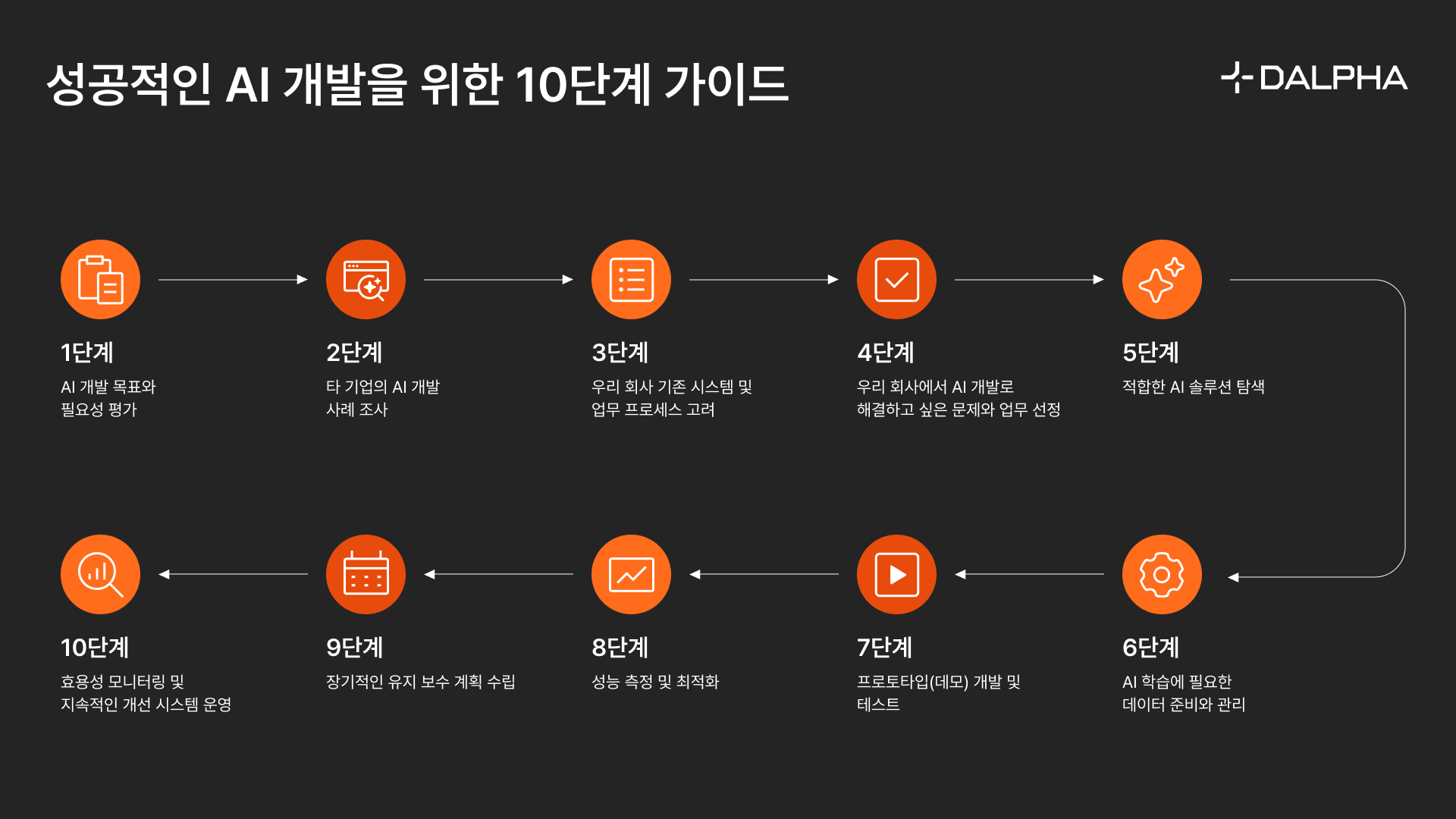
An at-a-glance image of the 10-step AI development guide.
Step 1 – Assess your AI development goals and needs
Why do you want to develop AI?
If you can't answer this question, you may not be satisfied even after developing AI.
That's because you might not be able to tell what actually improved after the AI was developed.
Start by assessing the goals and needs your company wants to achieve.
Evaluate whether your company's goal leans more toward cost reduction or toward revenue growth.
This makes it easier to judge whether generative AI is necessary to achieve that goal.
For example, revenue growthis the goal—let's imagine such a company.
This company could use generative AI to launch a new business or innovate its existing business model.
On the other hand, a company whose goal is cost reductioncan use generative AI across roughly three types of work.
Simple tasks, repetitive tasks, and things generative AI does better than people—such as data processing or image matching—can be replaced by AI, greatly reducing a company's man-months (Man/Month).
Which case is most common among Dalpha (DALPHA) clients?
They tend to feel the greatest satisfaction on the cost-reduction side.
Because their workload is dramatically reduced or completely replaced and eliminated, that change stands out clearly.
(Check out the real-life cases)
Step 2 – Research other companies' cases
Next, look into other companies' cases.
You can research roughly three areas.
Same-industry cases: See how others in your industry are using AI. For example, if your company is in commerce, research AI services commonly used in commerce, such as category tagging and search engines. If you're in manufacturing, you'll find uses like document OCR/automation, abnormal-equipment detection, and object classification in drawings. Companies in the same industry share similar work processes. This means they can use similar AI services to achieve similar effects. Look at how AI is used by others in your industry.
Problem-based cases: You can also search based on problems frequently encountered in the same role. If you're a designer or marketer, you might look into banner-production automation, copywriting automation, and the like. Check how companies facing the same problems boosted their work productivity with AI.
Take a look at Dalpha's AI Store, which offers the largest selection of AI solutions in Korea. You can see AI services by industry—commerce, marketing, content, fashion & beauty, HR & business, education, and more—all at a glance. You can even try out demos.

Step 3 – Consider your existing systems and work processes
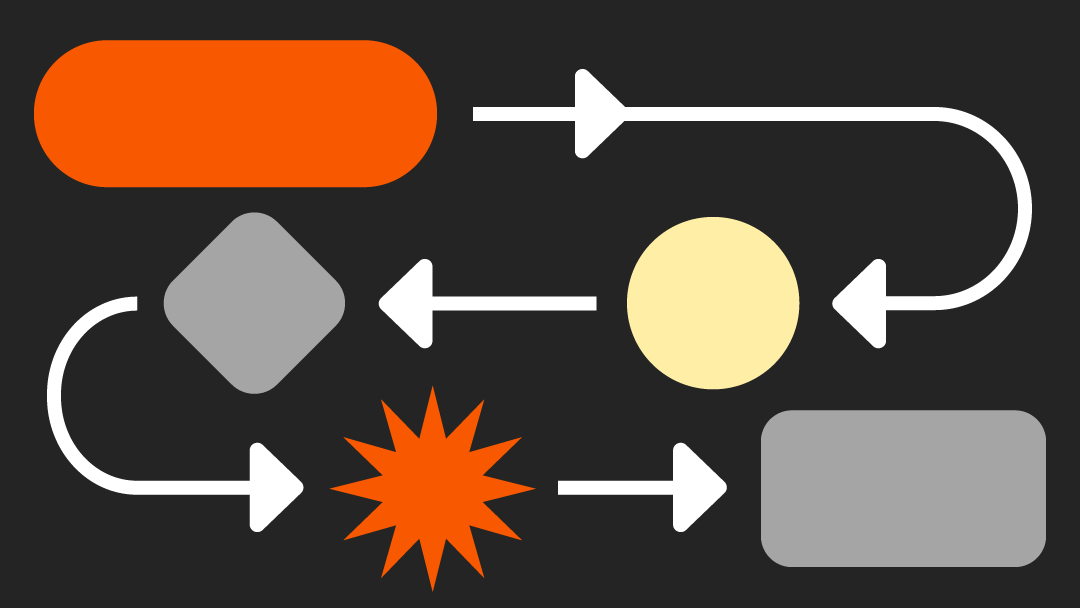
Now it's time to think concretely about the AI that fits your company.
Take a look at your company's systems and work processes.
One useful tip here is to list out your current workflows.
The more granularly you break down the work units you perform, the more it helps.
In this process, you only need to think about two things.
First, which problem does your company most want to solve right now,
and second, whether that problem can be solved with AI.
?There's an example in Step 4 of the guide
Step 4 – Choose the problem and the work you want to address
Let us show you the process of selecting the problem and the work you want to solve through a real example.
Let's say you're a marketer and designer who has to create ad banners for Meta, Google, and Naver.
The banner-production workflow can be broken into four steps.
Plan the banner design -> Create the banner -> Adjust to each platform's specifications -> Upload
In this workflow, Step 3, 'Adjust to each platform's specifications,' is a simple and repetitive task.
In that case, you can approach it like this: 'We could develop an AI service to automate that work!'
Just like this, decide which of your granular tasks to replace with AI development.
Step 5 – Explore the right generative AI solution
You need a process of concretely exploring 'how' to solve that problem.
Here, exploring doesn't simply mean choosing the highest-performing AI model.
Rather, it means considering an AI solution (AI model & AI service) that's well suited to actually solving the problem. Sometimes, you'll even combine multiple AI models to solve a single problem.
☝️ The key point! Don't focus only on superior performance— consider real-world usabilityas well.
That's because model usage may be limited depending on your company's infrastructure or your users' requirements.
For example, let's suppose you're introducing an internal information-search chatbot.
The latest generative AI models require massive infrastructure, such as high-performance GPU servers costing tens of thousands of dollars. They also require skilled data scientists and AI engineers who can properly preprocess and train data.
If you lack such infrastructure and personnel, using commercial AI services like ChatGPT or Claude can be far more efficient.
Conversely, if you're handling sensitive data such as personal information, training your own model may be more appropriate for security reasons.
So it's important not to simply pick a 'good' AI model, but to explore an AI solution well suited to actually solving your problem. This can vary depending on your company's purpose and direction, as well as your personnel and infrastructure situation.
This is the part where, in particular, many companies feel the greatest difficulty in AI development.
It helps to get support from an expert who can comprehensively weigh multiple factors—business insight, AI knowledge, an understanding of infrastructure, and more.
Step 6 – Prepare and manage your data
What you need to consider is the quantity and quality of data.
No matter how high the quality of your data is, training won't work properly without a certain amount of it.
Conversely, no matter how large the amount, it's useless if the quality is low.
So it's important to strike a balance between the quantity and quality of the data needed for training.
Deciding what data to train on requires a lot of thought.
You need to choose what form of data to feed in, how much is needed, and what level of quality is required.
That's because the performance and outcomes of your AI project can vary greatly depending on this training stage.
This process largely determines the success or failure of an AI project.
We also recommend getting help from an expert.
Step 7 – Develop and test a prototype (demo)
Once you receive well-organized data, you need a period for developing and testing a prototype (demo).
There's a reason for building a prototype (demo) instead of jumping straight to the product.
It's due to the nature of AI development, which requires training and optimization.
Unlike projects such as web page or app development, AI development can see large gaps between expected and actual performance and outcomes.
That's because the plan and the result change depending on data quality, model fit, and the degree of training.
So it's efficient to run performance tests through a prototype before deploying.
Step 8 – Measure performance and optimize
Through the prototype, you need to check two things: performance measurement and optimization.
Performance measurement
This is the process of measuring whether the deployed AI works properly.
There are two ways to measure performance: quantitative and qualitative.
If quantitative measurement is possible, it's best to measure quantitatively. That's because you can grasp things clearly in numbers.
However, depending on the problem you want to solve, sometimes only qualitative measurement is possible.
Background removal from a photo is one example. It's hard to quantitatively evaluate whether the background was removed well down to the pixel level.
Cases like 'it's fine if it looks okay to a person' have to be evaluated qualitatively.
This can be somewhat difficult. But even with qualitative criteria, it's important to agree on and define the standards in advance. That way, there will be no problems later when deciding whether to keep the AI in place.
If judging the performance measurement is difficult, we also recommend getting help from an expert who has deployed various solutions.
Optimization
At the same time, you need an optimization process.
Optimization is the process of efficiently balancing the accuracy of the output, response speed, and computing resources.
Let's take an example of when optimization hasn't been done.
Sometimes the output is accurate but the response speed is slow. That can make the service hard to use. In that case, you need a process to speed up the response.
Even if you're satisfied with the output's accuracy and response speed, you still need to optimize for cost.
If the amount of data is small but a lot of computing resources are used, that's wasteful in terms of cost.
Conversely, if there's a large amount of data or a lot to infer but computing resources are insufficient, performance may drop or speed may be slow.
Setting these factors up efficiently is optimization.
It must be considered in order to use AI efficiently.
Step 9 – Establish a long-term maintenance plan

Now you need to establish a long-term maintenance plan.
There are two reasons why maintenance matters more in AI development than in other IT development.
First, AI requires continuous data training.
For AI to perform properly, you need to periodically incorporate the data and feedback gained from using the service.
Second, AI models are advancing rapidly right now, with new models coming out.
You need to regularly check the evolving AI models to optimize cost and performance. That's because doing so lets you keep advancing your service.
Therefore, to use an AI service, ongoing management and maintenance are necessary.
Continuous management and maintenance of AI inevitably require personnel.
But that means significant resources on the company's side.
For that reason, working with an expert is also a good approach.
Because then you don't have to spend effort on maintenance and regular updates.
Step 10 – Monitor effectiveness and operate a system of continuous improvement
Monitor the impact your AI service has on your actual business.
There are many ways to measure effectiveness for each solution.
For example, with a labor-cost-reduction solution, you can check how much labor cost was saved—comparing working hours before and after to see whether work time was shortened.
With a text or image search engine, you can check how well searches that previously didn't surface results now turn up the right ones.
With similar-product recommendations, you can check how much product upselling occurred.
Measure the effectiveness of whether the AI service your company developed is being used well.
The more you systematize effectiveness measurement in advance, the better.
It's better to build it early and improve it gradually than to create it after deployment.
Boost efficiency through continuous measurement and improvement.
AI development is easier with a specialized partner
So far, we've gone over the 10-step process for successful AI development.
If you carry out each step thoroughly, you can certainly achieve good results,
but for a company adopting AI for the first time, it can be a challenging process.
??Steps that demand a high level of expertise
Step 5 – Explore the right generative AI solution
You have to select the optimal AI model for your company's situation.
Step 6 – Prepare and manage your data
You need efficient data preprocessing and management of training data.
Step 8 – Measure performance and optimize
You need to consider the balance among the AI service's accuracy, speed, and cost.
Step 9 – Establish a long-term maintenance plan
You need continuous model updates and performance monitoring.
Because of these steps that require expertise, many companies struggle with AI development.
In that case, consider collaborating with a proven AI development partner.
➕Benefits of working with a partner
☑️Saving time and cost by minimizing trial and error
☑️Building solutions that reflect the latest AI technology trends
☑️Stable maintenance and rapid technical support
☑️Establishing a custom AI strategy tailored to your company's situation
?How to find a trustworthy AI development partner

Want to find a trustworthy AI development partner?
Check out the 6-point checklist for choosing an AI development partner !
Want a partner with you from start to finish in AI development?
So far, we've broken down the process needed for successful AI development into 10 steps.
Want to handle AI development all at once, from A to Z?
Get a consultation from Dalpha. Dalpha currently develops and provides AI solutions for large enterprises such as KT Commerce, Daehong Communications, and CJ OliveNetworks, as well as startups such as MyRealTrip, MustIt, and Make Us (operator of Dingo).
develops and provides AI solutions.
Beyond these, we've been discussing AI projects with a total of 150 corporate clients.
Dalpha's expert AI consultants will provide consulting tailored precisely to your company.
Apply for a free AI consultation
Recommended reads ?
Enterprise AI use: 7 cases (feat. Danggeun Market (Karrot), Dropbox, Geek News)
Dingo (Make Us) cut short-form production costs by 35% using short-form generation AI
MyRealTrip achieves greater work efficiency by adopting manual-process automation AI!
Category tagging that used to be done manually—we saved 30 hours thanks to AI (feat. QMarket)
Dalpha Blog