6 Checklists for Choosing the Right AI Development Expert
An easy way to develop AI?
These days, many companies are preparing for and weighing AI development. But developing in-house often means a lack of expertise, while hiring AI talent makes it hard to find the right people and carries big risks. On top of that, AI development doesn't end with a single build—it requires ongoing management—so many companies struggle throughout the process of developing and adopting AI.
In situations like this, there's a great alternative: an 'AI development partner.' With an expert partner by your side, you can carry everything from AI development to operation and management forward in a stable way.
But the key is finding a 'trustworthy expert.' Choosing the wrong partner causes major losses in both time and cost. Worse still, in the worst case it can cause serious problems for your business. That's why it's so important to work with an AI development partner you can trust.
So we've put together 6 selection criteria and checklists to use when choosing an AI development expert.
With real-world examples included, this should help you identify the good partners and the ones to avoid.
6 Quick Checklist Items for an AI Development Expert
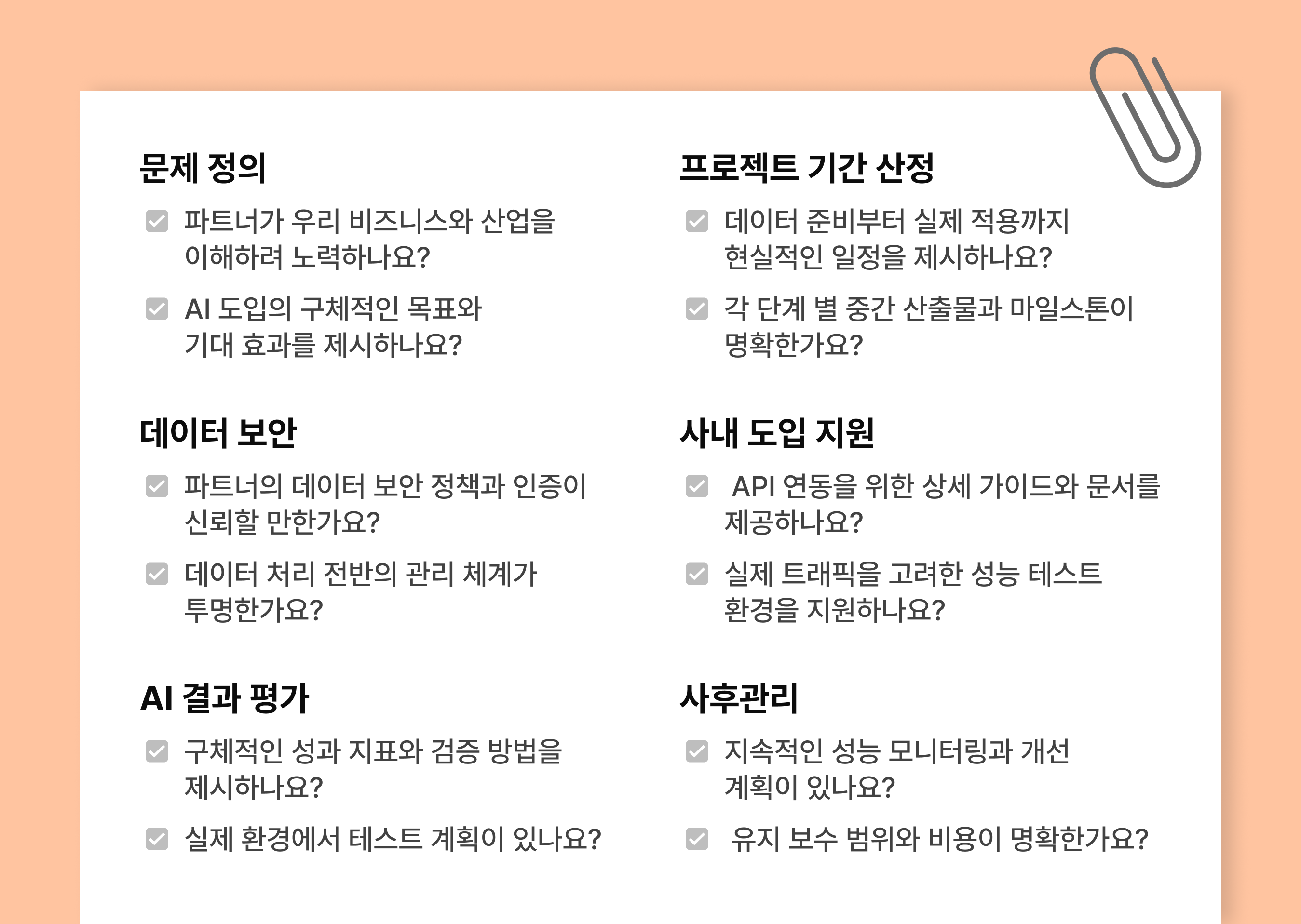
Problem definition
✅ Does the partner make an effort to understand your business and industry?
✅ Do they present concrete goals and expected outcomes for adopting AI?
Data security
✅ Are the partner's data security policies and certifications trustworthy?
✅ Is their management framework across the entire data-processing pipeline transparent?
AI results evaluation
✅ Do they present concrete performance metrics and verification methods?
✅ Do they have a plan to test in a real environment?
Project timeline estimation
✅ Do they present a realistic schedule from data preparation through actual deployment?
✅ Are the interim deliverables and milestones for each stage clear?
In-house adoption support
✅ Do they provide detailed guides and documentation for API integration?
✅ Do they support a performance-testing environment that accounts for real traffic?
Post-launch management
✅ Do they have a plan for continuous performance monitoring and improvement?
✅ Are the maintenance scope and costs clear?
Now let's look at the detailed checklists and real-world examples.
6 Detailed Checklists for Choosing an AI Development Expert
1. Problem definition
Many companies have a vague expectation that 'maybe things will get better if we adopt AI.' A good partner doesn't simply say 'let's build AI'—they carefully examine what your company's actual problems are and whether AI can solve them.
Checklist
[ ] Do they make an effort to understand your company's business situation and goals?
[ ] Do they analyze the specific problems in your current processes?
[ ] Do they present the tangible improvements you can gain from adopting AI?
[ ] Do they also consider whether there are solutions other than AI?
[ ] Do they even consider change management and operational plans after adoption?
Partners like this are great ✅
They study your company and industry in advance before the meeting
They are honest enough to say, "AI development may be premature for that area"
They explain the improvement effects with concrete examples and numbers
They make an effort to understand your company's unique circumstances
They actively listen to the opinions of the people doing the actual work
Avoid partners like this ⛔
They say, "Just adopt AI and everything will be solved"
They don't even know the basic characteristics of your industry
They don't ask about business goals and only talk about technology
They can't explain the cost-effectiveness in concrete terms
They bring up the contract right away without understanding the problem
? Real-world example
Company K met with several vendors while reviewing the adoption of an AI chatbot. Vendor A didn't ask about the current state of call-center operations or the expected cost savings from a chatbot, and only emphasized the superiority of its own AI technology. Vendor B, on the other hand, analyzed the current types of inquiries and presented, in concrete terms, the share of inquiries a chatbot could handle and the expected cost savings. In the end, Company K partnered with Vendor B and succeeded in reducing call-center inquiry volume by 30%.
2. Data security
AI development inevitably requires your company's critical data. You'll be handling sensitive information such as transaction data, customer information, and internal operational data. That's why you can't overstate the importance of data security.
Checklist
[ ] Do they have concrete policies and systems to protect data?
[ ] Do they properly comply with relevant regulations (the Personal Information Protection Act, GDPR, etc.)?
[ ] Can they manage data access permissions and track history?
[ ] Do they use data encryption and secure transmission methods?
[ ] Do they have a response plan in place for emergencies?
Partners like this are great ✅
They hold security certifications (ISO 27001, ISMS, etc.)
They propose signing an NDA first
They transparently disclose the entire data-processing process
They conduct regular security checks and updates
They thoroughly train their staff on security
Avoid partners like this ⛔
They say, "We'll take care of the data ourselves"
They can't give concrete answers to security-related questions
They don't keep proper records of data management
Responsibility is unclear when a security incident occurs
Their data access permission management is vague
? Real-world example
A financial firm, Company S, held meetings with potential partners as it prepared an AI project using customer data. Vendor C boasted outstanding technical capabilities, but when asked about data security, it only gave answers like "just store it in the cloud." Vendor D, on the other hand, presented detailed security policy documents at the first meeting and showed its experience handling financial data along with relevant certifications. It also reported on the security status every week throughout the project, building strong trust, and ultimately completed the project successfully.
3. AI results evaluation
It's only natural to expect good results once you adopt AI. But for AI to genuinely help your business, you need accurate measurement of utility and performance, along with continuous performance improvement.
Checklist
[ ] Do they present concrete metrics for performance evaluation?
[ ] Do they explain the impact AI performance will have on the business?
[ ] Do they go through a sufficient verification process during the testing stage?
[ ] Can they explain the rationale behind the AI model's evaluation metrics?
[ ] Do they have a response plan for when performance drops?
Partners like this are great ✅
They set clear performance metrics and goals together with you
They share test results transparently
They explain the AI's decision-making process in an easy-to-understand way
They provide regular performance reports
They actively incorporate real user feedback
Avoid partners like this ⛔
They just repeat, "It's 99% accurate"
They don't account for the difference between the test environment and the real environment
They can't explain why the AI made a certain decision
They dodge responsibility when performance declines
They have no concrete improvement plan
? Real-world example
A manufacturer, Company M, set out to adopt an AI quality-inspection system. Vendor E emphasized "99% accuracy!" but refused to test it in the actual factory environment. Vendor F, on the other hand, proposed starting at 80% accuracy. Instead, it ran a two-week on-site test and explained in detail the types of errors that could occur and how to address them. Even after deployment, it provided weekly performance reports and achieved the target accuracy of 95% within three months.
4. Project timeline estimation
"How long does it take to develop AI?" This is a question many people wonder about. AI projects require more time than you'd expect, from data preparation through actual deployment. A realistic schedule is the key to success.
Checklist
[ ] Do they present a concrete schedule for each stage?
[ ] Do they also account for your company's preparation period?
[ ] Have they included anticipated risk factors and the time to address them?
[ ] Are the interim deliverables and stage-by-stage goals clear?
[ ] Have they set up early warnings and countermeasures for schedule delays?
Partners like this are great ✅
They clearly distinguish the project scope and schedule
They present a full roadmap from the preparation stage through actual operation
They consider your company's work schedule and characteristics
They propose a realistic schedule that includes buffer time
They propose regular progress-sharing meetings
Avoid partners like this ⛔
They simply say, "Three months is plenty"
They don't account for the time needed for data cleansing or system integration
They can't identify the cause even when delays occur
They put off or avoid interim reports and status updates
They just say "We'll do it fast" no matter what
? Real-world example
A distribution company, Company R, reviewed adopting an AI demand-forecasting system. Vendor G said, "We'll finish within two months," but that schedule didn't account for data cleansing or integration with existing systems. At the first meeting, Vendor H presented a six-month schedule, dividing it into stages—△ data collection and cleansing (2 months), △ AI model development (2 months), △ testing and system integration (2 months)—and clearly defined the interim deliverables and verification process for each stage. As a result, Vendor H completed the project successfully on the planned schedule.
5. In-house adoption support
No matter how well an AI performs, it's meaningless if it doesn't apply well to your actual service, right? In the end, AI has to integrate naturally with your existing systems. Careful checks are needed to apply it to your service in a stable way.
Checklist
[ ] Are the API integration guide and technical documentation well organized?
[ ] Do they provide a test environment (sandbox)?
[ ] Do they guarantee processing capacity that accounts for real traffic?
[ ] Can they respond quickly when an outage occurs?
[ ] Are their API version management and update policies clear?
Partners like this are great ✅
They provide detailed API documentation and sample code
They support stage-by-stage test environments
They present a clear SLA (service-level agreement)
Their incident-response process is systematic
They carefully verify compatibility with existing systems
Avoid partners like this ⛔
Their API documentation is poor or not kept up to date
They demand going straight to live-service deployment without a test environment
They don't guarantee processing capacity or response speed
Responsibility is unclear when an outage occurs
They don't consider system dependency or compatibility issues
? Real-world example
Company P set out to add an AI image-recognition feature to its service. With Vendor I, frequent outages occurred after API integration, and response times were inconsistent, making it hard to apply to the live service. Vendor J, on the other hand, provided a four-week testing period before deployment and also ran performance tests that accounted for real traffic. In particular, it presented a clear SLA—response within 5 minutes when an outage occurs, 99.9% availability guaranteed, and so on—and has actually upheld it well, providing a stable service.
6. Post-launch management
AI isn't something you build once and you're done. Over time, data changes, and the business environment shifts too. Without continuous performance management and updates, it's hard to maintain the effects you saw at first.
Checklist
[ ] Do they have a plan for regular performance monitoring?
[ ] Can they respond quickly when a problem arises?
[ ] Do they present a system update and improvement plan?
[ ] Are the operating costs and maintenance scope clear?
[ ] Can they provide continuous support even if their assigned staff changes?
Partners like this are great ✅
They present a clear maintenance scope and SLA
They provide regular performance reports
They have a 24/7 emergency-response system in place
They propose a model retraining and update cycle
They document their operational know-how into a manual
Avoid partners like this ⛔
They say, "Once it's built, it runs just fine on its own"
They dodge responsibility when an outage occurs
Their maintenance costs are opaque
Their assigned personnel change frequently
They have no improvement plan for performance decline
? Real-world example
Company L adopted an AI customer-service system. After the system launched, Vendor K became hard to reach, and even when problems arose, it kept giving answers like "We'll check on it next week." Vendor M, on the other hand, performed regular monthly checks and provided detailed reports. In particular, it set up a system that automatically sends an alert when performance drops by 5% or more, and presents a root-cause analysis and solution within 48 hours. A year on, the system is still running reliably—and they say its performance has actually improved by 15% compared to the start.
Summary of the Criteria for Choosing an AI Development Expert
Problem definition
They accurately identify the business problem and review whether adopting AI is truly necessary.
Data security
They safely protect your company's critical data with thorough security policies and systems.
AI results evaluation
They objectively evaluate AI performance with clear performance metrics and a verification framework.
Project timeline estimation
They establish a realistic schedule and stage-by-stage plan, from data preparation through actual deployment.
In-house adoption support
They provide technical support for stable integration with your existing systems.
Post-launch management
They maintain the effectiveness of the AI system through continuous performance improvement and operational management.
Ready to find your AI development expert?
Did the 6 checklists we've covered so far help? We hope they serve as a useful reference for wisely choosing a trustworthy partner throughout your future AI development.
Many companies struggle at the stage of deciding whether and how to develop and adopt AI. You probably have countless concerns, such as 'Does our company really need AI?', 'Which areas should we apply AI to?', and 'Which partner should we choose?'
To help you solve these concerns together, Dalpha, an AI specialist company, offers a free consultation. Our experts, with experience across more than 400 AI projects, will propose the optimal AI adoption plan tailored to your company.
Apply for a free AI consultation
Recommended reads ?

Minwoo Kim