Beauty Brands, Take Note! 4 AI Cases for Own-Brand/Competitor Analysis with Actionable Insights
Many beauty-brand practitioners already understand the importance of own-brand and competitor analysis.
But once they've gathered customer data (reviews, Q&As, community and social reactions), they're at a loss for what action to actually take.
You can't read through hundreds of reviews, yet you're not confident that a mere few dozen reviews represent the opinions of all your customers.
Even after collecting competitor data, it's not clear what sets your product apart.
You try to analyze, but planning and execution end up relying on 'gut feeling.'
As AI advances, however, you can now run own-brand and competitor analysis like this.
By quickly catching recurring positive keywords like 'tone-up' and 'spreadability' across hundreds of reviews, you can plan marketing messages in the actual language of your buyers.
Based on expressions customers leave in competitor reviews — like 'I repurchased it, but it's a bit pricey' — you can clearly position your own product on its 'value-for-money strength.'
By extracting recurring related keywords like 'mom' and 'gift' from hundreds of reviews, you can run a marketing campaign around 'a great gift for mom.'
By using sentiment-score changes to see when negative reviews like 'slow delivery' or 'not enough coverage' began rising, you can respond immediately together with the logistics and product teams.
In this article, we introduce 'actionable steps' that beauty-brand practitioners took using AI-powered own-brand and competitor analysis, through 4 real cases.
At the end you can also request a demo to see reactions to your own product directly, so please read to the end 😄
Case 1. Put the real reasons customers buy your product into your marketing message (Own-Brand Analysis AI Report)
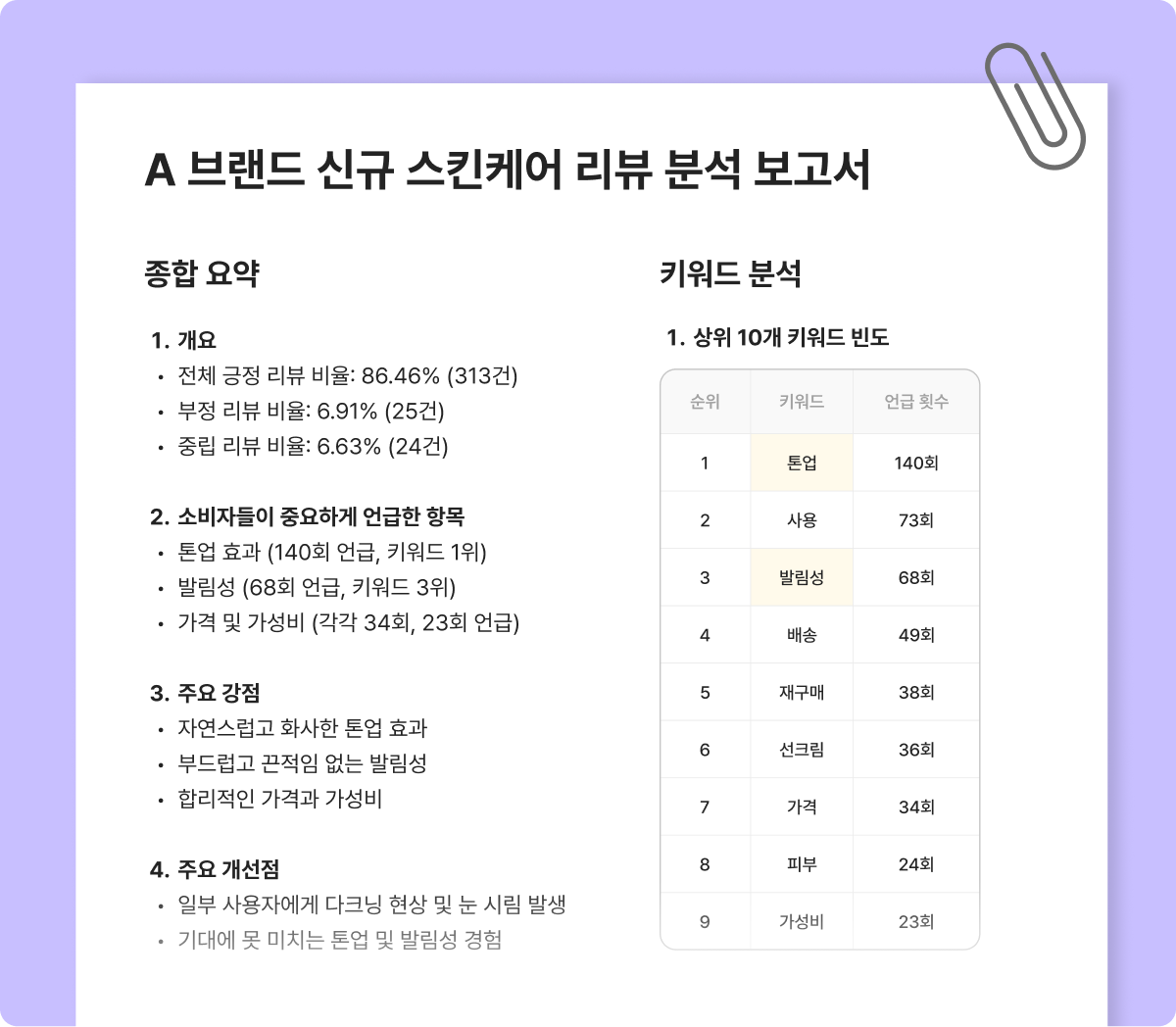
Why do customers buy our product? If you can pinpoint the reasons in detail — 'I like the ingredients,' 'it spreads well' — you can craft far more refined marketing messages.
But realistically, it's hard to read through the countless reviews scattered across open-market listings, communities, and social media one by one to find the meaningful reactions. Even when you spot a few striking sentences, you can't be sure they represent the overall opinion.
What if AI found the accurate voice of the customer for you?
AI analyzes your own reviews collected from various channels and extracts the keywords customers actually mention most, along with positive and negative expressions. You can visually see which features are perceived as strengths for each product, and where complaints arise.
As a result, you can plan marketing based on customers' real language, and connect it directly to product-improvement ideas.
Real case
Before
After launching a new skincare line, the marketer at Beauty Brand A read through reviews on Olive Young and Naver Commerce one by one, gathering comments worth turning into insights and organizing the data. They worked late into the night reading hundreds of reviews and manually classifying keywords, yet still missed important issues or spent far too long preparing for meetings.
After
After adopting Dalpha's own-brand/competitor analysis solution, Company A received a weekly review-analysis report for each product they managed. As a result, they quickly caught that customers were reacting very positively to 'tone-up' and 'spreadability' for a certain product. To maximize these strengths, they found influencers on TikTok and Instagram who focus on before-and-after videos, and ran a video campaign with them that strongly emphasized 'tone-up' and 'spreadability.' As several pieces of content went viral, they raised sales by nearly 30%.
Outputs and actions you can get from the competitor-analysis AI report
Automated customer-data collection
Output: Automatically collects product reviews from major commerce platforms like Naver and Olive Young, securing up-to-date customer data with no manual work
Action: Cuts review-analysis time and enables real-time trend detection
Key keyword extraction
Output: Organizes frequently mentioned keywords like 'tone-up,' 'spreadability,' and 'scent' together with sentiment (positive/negative)
Action: Use it to improve copywriting, detail pages, and ad messaging
Per-product key-issue summary
Output: Organizes, by item, the points customers repeatedly criticize or praise for each product (e.g., Product A – oiliness, Product B – longevity)
Action: Derive product-improvement points; use as base material for planning and renewal
Visualization of trend changes over time
Output: Provides graphs of keyword mention volume and sentiment changes on a daily/weekly/monthly basis
Action: Adjust marketing timing by period and respond to issues in advance
Direction proposals for marketing/product planning
Output: Organizes data-based messages customers responded to, and feedback-based improvement points
Action: Use immediately for brand-campaign planning and internal reports
Report download feature
Output: A meeting-ready report that includes a summary
Action: Use directly for weekly meetings and team sharing
Case 2. Use the differentiators customers mention versus competitors for marketing and product improvement! (Competitor Comparison Analysis AI Report)
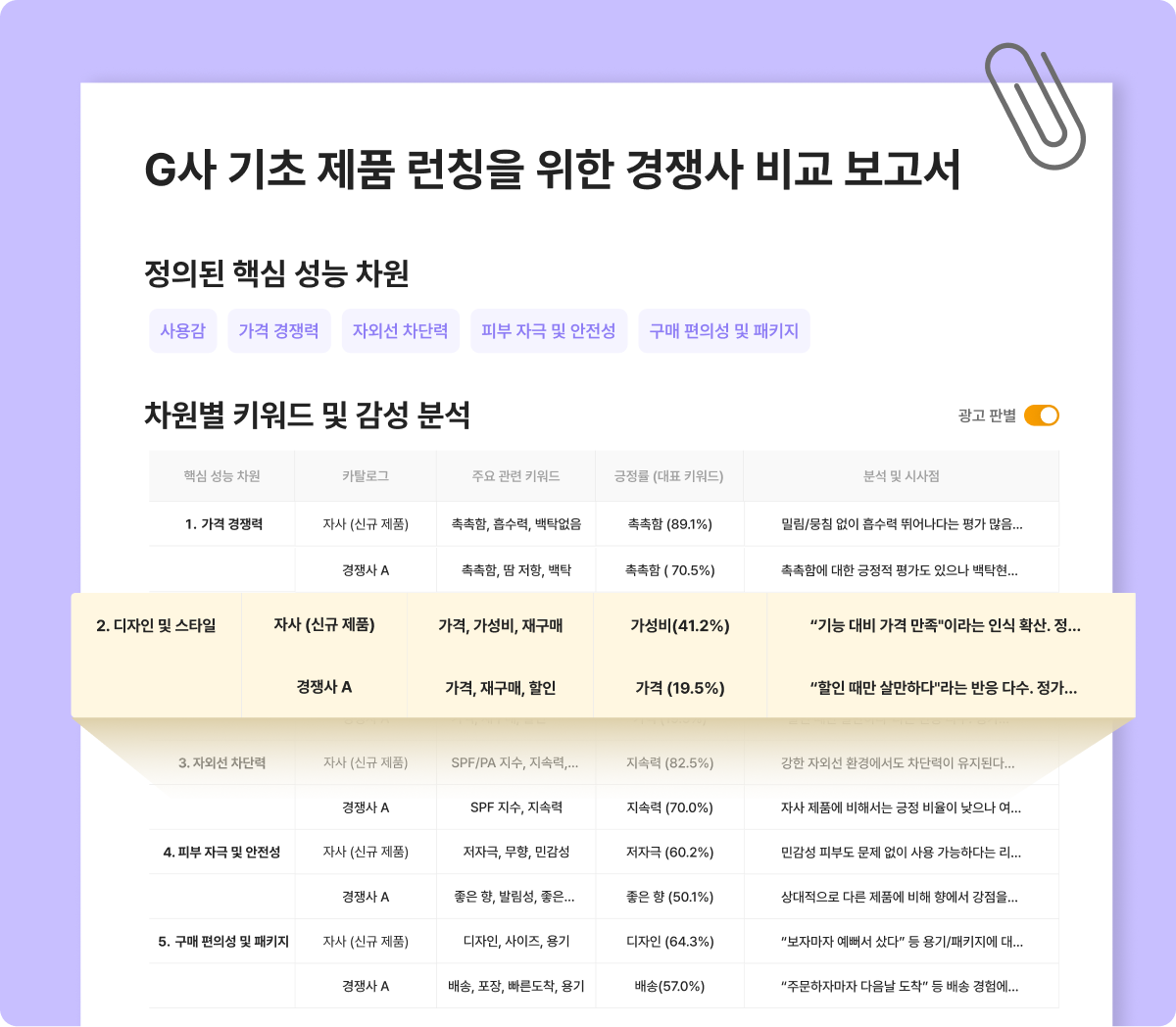
On what points is our brand rated better than competitors? And on what points does it fall behind? If you can pinpoint exactly what customers like and why, your marketing and product strategy can become far stronger.
But collecting competitor reviews and analyzing them against your own is very tedious and time-consuming. And because customer expressions are subjective, interpretations inevitably differ from person to person.
What if AI compared your own and competitor reviews at a glance and showed strengths and weaknesses objectively?
AI collects competitor brands' review data, then automatically analyzes keywords, sentiment, and mention volume to compare consumer reactions between you and competitors. Because it filters out promotional reviews and analyzes only customers' real feedback, it's even more trustworthy.
Based on this analysis, you can quickly grasp where you fall short of competitors and, conversely, what points you can push as stronger advantages.
Real case
Before
A marketer at beauty ad agency Company G, preparing a new women's basic-skincare brand, was tasked by the CEO with establishing a positioning strategy. They selected three competitors and collected real customer reactions directly across various channels. It took a lot of time to exclude ads and sponsorships and pull only customers' genuine reactions. They also put great effort into organizing it in Excel to compare customer perception brand by brand. Yet despite all that effort, they weren't confident — the doubt of 'is the information I gathered this way actually accurate?' kept lingering.
After
After adopting Dalpha's own-brand/competitor analysis solution, Company G could automatically collect competitor reactions from shopping-mall reviews, communities, and social posts they previously had to check one by one. On top of that, AI automatically excluded commercial reviews like 'sponsored' and 'ad,' so only real buyers' organic reactions were used for analysis. As a result, they could confirm competitor reactions like 'I repurchased it, but it's not exactly cheap' — customers who repurchase yet feel the price is regrettable. Based on this insight, Company G clearly positioned their product as 'sure value-for-money that drives repurchase.' Building on that strategy, they greatly shortened internal decision-making and brought their next lineup to market.
Outputs and actions you can get from the competitor-analysis AI report
Automated competitor-review collection
Output: Automatically collects competitor brands' review data from Olive Young, Naver Shopping, social media, and more
Action: Make competitor-trend monitoring a regular daily/weekly routine
Competitor keyword & sentiment analysis
Output: Analyzes key keywords and positive/negative sentiment for competitor products, such as 'value,' 'longevity,' and 'tone-up'
Action: Derive differentiation points and reflect them in marketing messages immediately
Own-brand vs. competitor comparison report
Output: Visualizes review counts, key keywords, and sentiment tone for your products and competitors' in tables and graphs
Action: Use directly in internal reports and proposals
Summary of key review sentences
Output: Extracts representative positive/negative sentences about competitor products to quickly grasp consumer reactions
Action: Reference when establishing brand-positioning strategy
Report download feature
Output: Provides competitor-analysis results as a summary plus a detailed data sheet
Action: Easily reuse in ad proposals and meeting materials
Case 3. Take marketing actions based on objective data extracted from tens of thousands of reviews. (Related-Word Analysis)
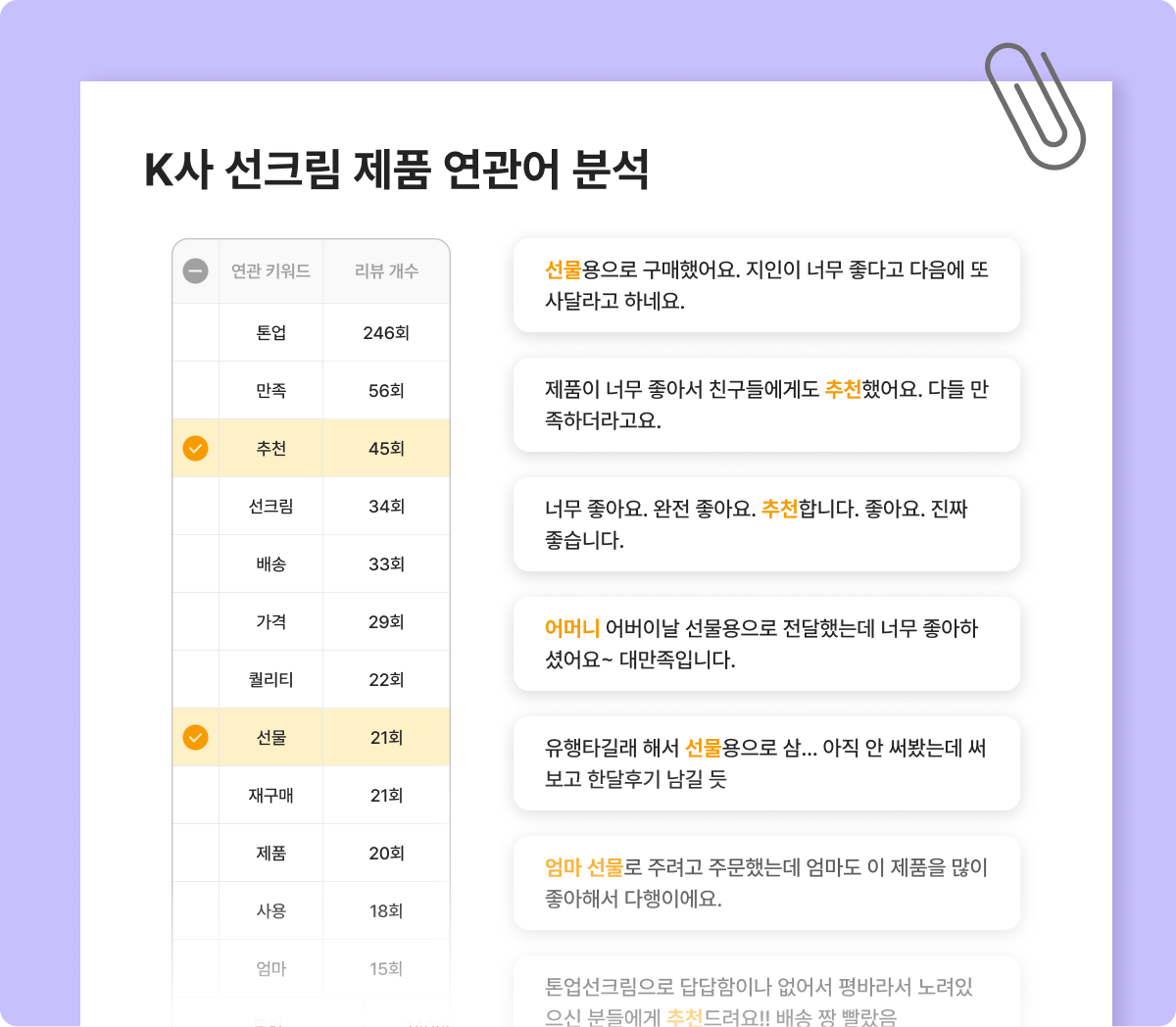
A simple keyword like 'sunscreen' alone makes it hard to grasp the attributes customers truly care about. What customers really value are specifics like 'stickiness,' 'white cast,' 'tone-up,' and 'moisture.'
But reading tens of thousands of reviews yourself to find recurring keywords is nearly impossible. And judging the whole from just a few dozen reviews lowers reliability.
What if AI automatically extracted the key keywords and related words from the actual language customers use?
Based on tens of thousands of pieces of customer feedback collected across various channels, AI analyzes the language people actually use to automatically extract and visualize objective keyword groups. Instead of relying on fragmentary cases or intuition, you get reliable insights based on a representative sample.
As a result, even the qualitative data you once relied on gut for is converted into objective evidence, connecting to insights you can use right away for marketing and product improvement.
Real case
Before
To plan an additional marketing campaign for its sunscreen, beauty select-shop Company K tried to manually collect Amazon and Qoo10 reviews and organize the key keywords to analyze customer reactions. But only keywords like 'sunscreen,' 'SPF,' and 'UV' were extracted, and they planned the campaign while missing the detailed needs customers care about (e.g., 'non-sticky,' 'natural tone-up'), so the actual sales response fell short of expectations.
After
After adopting Dalpha's own-brand/competitor analysis solution, Company K could visually confirm that many related keywords like 'gift,' 'mom,' and 'tone correction' were being extracted from customer data collected across various channels. In particular, they derived — with statistical significance — that women in their early-to-mid 20s, the brand's existing loyal customer base, were buying the product largely as gifts for their mothers. Inspired by this, they planned a campaign with the concept of 'a perfect gift for Parents' Day,' and by driving word of mouth through various seeding projects, they ran marketing that precisely matched consumer needs
Outputs and actions you can get from the related-word analysis feature
Automatic review-based keyword extraction
Output: AI automatically extracts frequently mentioned keywords from countless reviews
Action: Quickly grasp the core language without complex manual work
Meaning-based related-word clustering
Output: Groups semantically similar words like 'hydration,' 'moisture,' and 'mineral sunscreen' into a single category
Action: Cluster customer needs and link them to product attributes
Visualization with sentiment information
Output: See whether each keyword was mentioned with a positive or negative nuance
Action: Use immediately to improve copywriting, detail pages, and ad creative
Report download feature
Output: Organizes auto-clustered related words, visualizations, and representative sentences into report form
Action: Use directly for cross-team communication, internal proposals, and marketing materials
Case 4. Detect negative issues in real time and respond fast (Positive/Negative Analysis)
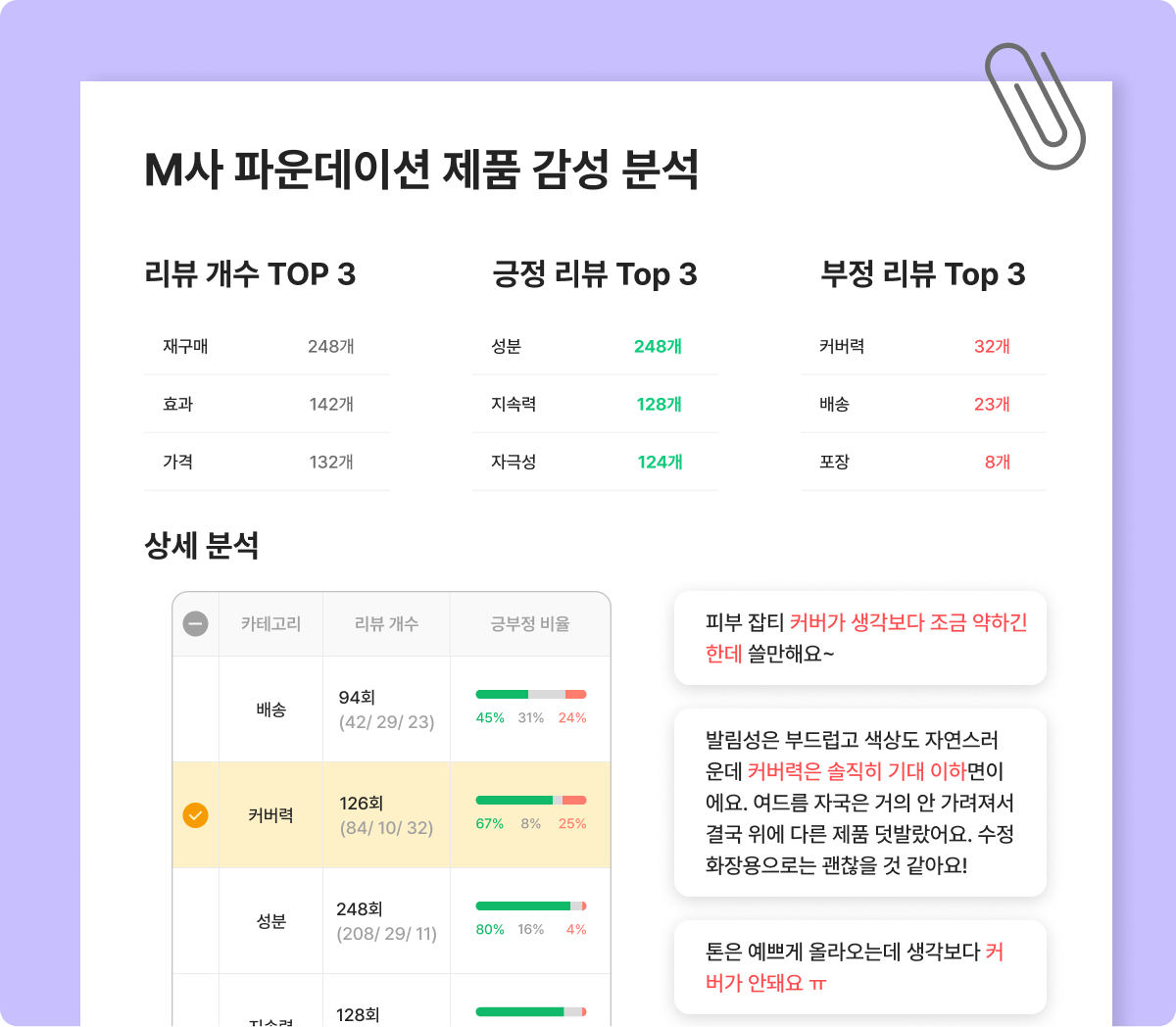
When and where do customer complaints begin? If you can respond quickly the moment negative reviews start piling up one by one, you can reduce brand risk.
But reading through countless reviews and comments and interpreting the emotion in each is no easy task. Interpretations often differ by team member, so the actual response direction gets split. It's hard to instantly judge whether a 'slow delivery' review is a simple shipping issue or will spread into broader brand dissatisfaction.
What if AI automatically detected the flow of negative reviews and alerted you before the issue grew?
AI analyzes the context and expressions of reviews to automatically classify positive/negative/neutral sentiment and scores it over time. Because it also structures recurring issues like 'delivery delays' and 'lack of coverage' by category, you can easily set response priorities.
The brand can act before problems arise, quickly improving product weaknesses while further strengthening its advantages.
Real case
Before
Women's cosmetics brand Company M noticed some negative reviews appearing on Naver Commerce for its recently launched foundation. But to figure out the problem, they had to read each review one by one — was it the CS handling, slow delivery, or marketing messaging that differed from the actual product and caused misunderstanding? Meanwhile the negative sentiment grew more likely to spread, and internal meetings only added confusion with conflicting interpretations. In the end, they were at risk of missing the response window without a clear conclusion.
After
Not long after adopting Dalpha's own-brand/competitor analysis solution, Company M noticed negative reviews suddenly rising for another foundation product. On checking, about 60% of the negative reviews were concentrated on 'lack of coverage' and 'delivery delay' issues. These issues were immediately shared with the product-improvement and logistics teams, and a response strategy was executed quickly. Afterward, the number of complaints filed with customer service dropped. From then on, Company M could check positive/negative trends by time and channel, building a system to respond quickly to future issues as well.
Outputs and actions you can get from the positive/negative analysis feature
Automatic positive/negative review classification
Output: Analyzes sentiment nuance across tens of thousands of reviews to auto-classify them as positive/negative/neutral
Action: Real-time brand-image monitoring and early detection of warning signs
Issue-cause identification by category
Output: Sentiment tags on key issues like 'coverage,' 'spreadability,' 'longevity,' 'breakouts,' 'inconvenient packaging,' and 'delivery delay'
Action: Structure complaint factors and use to prioritize problem-solving
Positive/negative score visualization and trend analysis
Output: Visualizes positive/negative review scores and change trends by time and channel
Action: Track when and how issues arise, and optimize response timing
Review-sentence summaries
Output: Summarizes representative positive and negative review sentences to hear the real user's voice directly
Action: Use to make the case for product-improvement points and as internal-sharing material
Report download feature
Output: A report that automatically organizes category-level negative issues, sentiment-score trends, and representative review sentences based on the sentiment-analysis results
Action: Use directly for cross-team issue sharing, brand-risk response meetings, and as material for product improvement and CS strategy
In closing
So far, we've covered how beauty-brand practitioners, through real AI-based own-brand/competitor analysis,
derived actionable insights — 4 cases in all.
If you've read this far, please remember just these two things.
1. Does the analysis result connect to 'strategy and action'?
It has to go beyond simply showing data.
Only when you grasp the language customers use to praise a product, and the points where they feel let down, does a real marketing/product strategy emerge.
Dalpha's own-brand/competitor analysis AI extracts meaningful keywords from hundreds of reviews and mentions, and even organizes the flow of sentiment to deliver actionable insights.
2. Can you automate repetitive work to optimize your practical resources?
Handling the entire process — review collection, keyword organization, trend visualization, and marketing-strategy proposals — manually is hard to apply in practice.
Dalpha's own-brand/competitor analysis AI lets practitioners focus solely on action, while
AI handles all the rest of the tedious work.
So what are your customers saying about your product right now?
Apply by clicking the button below, and you'll receive a demo report containing real customer reactions to your brand.
Check what your customers are saying right now 👇
Dalpha Blog