Interview with KT Commerce AX Innovation Center Head Maeng Chang-ju | "I recommend Dalpha for companies that need precise problem definition and fast experimentation"
This is a great read if you are
-Driving an innovation initiative in an AX or DT department
-Wondering how your company could put AI to use
-Looking for a specialized AI development partner
KT Commerce is a company that, drawing on specialized procurement capabilities and expertise, provides leading domestic enterprise clients with optimal tailored integrated procurement services and differentiated procurement consulting services.
About two years ago, KT Commerce began its collaboration with Dalpha by adopting a category-classification solution. Building on that successful first project, the two are now working together on a total of three projects.
In this interview, we sat down with Maeng Chang-ju, head of KT Commerce's AX Innovation Center, to talk about the past two years of collaboration with Dalpha and where things are headed next.
Could you please introduce yourself?

Hello, I'm Maeng Chang-ju, the head overseeing KT Commerce's AX Innovation Center. It's the department that drives the internal adoption of AI and runs the related projects. Until last year, we were the IT Platform Team, focused mainly on IT planning, but starting in 2025 we were given an AI mission and were reborn as the AX Innovation Center.
Our team is largely divided into two. There's the former IT Platform Team, which has now grown into the AI Innovation Team, and the other is the Operations Innovation Team, which handles RPA (intelligent process automation), the customer center, the logistics center, and more. I oversee these two innovation teams.
How did you first come to work on a project with Dalpha?
We came across Dalpha while looking for a way to solve a problem we had. Honestly, we didn't set out to use AI from the start. We tried to solve it the way many other companies do with existing vendors. We usually solve the kinds of problems we faced with products from Company S, and we were looking into that product too. But then it suddenly occurred to us—we'd heard AI had gotten really good lately, so could we try solving our problem with AI? That's how we found two or three vendors. Among those several vendors, Dalpha was the second one we met.
It sounds like you met several vendors—what ultimately made you decide to go with Dalpha?
First of all, unlike the established vendors, a young CEO and a smart PM showed up, so honestly my first thought was, 'What's the deal with this place?' Then in the next meeting, what set Dalpha apart was that they proposed a way to use AI precisely tailored to our needs. Established companies usually pitch something huge—"we can do this, we can do that, we can do it all"—but in reality only a portion of that is what we actually need.
Where established companies stopped at introducing their own products, Dalpha really listened to our problems and concerns and made a visible effort to solve those problems concretely—that's how I'd put it. That's where the trust came from.
On the flip side, since they were a small company that had only just been founded back then, I imagine you may have had some concerns.
It wasn't so much that I worried because they were a small company or a startup—rather, a different concern came to mind.
The more we worked together and the more meetings we had, the better they performed, so concerns like 'What happens if they exit after we've adopted the solution?' and 'What if they can't keep it going?' started to creep in.
Other established companies have been in business so long that I don't really see them as candidates to exit. But with a company that performs as well as Dalpha, I actually felt a bit anxious—what if they exit?
I raised these concerns with PM Soo-jung and CEO Do-gyun, and the communication on this point went smoothly, so things have gone well right up to now.
It's now been about two years since you adopted and started using the solution. How has the overall collaboration experience been?
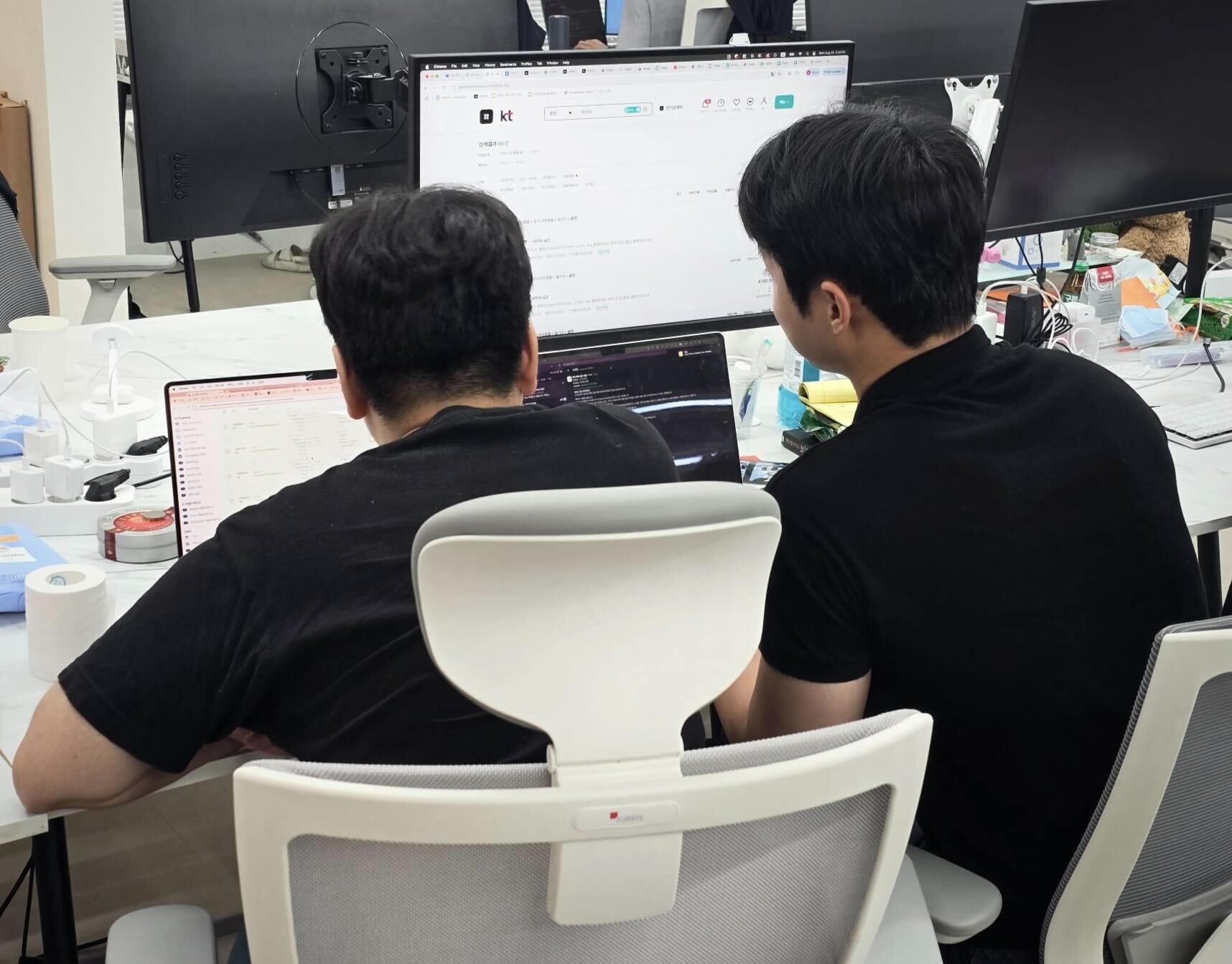
Dalpha gave me a strong impression of being focused on solving the customer's problems—thinking them through carefully and resolving them—as a team of real talent.
Honestly, when you first start working together, there's bound to be a lack of understanding of the domain, but once we explained things well, they grasped them quickly. After they understood, they tried things fast and pinpointed the exact spot to solve—that was really great.
I've worked with several startups besides Dalpha, and I definitely got the sense that Dalpha is a place that's smart and has a solid way of working.
Specifically, there's that thing where they build a demo within two weeks. The process of quickly producing a prototype to show, getting feedback from the customer, and improving it fast. I was impressed by how well they handle that process, which can be quite exhausting. From our side, as the customer, it was great to see the solution's level of completeness rise before our eyes. Even now, two years later, I think that's still one of their strengths.
What about the actual results across the projects? Did the problems you wanted to solve get solved well?
So far we've worked with Dalpha on a total of three projects.
First, the very first project we did—category classification—has been a great success. Given the nature of our company, product sourcing work is important. We're B2B, but it's closer to distribution, so product and sourcing work matter, and because of that the category, which serves as our reference information, is crucial. But our MDs were classifying the categories of products registered on the platform one by one, by hand, which was extremely difficult. We wanted to improve this, and once we automated it with category-classification AI together with Dalpha, the problem was solved. The accuracy is satisfying, of course, and it's also easy to manage. We've been using it well for two years now.
Next, to try to solve another problem, we did a PoC on similar-product search. They worked really hard on it, but unfortunately that project didn't reach a good conclusion. That said, building on that experience, we accumulated our own trial-and-error lessons, and it ultimately became a good catalyst for finding a solution internally.
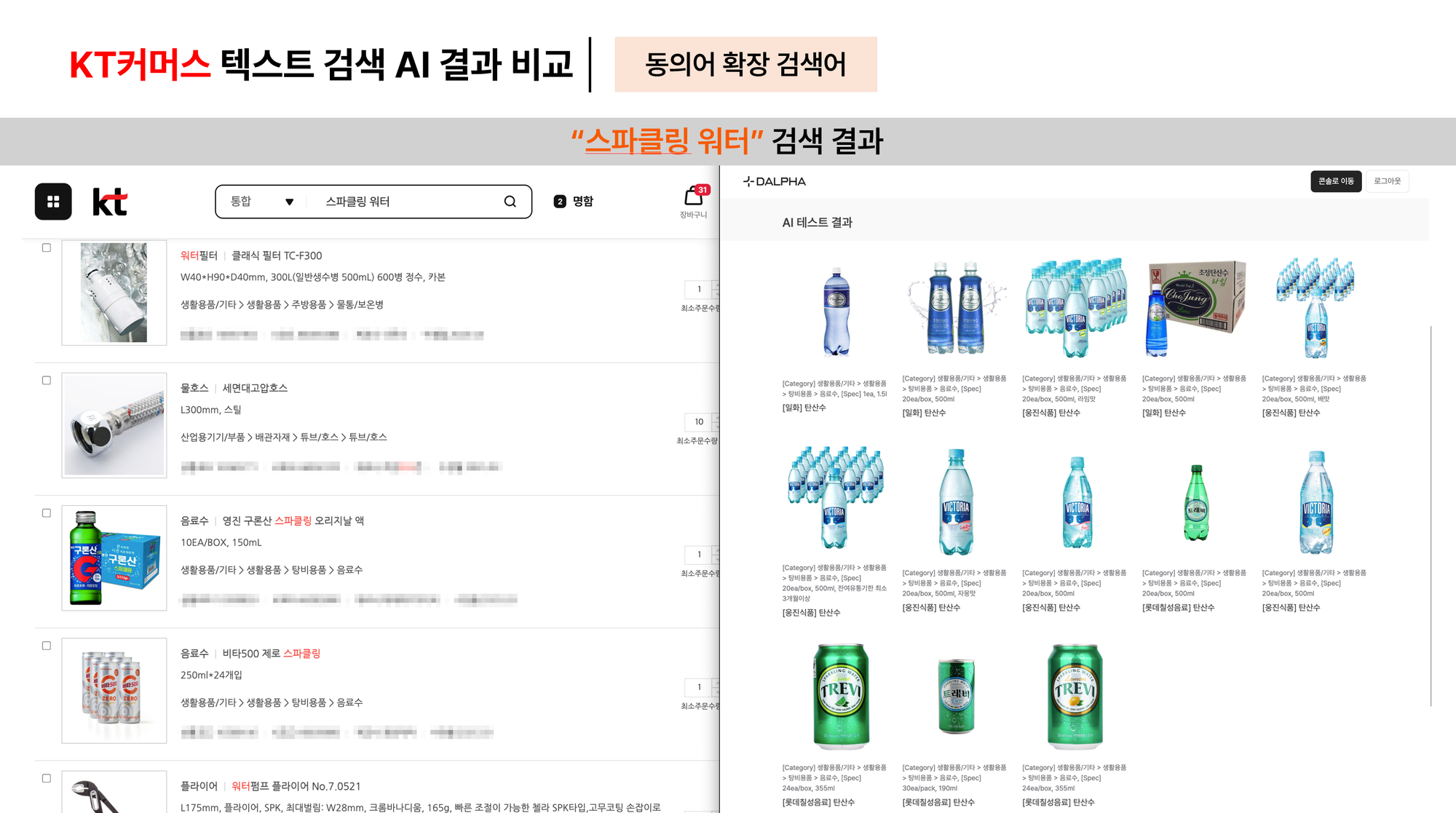
Lastly, there's the 'AI-based search' project we're working on now. We were actually using another vendor before, and this is a project to switch over to Dalpha. Search is an extremely important solution for us, so even though we had complaints while using the other vendor, we couldn't easily make the switch.
After seeing the performance of the search engine Dalpha provided, everyone from the executives to our staff reached a consensus that 'there's no reason not to adopt this,' and that's how we started the project.
Honestly, setting aside our existing relationship with Dalpha, we had to be careful in our choice, so we compared them against other vendors. We ran a PoC, and Dalpha's performance was overwhelmingly better. Above all, unlike other vendors, they're easy to collaborate with. With other vendors, the PM seems to define the customer's requirements well and go off with them, but when you look at what they actually bring back, it deviated a lot from our intent. And when we asked whether they could improve it further, the feedback didn't flow smoothly either. Dalpha was very smooth on that front. We're moving forward confident it will produce good results.
What are KT Commerce AX Innovation Center's goals going forward?
At the current stage, I'd say there are largely two. First, integrating AI well into our all-important search engine. Successfully carrying out this AI-based search project is a key goal.
Second, internally we're putting a lot of thought into how to make good use of AI agents. Since Dalpha is so good at sharp problem-solving, over the next month or two we're in the process of intensively discussing how to connect that with our data and use it well, and then designing the next direction. I'd like to carry this work out well.
I think it would be great to keep doing more work with Dalpha going forward, with a focus on problem-solving.
Finally, are there any companies you'd like to recommend Dalpha to?
Two types of companies.
First, a company with a clear problem it wants to solve internally—you'll be able to get a lot of help by working with Dalpha. Dalpha is a team that's used to solving customers' problems with technology, so I think the clearer your goal, the greater the impact you can see through AI.
The other is a company that wants to try a pilot quickly. I think one of Dalpha's biggest strengths is their execution—quickly taking in the customer's needs and reflecting them in tangible deliverables. If you're considering a new attempt, I think Dalpha can be a more than good enough partner.
Looking for an AI development partner?
Dalphaprovides 1:1 consulting to
plan and build an AI agent optimized for each company and field.
Leave an inquiry below and we'll provide a free consultation.
Dalpha Blog